
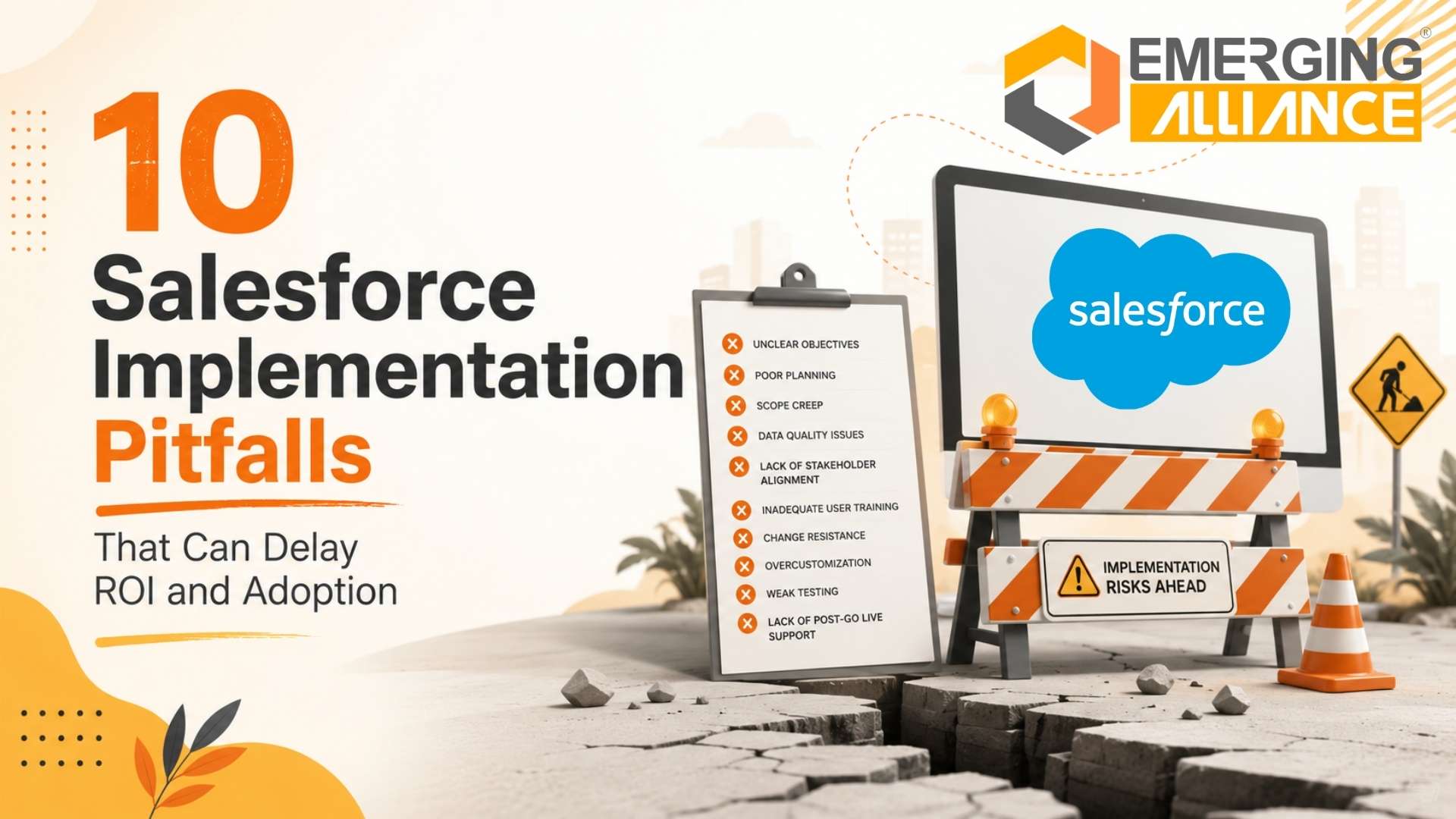
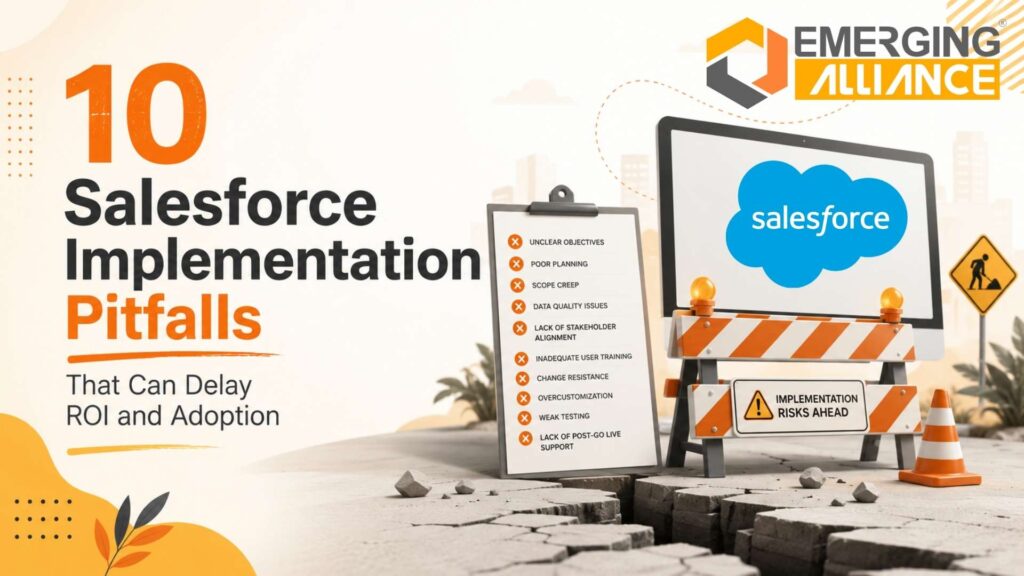
10 Salesforce Implementation Pitfalls That Can Delay ROI and Adoption
Discover the ROI Drivers That Maximize Salesforce Implementation Value
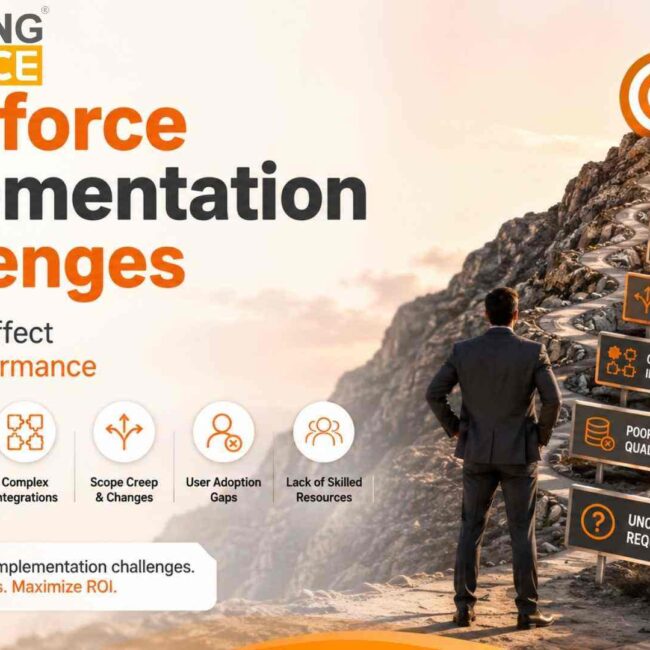
A Salesforce implementation is often expected to improve customer visibility, automate processes, accelerate sales performance, and support enterprise growth. Yet many organizations fail to realize the full value of their investment because implementation decisions are made without aligning technology to business outcomes.
According to Salesforce’s State of Sales research, sales teams continue to face increasing pressure to improve productivity, deliver better customer experiences, and generate predictable revenue growth. However, disconnected processes, poor data quality, low adoption, and workflow bottlenecks frequently prevent organizations from achieving these objectives.
The reality is that most Salesforce implementation challenges are not technology problems. They are business transformation problems. Understanding these pitfalls early can help reduce risk, accelerate adoption, and maximize return on investment.
Why Salesforce Implementation Success Directly Impacts Business Performance
A Salesforce implementation affects far more than customer relationship management.
It influences:
- Revenue visibility
- Sales productivity
- Customer retention
- Forecast accuracy
- Workflow automation
- Compliance readiness
- Operational efficiency
- Executive decision-making
When implementation issues arise, organizations often experience:
- Delayed ROI
- Low user engagement
- Reporting inconsistencies
- Data silos
- Manual workarounds
- Missed growth opportunities
Avoiding these risks requires a strategic approach that connects business objectives, people, processes, and technology.
1. Treating Salesforce Implementation as a Technology Project Instead of a Business Transformation Initiative
One of the most common Salesforce implementation pitfalls is viewing the initiative solely as a CRM deployment.
Many organizations delegate ownership entirely to IT while business stakeholders remain minimally involved.
As a result, workflows are configured without fully understanding operational requirements, customer journeys, or executive reporting needs.
Business Impact
- Misaligned business processes
- Low adoption across departments
- Reduced executive visibility
- Delayed value realization
Successful organizations establish executive sponsorship and cross-functional ownership from the beginning.
2. Building a Salesforce Implementation Plan Without Clear Business Objectives
A Salesforce implementation plan should begin with measurable business outcomes.
Too often, organizations focus on features before defining success criteria.
Without clear objectives, projects become configuration exercises rather than transformation initiatives.
Questions Leaders Should Answer First
- Which operational bottlenecks must be eliminated?
- What reporting gaps need to be addressed?
- Which workflows should be automated?
- How will success be measured?
- What business outcomes are expected within 12 months?
A business-first implementation roadmap improves decision-making throughout the project lifecycle.
3. Replicating Existing Process Inefficiencies Inside the Salesforce Platform
Many companies digitize inefficient processes instead of redesigning them.
For example, a manufacturing organization may automate a lengthy approval workflow that already delays order processing.
The workflow becomes digital, but the bottleneck remains.
Warning Signs
- Excessive approval layers
- Duplicate data entry
- Manual spreadsheet tracking
- Inconsistent customer handoffs
- Delayed service response times
Before enabling Salesforce features, organizations should evaluate and optimize business processes.
Automation should eliminate friction—not preserve it.
4. Ignoring Data Quality and Governance During Salesforce Implementation
Data quality remains one of the largest contributors to salesforce adoption problems.
Users lose confidence when reports contain inconsistent information or duplicate records.
Poor data governance also creates compliance concerns and limits executive visibility.
Common Data Challenges
- Duplicate accounts and contacts
- Incomplete customer information
- Inconsistent sales reporting
- Poor ownership management
- Lack of validation controls
Organizations that prioritize governance early typically achieve stronger adoption and better reporting accuracy.
A Salesforce system is only as effective as the quality of the information it contains.
5. Underestimating User Adoption Challenges
Technology adoption is often the difference between success and failure.
Even a well-designed Salesforce solution can struggle if users continue relying on spreadsheets, email chains, and offline processes.
Research from various CRM industry studies consistently shows that user adoption remains one of the most significant determinants of CRM project success.
Key Adoption Drivers
- Role-based training
- Executive sponsorship
- Simplified workflows
- Ongoing user support
- Performance dashboards
- Clear communication of business value
Adoption should be planned from day one—not after go-live.
6. Over-Customizing the Salesforce Solution
Customization can address unique business requirements, but excessive customization often creates long-term complexity.
Organizations sometimes modify the Salesforce platform extensively to match legacy processes rather than adopting modern best practices.
Risks of Over-Customization
- Increased maintenance costs
- Upgrade limitations
- Reduced scalability
- Longer deployment timelines
- Greater technical debt
The goal should be business enablement and agility—not unnecessary system complexity.
7. Failing to Integrate Salesforce With Critical Business Systems
Modern enterprises rely on multiple business applications including ERP, finance, customer service, marketing automation, and analytics platforms.
When integration is overlooked, new data silos emerge.
Enterprise Scenario
A distributor manages customer data in Salesforce while inventory information resides in ERP.
Without integration, sales teams lack visibility into stock availability, resulting in delayed commitments and customer dissatisfaction.
Business Consequences
- Data inconsistencies
- Reporting gaps
- Manual reconciliation
- Slower decision-making
- Reduced customer experience
A comprehensive Salesforce implementation process must include enterprise-wide integration planning.
8. Neglecting Compliance and Security Requirements
As organizations expand, governance becomes increasingly important.
Industries such as healthcare, manufacturing, financial services, and logistics often require strict audit controls and data protection standards.
Ignoring governance during implementation can introduce unnecessary risk.
Critical Governance Areas
- Role-based permissions
- Approval controls
- Audit readiness
- Data retention policies
- Regulatory compliance monitoring
Governance should be embedded into the architecture from the beginning.
9. Choosing the Wrong Salesforce Implementation Partner
Selecting a Salesforce implementation partner based solely on cost often creates challenges later.
Implementation success requires more than technical expertise.
Organizations need guidance on:
- Business process optimization
- Change management
- Digital transformation strategy
- Data governance
- Enterprise scalability
- Operational excellence
The right Salesforce partner helps align technology investments with business priorities.
10. Stopping Optimization After Go-Live
Many organizations view deployment as the finish line.
In reality, Salesforce implementation is an ongoing business improvement journey.
Business requirements evolve. Customer expectations change. New automation opportunities emerge.
Organizations that continuously optimize their Salesforce solution consistently achieve stronger long-term returns.
Continuous Improvement Areas
- Workflow optimization
- Dashboard refinement
- Adoption monitoring
- Process automation
- User feedback analysis
- Integration enhancement
The highest-performing organizations treat Salesforce as a strategic business platform rather than a one-time project.
How Emerging Alliance Helps Organizations Maximize Salesforce ROI
At Emerging Alliance, we believe successful Salesforce implementation requires more than technical deployment.
Our approach focuses on aligning business strategy, operational processes, user adoption, governance, and technology architecture.
We help organizations:
- Eliminate workflow bottlenecks
- Improve enterprise visibility
- Accelerate automation initiatives
- Strengthen governance frameworks
- Increase user adoption
- Support scalable growth
As a digital transformation and enterprise solutions partner, our objective is to help businesses create measurable operational and financial outcomes from their Salesforce investment.
Frequently Asked Questions
1. Why do Salesforce implementations fail to deliver expected ROI?
Salesforce implementations often fall short when organizations focus on technology deployment without aligning the platform to business goals, user needs, and process improvements.
2. What is the biggest mistake companies make during Salesforce implementation?
One of the biggest mistakes is replicating outdated or inefficient processes within Salesforce instead of redesigning workflows to improve efficiency and scalability.
3. How important is user adoption in Salesforce success?
User adoption is critical. Even the most advanced Salesforce solution cannot deliver value if employees do not consistently use the platform as part of their daily workflows.
4. Should Salesforce implementation be led by IT or business teams?
Successful implementations require collaboration between IT and business stakeholders. Business leaders define objectives and processes, while IT ensures technical execution and integration.
5. How can organizations improve Salesforce user adoption?
Organizations can improve adoption through role-based training, executive sponsorship, simplified user experiences, ongoing support, and clear communication of business benefits.
6. Why is data quality important in Salesforce?
High-quality data improves reporting accuracy, forecasting, customer insights, and decision-making while increasing user trust in the platform.
7. What role do integrations play in Salesforce implementation?
Integrations connect Salesforce with ERP, finance, marketing, customer service, and other systems, creating a unified view of business operations and reducing manual work.
8. How often should Salesforce be optimized after deployment?
Salesforce should be reviewed and optimized regularly to address changing business requirements, improve workflows, enhance reporting, and support growth initiatives.
9. What should organizations look for in a Salesforce implementation partner?
Organizations should seek a partner with expertise in business process optimization, change management, governance, integration strategy, and long-term digital transformation.
10. How can executives measure Salesforce implementation success?
Executives can evaluate success through metrics such as user adoption rates, process efficiency gains, revenue growth, forecast accuracy, customer satisfaction, and overall return on investment.
Planning a Salesforce implementation or looking to improve adoption and ROI? Our experts can help you reduce risks, streamline processes, and maximize the value of your Salesforce investment.
Fill out the form and our experts will contact you shortly