
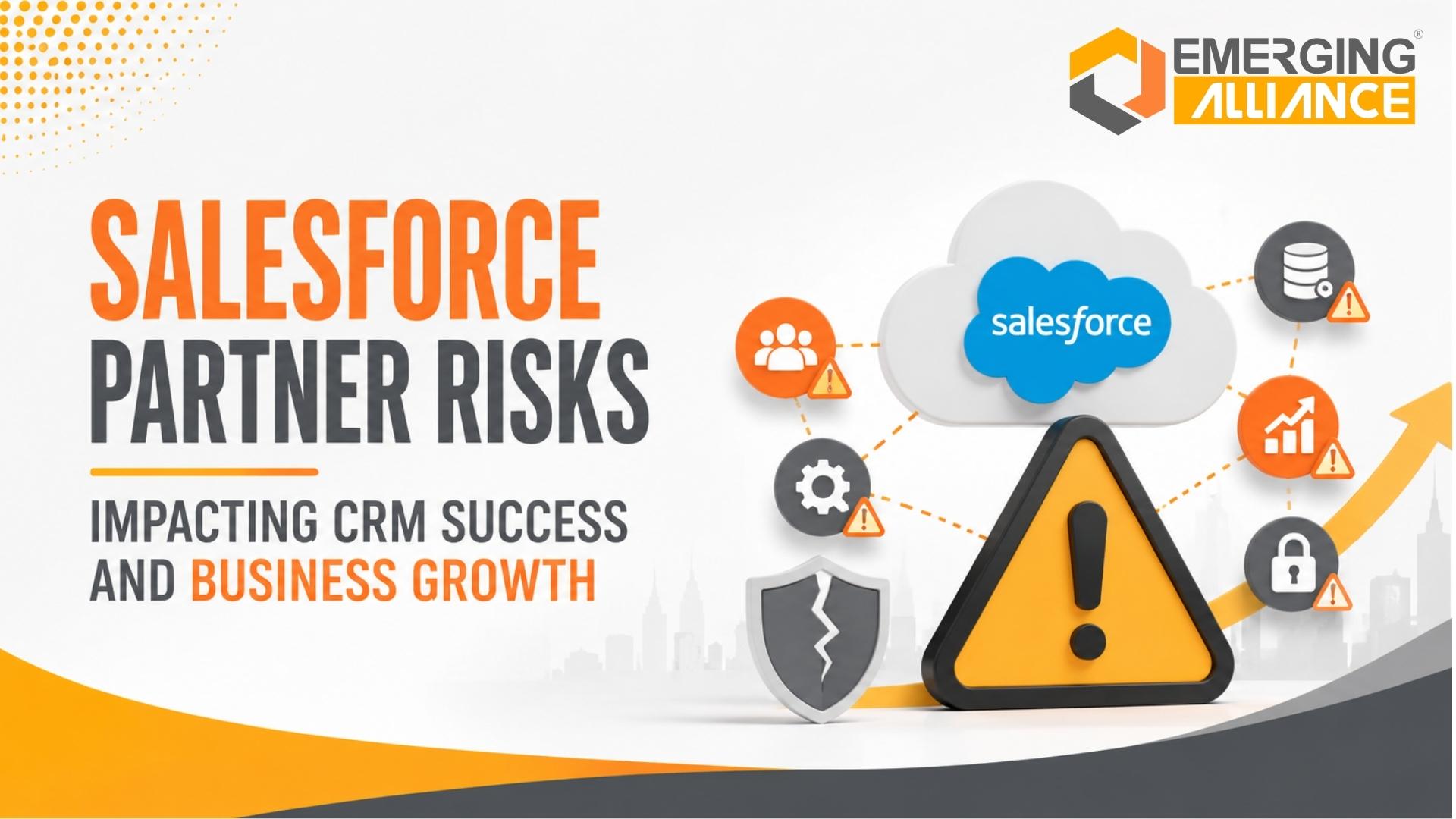
Salesforce Partner Risks Impacting CRM Success and Business Growth
Salesforce Partner Guidance for Lower Deployment Risk and Stronger ROI
A Salesforce implementation can improve sales visibility, customer service, business automation, and executive decision-making. However, Salesforce technology alone does not guarantee these outcomes. The implementation approach, solution architecture, data strategy, integration design, user training, and post-go-live support all influence whether the CRM delivers measurable value. For that reason, choosing the right Salesforce Partner is one of the most important decisions in a CRM transformation programmed.
The wrong partner may deliver a technically functional system that users avoid, managers cannot trust, and internal teams struggle to maintain. The right partner connects Salesforce capabilities with business processes, adoption goals, governance requirements, and long-term growth plans.
Why Salesforce Partner Selection Directly Affects CRM Success
A Salesforce Partner influences the quality of discovery, configuration, data migration, integration, testing, training, deployment, and continuous optimization.
Poor decisions during any of these stages can create problems that remain long after go-live. These problems often include:
- Workflows that do not reflect actual business operations
- Duplicate or incomplete customer data
- Unnecessary customization
- Disconnected sales, service, finance, and marketing systems
- Low user adoption
- Inaccurate dashboards and forecasts
- Higher maintenance costs
- Delayed return on investment
A capable Salesforce Consulting Partner evaluates the business problem before recommending the technical solution. This reduces the risk of building a CRM around assumptions rather than verified operational requirements.
Major Risks of Choosing the Wrong Salesforce Partner
Inadequate Business Discovery
Salesforce CRM implementation should begin with a detailed understanding of current processes, pain points, reporting needs, user roles, approval structures, integrations, and future plans.
When discovery is rushed, the implementation team may configure Salesforce without understanding how the business actually operates.
This can result in:
- Incorrect process flows
- Missing approval stages
- Unclear ownership rules
- Incomplete reporting requirements
- Repeated redesign after deployment
A structured discovery phase helps prevent expensive changes later in the project.
CRM Strategy Misaligned with Business Goals
A generic implementation may reproduce existing inefficiencies inside a new platform.
For example, automating an ineffective lead-management process does not improve sales performance. It only makes the ineffective process run faster.
A strategic Salesforce Implementation Partner should connect CRM design with measurable objectives such as:
- Faster lead response
- Higher opportunity conversion
- Better pipeline visibility
- Improved service response
- Reduced manual work
- More accurate forecasting
- Stronger customer retention
This outcome-based approach keeps the project focused on business value rather than feature deployment.
Excessive or Unnecessary Customization
Customization may be necessary when standard Salesforce functionality cannot support an important requirement. However, unnecessary custom development can increase complexity, testing effort, upgrade risk, and long-term maintenance costs.
Common warning signs include:
- Custom code proposed before standard functionality is assessed
- Multiple exceptions built around outdated processes
- Complex workflows with unclear business value
- Heavy dependence on one developer or vendor
- Limited documentation of custom components
The right Salesforce Partner follows a configuration-first approach and recommends customization only when it delivers a justified business benefit.
Data Migration Failures
Customer, opportunity, product, service, and activity data are essential to CRM performance. Poor migration planning can introduce duplicates, incomplete records, incorrect ownership, invalid fields, and unreliable reports.
A robust migration plan should cover:
- Data profiling
- Data cleansing
- Field mapping
- Duplicate management
- Validation rules
- Test migrations
- Reconciliation
- Business-user sign-off
Without these controls, organizations may launch a new CRM with unreliable information.
Weak Integration Architecture
Salesforce often needs to exchange information with ERP, marketing automation, finance, e-commerce, customer support, analytics, and other business platforms.
Poorly designed integrations can create:
- Duplicate customer records
- Delayed order or invoice visibility
- Conflicting information between systems
- Manual data re-entry
- Failed transactions
- Inaccurate reporting
- Customer service delays
A qualified Salesforce Partner should define system ownership, synchronization rules, error handling, security controls, and monitoring requirements before integration development begins.
Low User Adoption
A technically successful Salesforce deployment can still fail when employees find the system difficult, irrelevant, or time-consuming.
Low adoption is often caused by:
- Complex screens
- Too many mandatory fields
- Inadequate training
- Poor mobile usability
- Unclear process ownership
- Limited executive sponsorship
- Insufficient change management
User adoption should be treated as a measurable workstream rather than a one-time training activity.
Uncontrolled Scope and Cost Overruns
CRM projects become expensive when requirements are unclear, changes are poorly governed, or responsibilities are not defined.
A reliable implementation partner should establish:
- Approved project scope
- Deliverables and acceptance criteria
- Roles and responsibilities
- Change-request procedures
- Risk and issue tracking
- Testing responsibilities
- Deployment milestones
- Budget controls
Strong project governance protects both the implementation timeline and the CRM investment.
Limited Post-Go-Live Support
Go-live is the beginning of operational use, not the end of CRM transformation.
After deployment, organizations may need support for:
- User issues
- Workflow adjustments
- Integration monitoring
- Dashboard improvements
- New feature requests
- Security reviews
- Salesforce release readiness
- Additional business units
- Data-quality improvement
Without dependable Salesforce Support Services, minor issues can accumulate and gradually reduce system performance and user confidence.
Salesforce Partner Risk Comparison
| Risk Area | Weak Partner Approach | Strong Partner Approach |
| Discovery | Starts configuration immediately | Maps processes, users, goals, and constraints |
| Solution design | Copies generic templates | Designs around business outcomes |
| Customization | Builds custom code too early | Evaluates standard functionality first |
| Data migration | Imports available data | Cleans, maps, tests, and reconciles data |
| Integration | Connects systems without governance | Defines ownership, sync rules, and monitoring |
| Training | Provides one generic session | Delivers role-based and process-based training |
| Adoption | Assumes users will adapt | Tracks usage and removes adoption barriers |
| Governance | Handles changes informally | Uses documented scope and approval controls |
| Support | Ends involvement after go-live | Provides continuous support and optimization |
| Scalability | Solves only current requirements | Designs for users, markets, products, and growth |
What to Look for in a Salesforce Partner
The right Salesforce Partner should provide business consulting, technical capability, implementation governance, and long-term support.
Relevant Industry and Process Experience
Industry knowledge helps a partner understand common operational models, customer expectations, reporting requirements, compliance considerations, and integration needs.
However, industry experience should not replace discovery. The partner must still validate how your organization operates instead of assuming every company follows the same process.
Certified and Experienced Salesforce Consultants
Certifications indicate platform knowledge, but certification alone is not sufficient.
Evaluate whether the proposed team has practical experience in:
- Business analysis
- Solution architecture
- Salesforce configuration
- Data migration
- Integration
- Automation
- Security
- Reporting
- Testing
- Training
- Release management
Ask which consultants will actually work on the project rather than evaluating only the sales team.
A Structured Implementation Methodology
A dependable Salesforce CRM implementation methodology should include:
- Business discovery
- Requirement validation
- Solution architecture
- Configuration and development
- Data migration
- Integration
- System and user-acceptance testing
- Role-based training
- Deployment planning
- Hypercare and continuous optimization
Each phase should have clear deliverables, owners, dependencies, and acceptance criteria.
Integration and Data Expertise
A partner should understand both Salesforce and the connected business ecosystem.
Important evaluation questions include:
- Which system will own customer, product, order, and invoice data?
- How will duplicate records be prevented?
- How will integration failures be identified?
- What happens when one system is unavailable?
- How will historical data be migrated?
- How will data access and security be controlled?
- Who will monitor integrations after go-live?
These questions reveal whether the partner is designing a sustainable architecture or only a short-term technical connection.
Change Management and Adoption Planning
The implementation plan should address the human side of CRM transformation.
A strong adoption programme includes:
- Executive sponsorship
- Stakeholder communication
- User participation during design
- Role-based training
- Process documentation
- Super-user development
- Usage monitoring
- Feedback collection
- Post-launch reinforcement
Users are more likely to adopt Salesforce when the system simplifies their work and they understand why the new process matters.
Transparent Governance and Commercial Terms
The proposal should clearly define:
- Scope
- Assumptions
- Exclusions
- Deliverables
- Timeline
- Team structure
- Customer responsibilities
- Testing approach
- Change-request process
- Support model
- Commercial terms
Vague proposals increase the likelihood of disagreements, delays, and unexpected costs.
Ongoing Salesforce Partner Services
A long-term partner should support continuous CRM improvement after launch.
Relevant services may include:
- Salesforce administration
- Workflow optimization
- Dashboard and reporting enhancement
- Release assessment
- Security reviews
- User support
- Integration monitoring
- Data-quality management
- New feature implementation
- Managed Salesforce services
Continuous optimization keeps Salesforce aligned with changing business requirements.
How the Right Salesforce Partner Improves Business Outcomes
Faster and More Controlled Deployment
Experienced consultants use repeatable implementation practices, validated design decisions, defined testing processes, and clear governance.
This helps reduce avoidable delays while maintaining solution quality.
Higher CRM Adoption
Salesforce adoption improves when workflows reflect real user responsibilities and unnecessary administrative steps are removed.
Higher adoption supports:
- Better data completeness
- More reliable pipeline information
- Accurate activity tracking
- Improved team collaboration
- Stronger management reporting
Improved Sales Productivity
Salesforce automation can reduce repetitive administrative work through:
- Automated lead assignment
- Follow-up reminders
- Opportunity-stage guidance
- Approval workflows
- Quote and proposal processes
- Task creation
- Escalation rules
The objective should be to reduce friction and help sales teams spend more time on customer engagement.
Better Customer Experience
Connected customer data gives sales, service, and marketing teams a more complete view of every interaction.
This supports:
- Faster response
- More relevant communication
- Consistent service
- Better case visibility
- Improved handoffs
- More personalized engagement
More Reliable Reporting and Forecasting
CRM reports are only as reliable as the underlying process and data.
A well-designed Salesforce environment provides leadership with:
- Pipeline visibility
- Forecast accuracy
- Conversion analysis
- Sales activity metrics
- Service performance
- Customer trends
- Revenue indicators
Reliable reporting enables faster and more informed decisions.
Stronger Salesforce ROI
Salesforce ROI improves when the platform supports measurable business objectives.
Value may come from:
- Reduced manual work
- Faster lead response
- Improved opportunity management
- Better customer retention
- More accurate forecasts
- Lower reporting effort
- Improved service productivity
- Reduced application fragmentation
The partner should establish baseline metrics before implementation so that improvements can be measured after deployment.
Scalable CRM Architecture
A scalable Salesforce design should accommodate:
- Additional users
- New business units
- New sales territories
- More products and services
- New integrations
- Advanced automation
- Additional Salesforce clouds
- AI-enabled capabilities
Scalability reduces the need for major redesign as the organization grows.
Why Emerging Alliance
Emerging Alliance helps organizations design, implement, integrate, support, and optimize Salesforce around practical business requirements.
Our Salesforce services include:
- Salesforce CRM consulting
- Salesforce CRM implementation
- CRM strategy and process design
- Salesforce configuration and customization
- ERP and third-party integration
- Data migration
- Workflow automation
- Reporting and dashboards
- User training
- Salesforce support services
- Managed Salesforce services
- Continuous CRM optimization
Our approach focuses on four priorities:
- Reducing implementation and operational risk
- Aligning Salesforce with measurable business outcomes
- Improving user adoption and data reliability
- Building a scalable CRM foundation for future growth
Whether your organization is planning a new Salesforce implementation, correcting an underperforming deployment, or expanding an existing CRM environment, Emerging Alliance can provide the consulting and implementation support required to move forward with greater control.
Frequently Asked Questions
How do I choose the right Salesforce Partner?
Choose a Salesforce Partner with relevant implementation experience, qualified consultants, a documented delivery methodology, data and integration expertise, adoption planning, transparent governance, and dependable post-go-live support. The partner should first understand your business processes and desired outcomes before recommending configuration or customization.
What risks can an inexperienced Salesforce Implementation Partner create?
An inexperienced partner may cause unclear requirements, excessive customization, data migration errors, integration failures, project delays, cost overruns, low user adoption, inaccurate reporting, and inadequate post-go-live support. These issues can increase the total cost of ownership and delay CRM ROI.
Can a Salesforce Partner improve an existing CRM implementation?
Yes. A Salesforce Consulting Partner can assess architecture, workflows, automation, data quality, security, reporting, integrations, and user adoption. The partner can then prioritize improvements that increase usability, productivity, governance, and business value without unnecessarily replacing the existing environment.
Why are Salesforce Support Services important after go-live?
Salesforce Support Services help organizations resolve issues, manage users, improve workflows, monitor integrations, maintain data quality, prepare for platform releases, and introduce new capabilities. Continuous support ensures the CRM remains aligned with changing operational requirements.
What should be included in a Salesforce Partner proposal?
A detailed proposal should define scope, deliverables, assumptions, exclusions, project phases, team roles, timeline, data migration, integrations, testing, training, change control, deployment, hypercare, ongoing support, and commercial terms.
How can a Salesforce Partner improve CRM user adoption?
A partner can improve adoption by involving users in process design, simplifying screens, reducing unnecessary fields, providing role-based training, developing internal champions, monitoring usage, and resolving workflow barriers after launch.
How should CRM implementation success be measured?
Success should be measured using business and adoption metrics such as lead-response time, conversion rates, pipeline visibility, forecast accuracy, user activity, data completeness, service response, manual effort reduction, and reporting efficiency.
When should a business replace its existing Salesforce Partner?
Consider changing partners when projects repeatedly miss deadlines, documentation is incomplete, support is reactive, integrations remain unstable, costs are unclear, adoption stays low, or the partner cannot connect technical work with measurable business priorities.
What is the difference between a Salesforce Consulting Partner and an implementation vendor?
A consulting partner helps define strategy, processes, architecture, governance, adoption, and long-term optimization. An implementation-only vendor may focus primarily on technical configuration. Businesses usually gain more value from a partner that combines strategic consulting with delivery capability.
Can Salesforce integrate with ERP, finance, and marketing platforms?
Yes. Salesforce can be integrated with ERP, accounting, marketing automation, e-commerce, customer support, analytics, and other applications. Integration success depends on clear data ownership, secure architecture, synchronization rules, testing, error handling, and ongoing monitoring.
Protecting CRM Success Through the Right Salesforce Partner
Choosing a Salesforce Partner is not simply a technology-procurement decision. It is a business decision that affects user productivity, customer experience, data quality, operational visibility, and long-term CRM ROI.
The wrong partner can introduce complexity, delays, unreliable data, integration problems, and low adoption. The right partner provides structured discovery, sound architecture, disciplined governance, practical training, and continuous improvement.
Organizations should therefore evaluate potential partners on implementation methodology, process expertise, data capability, integration experience, adoption planning, governance, and post-go-live support—not only price or technical certification.
Planning a Salesforce implementation or concerned about the performance of your existing CRM? Book a consultation with Emerging Alliance to assess implementation risks, identify optimization opportunities, and define a practical roadmap for CRM success.