
Enterprise Cloud Security Evaluation Before Choosing GROW with SAP
Quick Answer
Enterprise Cloud Security Evaluation helps organizations determine whether GROW with SAP can meet security, compliance, access-control, integration, and business-continuity requirements before implementation.
A complete evaluation should examine Identity and Access Management (IAM), Multi-Factor Authentication (MFA), business roles and authorizations, segregation of duties, encryption, monitoring, integration security, disaster recovery, data residency, regulatory requirements, and cloud governance.
GROW with SAP provides enterprise-grade cloud ERP security capabilities, but implementation security follows a shared-responsibility model. SAP protects significant parts of the cloud infrastructure and platform, while customers remain responsible for business-user authorizations, identity policies, integrations, access governance, monitoring, and organization-specific controls.
What Is Enterprise Cloud Security Evaluation?
Enterprise Cloud Security Evaluation is a structured assessment of the technologies, controls, responsibilities, governance policies, and recovery capabilities required to protect business-critical applications and data in a cloud ERP environment.
For organizations considering GROW with SAP, this evaluation goes beyond checking encryption or authentication. Decision-makers must understand which responsibilities are managed by SAP, which remain with the customer, how users and integrations will be governed, which regulations apply, and how operations will recover after disruption.
Because cloud ERP can become the operational backbone of finance, procurement, manufacturing, inventory, sales, and supply chain, security becomes a business-governance priority rather than only an IT requirement.
Why Enterprise Cloud Security Evaluation Matters Before GROW with SAP
Evaluating cloud security before choosing GROW with SAP helps organizations identify security, compliance, governance, and resilience requirements before those requirements become expensive implementation problems. This approach also improves executive decision-making by connecting security controls to business priorities, readiness, compliance exposure, and operational resilience before investment decisions are finalized.
ERP evaluations often prioritize functionality, timelines, cost, and ROI, but security decisions influence the environment throughout its lifecycle. Poor authorization design, insecure integrations, weak identity processes, or unclear recovery plans can create problems long after go-live.
A structured evaluation enables leadership teams to answer critical questions:
- Can sensitive financial and operational information be adequately protected?
- How will access be granted, reviewed, and revoked?
- Are segregation-of-duties requirements clearly defined?
- Which security controls are SAP-managed and which are customer-managed?
- Can ERP integrations exchange information securely?
- Are regulatory requirements supported?
- What happens if a critical service or integration becomes unavailable?
- How will security events be detected and investigated?
Addressing these questions early improves implementation readiness and reduces avoidable redesign.
Security as a Business Decision
Enterprise cybersecurity can directly affect revenue, operations, compliance, customer relationships, and reputation. A security failure within a central ERP environment can disrupt finance, procurement, production, warehouse operations, order processing, customer service, and regulatory reporting.
Poorly designed access privileges may allow conflicting financial activities, while an insecure third-party integration could expose sensitive ERP data. These are business risks, not merely technical issues.
Shared Security Responsibility in GROW with SAP
A critical part of GROW with SAP security evaluation is understanding that cloud security is a shared responsibility.
SAP manages significant areas of the cloud ERP infrastructure and platform security. Depending on the specific service and architecture, these responsibilities can include infrastructure protection, security patching, platform-level protections, encryption capabilities, backups, vulnerability management, and secure development practices.
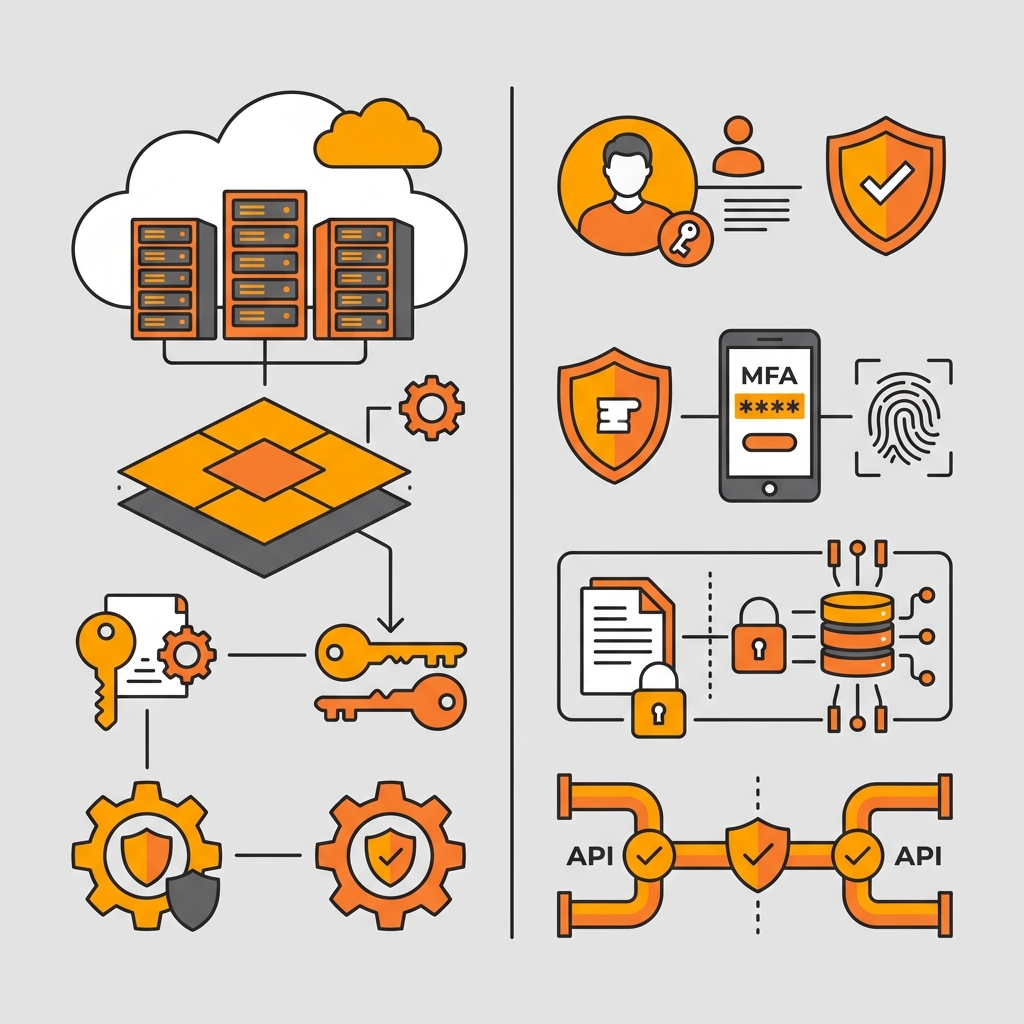
Shared security responsibility model defines the clear division of roles between SAP’s platform defense and customer-side control configurations.
The customer remains responsible for organization-specific controls and decisions such as:
- Business-role design
- User authorizations
- Segregation of duties
- Identity-provider configuration
- MFA policies
- Access approval processes
- External integrations
- Data-governance requirements
- Security monitoring responsibilities
- Internal policies
- Regulatory interpretation
- Periodic access reviews
A secure cloud ERP platform does not automatically guarantee a secure implementation. The final security posture depends on how identities, authorizations, integrations, processes, and governance are configured and managed.
Major Cloud ERP Security Risks Before Implementation
Cloud ERP security evaluation should identify the risks most likely to affect sensitive data, critical business processes, compliance, and operational continuity.
Unauthorized Access
Unauthorized access can occur when credentials are compromised or users receive privileges beyond their responsibilities. Consequences can include financial-data exposure, unauthorized transactions, fraud risk, and regulatory violations. Strong authentication and access governance help reduce this exposure.
Weak Identity and Access Management
Identity and Access Management determines who can enter the ERP environment and what they can do after authentication. Weak IAM practices can create excessive access, shared accounts, delayed deprovisioning, inconsistent approvals, and inactive accounts. A structured IAM model becomes more important as the organization grows.
Authorization and Segregation-of-Duties Conflicts
SAP environments require careful authorization design. Users should receive access based on legitimate business responsibilities while avoiding combinations that introduce financial or operational conflicts. Typical concerns include users who can create and approve transactions, maintain vendors and process payments, or modify sensitive master data and execute related transactions. Periodic authorization reviews and segregation-of-duties analysis help identify these risks.
Cloud Misconfiguration
Strong platform security can still be weakened by poor customer-side configuration, including excessive privileges, improper roles, insecure integrations, weak authentication, or inadequate monitoring. Configuration reviews should therefore continue after go-live.
Insecure Integrations
GROW with SAP may exchange information with CRM, HR, banking, manufacturing, e-commerce, warehouse, supplier, or logistics systems. Each connection introduces another trust relationship, so APIs, middleware, credentials, certificates, and data flows must be secured.
Insider Risk
Employees, contractors, administrators, or third parties may misuse legitimate access. Role design, audit logging, access reviews, and monitoring help reduce insider exposure.
Data Protection Gaps
Cloud ERP environments contain sensitive financial, customer, supplier, employee, inventory, production, and intellectual-property data. Organizations should evaluate how this information is protected while stored, transmitted, backed up, integrated, and retained.
Compliance Gaps
Regulatory requirements vary by industry and geography. Organizations may need to address data privacy, financial controls, auditability, retention, cross-border transfers, and industry-specific requirements before configuration is finalized.
Inadequate Monitoring
Security controls provide limited protection if suspicious activities are not detected promptly. Monitoring should cover authentication events, authorization changes, administrative activity, integration errors, unusual access behavior, and configuration changes. Relevant logs should feed broader monitoring and incident-management processes where appropriate.
Weak Business Continuity Planning
Cloud availability alone does not guarantee end-to-end business continuity. Business processes may still be interrupted by failed integrations, identity outages, network disruption, third-party failures, or cyber incidents. Evaluate the complete process, not only ERP uptime.
Enterprise Cloud Security Evaluation Checklist
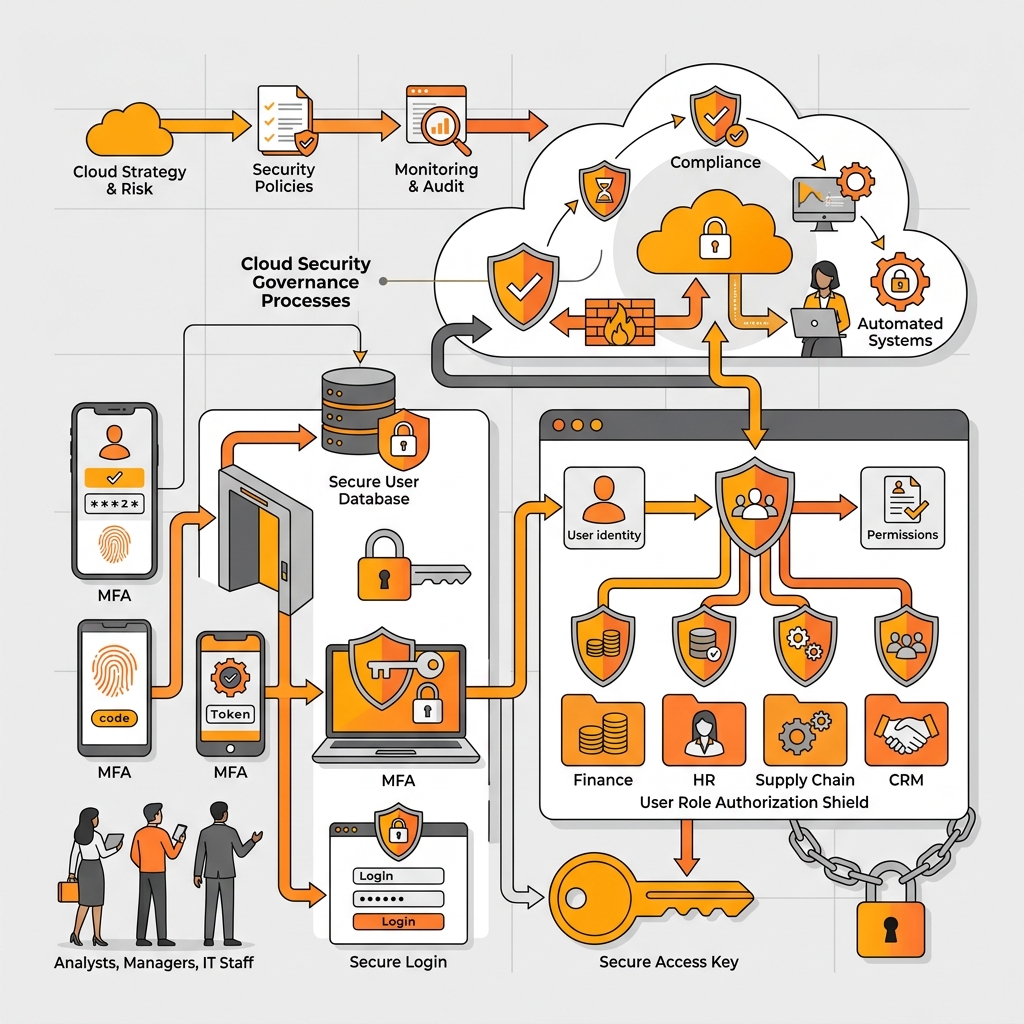
Identity governance and multi-factor authentication serve as the critical first line of defense for cloud ERP security.
Identity and Authentication
Evaluate centralized identity management, Single Sign-On, identity federation, MFA, administrative-account protection, automated provisioning and deprovisioning, and authentication policies. Business objective: ensure only verified users can access the ERP environment.
Business Roles and Authorizations
Review business-role architecture, business catalogs, role ownership, least privilege, temporary access, privileged access, and periodic reviews. Business objective: ensure users receive only required access.
Segregation of Duties
Evaluate authorization combinations across finance, procurement, vendor management, payments, master data, approvals, and administration. Business objective: reduce fraud exposure and strengthen internal controls.
Data Protection and Encryption
Evaluate data-at-rest and data-in-transit protection, backups, document security, retention, and sensitive-data handling. Business objective: protect critical information throughout its lifecycle.
Integration and API Security
Review communication arrangements, authentication methods, OAuth where applicable, certificate-based authentication, TLS, credential storage, interface authorization, logging, and monitoring. Business objective: prevent integrations becoming an uncontrolled path into ERP processes.
Security Logging and Monitoring
Evaluate security audit logs, authentication events, authorization changes, critical business events, integration logs, retention, SIEM integration where appropriate, and escalation procedures. Business objective: improve visibility and accelerate incident investigation.
Compliance and Audit Readiness
Identify relevant regulations, standards, and controls, including ISO-based information-security requirements, SOC assurance reports, GDPR where applicable, local privacy rules, financial controls, and industry-specific requirements. Business objective: design controls around real obligations before go-live.
Backup, Recovery, and Business Continuity
Evaluate backups, recovery capabilities, Recovery Time Objective, Recovery Point Objective, integration recovery, process dependencies, escalation responsibilities, and continuity procedures. Business objective: minimize disruption.
Data Residency and Privacy
Determine where data may be hosted or processed, whether cross-border restrictions apply, which contractual obligations matter, and how retention and deletion will be governed. Business objective: align deployment with privacy and regulatory obligations.
Cloud Governance
Establish responsibility for security policies, role ownership, access approvals, configuration changes, risk reviews, compliance monitoring, and incident management. Business objective: prevent security becoming reactive or unowned.
Implementation Partner Security Capability
Evaluate whether the implementation partner demonstrates expertise in SAP Cloud ERP architecture, role design, authorization governance, segregation of duties, secure integrations, identity architecture, migration controls, compliance planning, and post-go-live governance. Business objective: avoid implementation-driven security or compliance exposure.
GROW with SAP Security Evaluation Framework
| Evaluation Area | Primary Objective | Business Value |
|---|---|---|
| Identity & Authentication | Verify user identity | Reduce unauthorized access |
| Business Roles | Least-privilege access | Improve accountability |
| Segregation of Duties | Prevent conflicting access | Reduce fraud and control risk |
| Data Protection | Protect sensitive information | Maintain confidentiality |
| Integration Security | Secure connected systems | Reduce external exposure |
| Monitoring & Logging | Detect suspicious activity | Accelerate incident response |
| Compliance | Align with obligations | Improve audit readiness |
| Recovery | Restore critical operations | Reduce downtime |
| Data Residency | Meet geographic obligations | Support privacy compliance |
| Governance | Define ownership and controls | Maintain long-term security |
| Partner Capability | Secure implementation decisions | Reduce deployment risk |
Common Enterprise Cloud Security Evaluation Mistakes
Choosing ERP Mainly on Price
Cloud ERP cost matters, but the lowest initial price may not represent the lowest long-term risk. Authorization design, integrations, governance, compliance, and monitoring still require planning, and ignoring them can create remediation work later.
Treating SAP Security as Fully Managed
Because SAP operates the cloud environment, some organizations assume the customer has few security responsibilities. Customers must still govern identities, roles, authorizations, MFA, integrations, data use, monitoring, and internal processes.
Designing Roles After Go-Live
Authorization design should begin during business-process design. Creating roles late can cause excessive permissions, workarounds, segregation-of-duties conflicts, and testing delays. Roles should reflect real responsibilities before production deployment.
Ignoring Third-Party Integrations
A secure ERP can still be exposed through an insecure connected application. Evaluate third-party authentication, data exchange, credentials, encryption, logging, vendor practices, and failure scenarios before integration.
Skipping Formal Security Assessment
Moving directly from selection into implementation can leave requirements undiscovered. A structured assessment should identify critical data, process risks, access requirements, compliance obligations, integration dependencies, and recovery expectations.
Assuming Disaster Recovery Equals Business Continuity
Platform recovery is only one part of continuity. Organizations should also consider identity services, networks, integrations, banking interfaces, warehouse applications, manufacturing dependencies, third parties, and internal recovery procedures.
Treating Security as a One-Time Project
Cloud ERP security continues after go-live. Establish recurring access reviews, role reviews, monitoring, integration reviews, compliance assessments, configuration reviews, and incident-response testing.
Cloud Security Best Practices for GROW with SAP
Adopt Least-Privilege Access
Users should receive only the access required for legitimate responsibilities. This reduces unauthorized activity, accidental changes, excessive privileges, and insider risk. Review access whenever responsibilities change.
Apply Strong Identity Governance
Identity governance should define how access is requested, approved, provisioned, reviewed, modified, and revoked. Appropriate automation can reduce administrative errors and orphaned accounts.
Use Multi-Factor Authentication
MFA reduces exposure to credential-compromise attacks when combined with sound identity policies. Prioritize it for administrators, remote users, finance teams, sensitive functions, and privileged operations.
Review Authorizations Regularly
Authorization requirements change as roles and processes evolve. Periodic reviews help identify excessive access, unused privileges, inappropriate combinations, and segregation-of-duties conflicts.
Secure Communication and Integrations
Every external connection should follow approved standards for authentication, encryption, certificates, credentials, API permissions, monitoring, and error handling. Design integration security before development begins.
Maintain Continuous Security Visibility
Organizations should monitor authentication activity, privilege changes, administrative events, critical configuration changes, integration behavior, and suspicious transactions. Relevant logs can support broader SIEM and incident-management processes.
Integrate Compliance into ERP Governance
Compliance should be part of day-to-day ERP management. Maintain policies, control ownership, access evidence, change records, audit documentation, and security reviews instead of preparing only when an audit approaches.
Test Recovery Procedures
A recovery process matters only if it supports business requirements during disruption. Periodically validate responsibilities, escalation procedures, integration recovery, critical dependencies, and communication plans.
Perform Continuous Risk Assessments
Security requirements change with new integrations, locations, acquisitions, regulations, automation, AI capabilities, and digital services. Periodic risk assessments keep controls aligned with actual exposure.
Business Benefits of Enterprise Cloud Security Evaluation
Reduced Security Exposure
Early evaluation identifies security requirements before production and enables proactive design improvements.
Stronger Regulatory Readiness
Compliance requirements can be incorporated into authorization design, audit logging, data handling, documentation, and business processes.
Improved Operational Resilience
Security evaluation clarifies critical processes, dependencies, recovery priorities, and ownership for better continuity planning.
Faster ERP Implementation
Clear security requirements reduce late-stage changes around identity, roles, integrations, compliance, recovery, and governance.
Lower Remediation Costs
Security weaknesses are easier to address during design than after go-live. Early planning can reduce role redesign, integration remediation, compliance rework, emergency projects, and disruption.
Greater Stakeholder Confidence
Customers, regulators, auditors, investors, employees, and partners expect appropriate protection of sensitive information. A documented security framework demonstrates governance and accountability.
Scalable Digital Transformation
A strong security foundation supports analytics, automation, AI, connected manufacturing, new digital channels, additional cloud applications, and expansion. Security becomes an enabler of transformation rather than a barrier.
Illustrative Scenario: Security Evaluation Before International Expansion
Consider a hypothetical mid-sized manufacturer preparing to expand operations into multiple countries. The company plans to adopt GROW with SAP to replace disconnected finance, procurement, inventory, and production systems. During evaluation, the team identifies country-specific compliance obligations, segregation-of-duties requirements, user lifecycle controls, secure supplier integrations, MFA, data-residency considerations, recovery objectives, and integration monitoring. These requirements become part of ERP design before implementation, improving readiness and creating a stronger platform for expansion.
Role of an Implementation Partner in Secure GROW with SAP Adoption
Selecting the right technology is only one part of secure cloud ERP adoption. An experienced implementation partner can translate security policies and business requirements into practical configuration and governance. Support should cover security-readiness assessment, business-role architecture, authorization planning, segregation of duties, identity architecture, secure integrations, migration controls, compliance planning, go-live readiness, and post-implementation reviews. The objective is to align SAP security controls with real business processes, responsibilities, risks, and regulatory requirements.
Why Emerging Alliance for GROW with SAP Security Planning
Emerging Alliance helps organizations incorporate security into the wider GROW with SAP implementation process. Relevant areas can include cloud security readiness, ERP security architecture, identity and access requirements, business-role design, segregation-of-duties planning, secure integrations, migration controls, compliance readiness, governance, risk mitigation, and post-go-live review. This positions cloud ERP security as part of enterprise transformation rather than an isolated technical workstream.
Conclusion
Enterprise Cloud Security Evaluation should be completed before choosing GROW with SAP because security decisions affect access, compliance, integrations, continuity, governance, and long-term ERP resilience.
A complete evaluation should assess identity, authorizations, segregation of duties, data protection, integration security, monitoring, regulatory obligations, recovery, data residency, and cloud governance.
Organizations should also understand the shared-responsibility model. SAP provides significant cloud platform and infrastructure security capabilities, while customers remain responsible for identities, authorizations, integrations, policies, monitoring, and business governance.
Addressing these responsibilities early reduces implementation uncertainty and supports secure digital transformation.
Frequently Asked Questions
Ready to Evaluate GROW with SAP Security?
Before implementation, identify the access-control, compliance, integration, governance, and continuity requirements that could affect your cloud ERP project.
Emerging Alliance can help evaluate cloud security readiness, define priorities, identify risk areas, and develop a secure GROW with SAP roadmap aligned with operational and compliance requirements.
Request a GROW with SAP Cloud Security Demo