
Choosing a Modern Salesforce Dealer Management System: Features, Integration & Evaluation Guide
Quick Answer: What Should a Modern Salesforce Dealer Management System Include?
A modern Salesforce dealer management system should connect dealer sales, customer data, vehicle and parts inventory, service workflows, finance, reporting, automation, and external systems in one connected environment. The right solution should reduce duplicate data, improve dealer visibility, support integration with existing ERP and DMS platforms, and provide scalable workflows for growing automotive operations.
What Is a Salesforce Dealer Management System?
A Salesforce dealer management system combines Salesforce-based customer and dealer management capabilities with the operational processes required to manage dealership networks.
Traditional dealer management systems typically focus on operational functions such as vehicle inventory, sales transactions, parts, service, finance and accounting. Salesforce is primarily a CRM platform, but its automotive capabilities can extend customer, vehicle, dealer, sales and partner information into a broader connected environment.
This distinction matters when evaluating a Salesforce dealer management system.
The objective should not simply be to replace an existing DMS with another application. The more important question is whether the technology environment can connect customer engagement, dealer operations, inventory, finance and reporting without creating another layer of disconnected data.
For automotive businesses, the environment may include:
A modern Salesforce dealer management approach therefore needs to address both CRM requirements and the operational systems surrounding the dealership.
Why Traditional Dealer Management Systems Create Operational Gaps
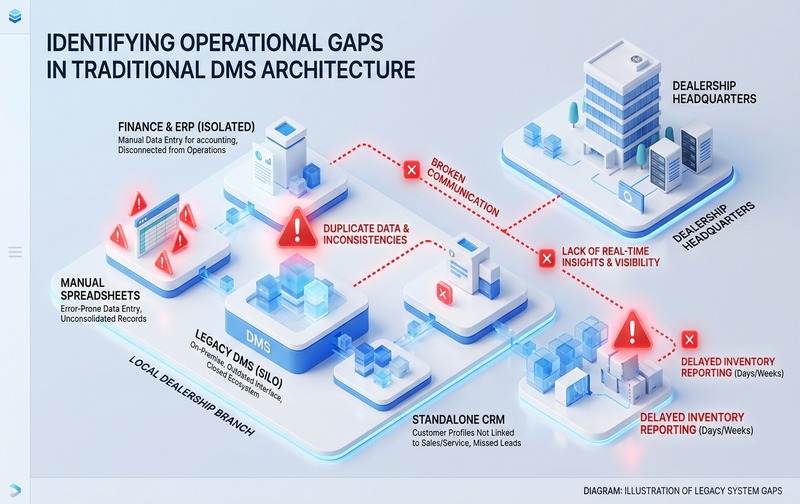
Traditional dealer management systems create critical operational friction when customer data, inventory availability, and financial reporting remain trapped in disconnected silos.
Many dealership environments have evolved through multiple technology investments rather than through a single integrated architecture.
A dealer may use one application for customer management, another for inventory, an ERP for finance, separate tools for marketing, and spreadsheets for operational reporting.
Each system may work effectively on its own. The problem appears when information needs to move between them.
A sales team may have customer information in a CRM while vehicle availability is maintained somewhere else. Finance may depend on a separate ERP. Dealer managers may receive reports that are generated after data has already passed through several systems.
This creates operational friction.
Common gaps include:
These problems become more significant as dealership networks expand.
A modern dealer management architecture should therefore focus on connected data and processes, rather than simply adding more features.
10 Capabilities to Evaluate in a Modern Dealer Management System
The right Salesforce dealer management system should be evaluated against the operational requirements of the dealership, dealer group, OEM or automotive organization.
1. Unified Customer and Vehicle Data
Customer information should not exist independently from vehicle and transaction information.
A connected environment should provide visibility into relevant customer, household, vehicle and interaction information so that sales and service teams can work from a consistent record.
This can include:
The objective is a more complete view of the customer journey.
2. Dealer Lead and Opportunity Management
Lead management is central to automotive sales.
A modern system should allow organizations to capture, distribute, qualify and track leads across dealer locations.
Important capabilities include:
This becomes especially important when leads originate from multiple channels.
Without centralized visibility, management may know how many leads were generated but not whether dealers followed up effectively or where opportunities were lost.
3. Vehicle and Parts Inventory Visibility
Inventory information needs to be available to the people making sales and operational decisions.
A modern dealer management environment should support visibility into relevant inventory information across locations.
Depending on the architecture, this may include:
The critical requirement is data synchronization.
If the CRM displays outdated inventory information, sales teams can make decisions based on information that is no longer accurate.
4. Sales and Deal Workflow Management
Dealer sales processes often involve multiple stages and stakeholders.
A modern system should provide structured workflows for:
Automation can reduce repetitive administrative work while giving managers greater visibility into pipeline progression.
5. Service and Appointment Coordination
Customer relationships continue after the initial vehicle sale.
Sales, service and customer engagement information should therefore be connected wherever the business process requires it.
A connected environment can help organizations manage:
This reduces the risk of customer information becoming fragmented between sales and service teams.
6. Finance and Accounting Integration
A dealer management system should not operate as an isolated financial environment.
Finance and accounting information frequently resides in an ERP or specialized financial system. The integration between operational applications and finance therefore becomes a critical architecture consideration.
Relevant integration areas may include:
The goal is not necessarily to move all financial functionality into Salesforce.
Instead, the objective should be to establish a reliable flow of information between the customer-facing and operational environment and the financial system.
7. Dealer and OEM Partner Management
Organizations managing multiple dealerships need more than customer-level CRM.
They also need visibility into dealer relationships and performance.
A modern dealer management system can support:
This creates a more structured approach to dealer network management.
8. Dealer Performance Analytics
Management decisions depend on reliable operational data.
A modern system should provide reporting across relevant dimensions such as:
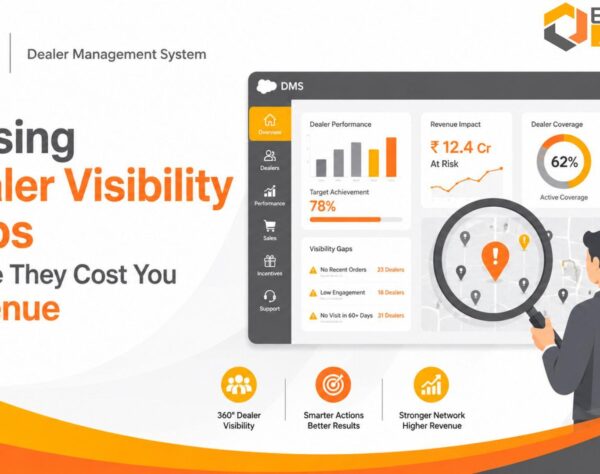
Analytics should help management identify performance gaps rather than simply display historical numbers.
For example, a dealer performance dashboard should make it easier to identify locations with strong lead generation but weak conversion, or locations with inventory availability but slower sales performance.
9. Workflow Automation and AI
Manual processes become increasingly expensive as dealer networks scale.
Automation can help reduce repetitive tasks such as:
AI can further support decision-making and user productivity when implemented around reliable business data.
However, AI should not be treated as a substitute for data quality or integration.
Poorly connected data will produce limited business value regardless of how advanced the AI layer appears.
10. Integration, Security and Scalability
Integration should be evaluated as a core capability rather than as an implementation afterthought.
A modern Salesforce dealer management system may need to connect with:
API availability, authentication, data synchronization, master-data ownership, error handling and monitoring should all be considered during solution design.
Security and scalability are equally important for organizations operating across multiple dealerships, brands or regions.
Salesforce Dealer Management vs Traditional DMS Software
Salesforce and a traditional DMS should not automatically be viewed as interchangeable products.
A traditional DMS is generally designed around dealership operations. Salesforce is fundamentally a CRM platform that can be extended with automotive-specific capabilities and integrated with other business systems.
The right architecture depends on the organization’s requirements.
| Business requirement | Traditional DMS | Salesforce-based environment |
|---|---|---|
| Customer relationship management | Usually available | Strong CRM capability |
| Lead and opportunity management | Available | Strong capability |
| Dealer relationship management | Available depending on platform | Strong potential with configuration |
| Vehicle inventory | Core capability | Can be connected to inventory systems |
| Parts management | Common core capability | Usually requires integration |
| Finance and accounting | Often available | Typically integrated with ERP/finance |
| Customer engagement | Varies | Strong CRM capability |
| Dealer analytics | Varies | Can be extended with analytics |
| Enterprise integrations | Depends on platform | Strong API/integration potential |
| Custom workflows | Platform dependent | Highly configurable |
The important consideration is not which technology has the longer feature list.
It is whether the architecture supports the organization’s complete dealer operating model.
Salesforce DMS vs CRM vs ERP: Understanding the Difference
The terms DMS, CRM and ERP are sometimes used interchangeably even though they address different business requirements.
A simple distinction is:
In many organizations, these systems need to work together.
For example:
➔
➔
➔
➔
➔
The exact architecture will vary, but the principle remains the same: customer, operational and financial data should move between systems without unnecessary manual intervention.
Connecting Dealer Sales, Inventory, Service and Finance
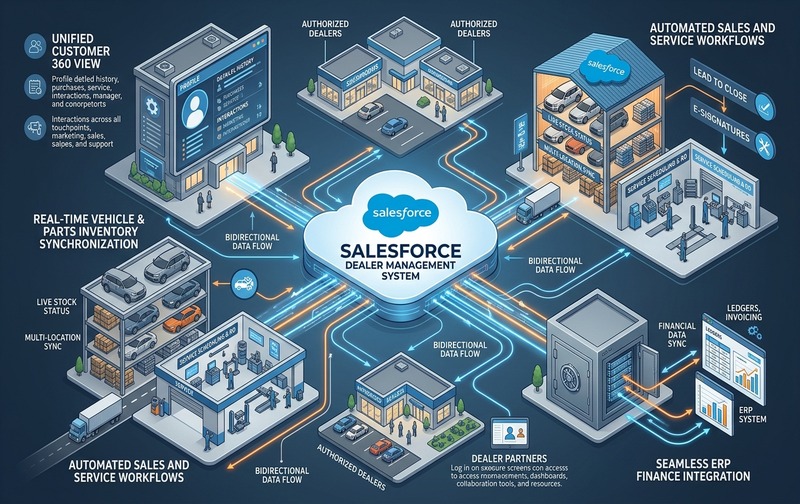
A modern Salesforce dealer management system connects dealer sales pipelines, vehicle and parts inventory, service coordination, and ERP finance into a single synchronized environment.
One of the strongest reasons to modernize a dealer management environment is to connect processes that previously operated independently.
Consider a customer who submits an enquiry for a specific vehicle.
The system may need to:
If each stage relies on a different disconnected application, employees may have to re-enter information several times.
A connected architecture reduces this dependency on manual transfer.
The result is not simply a better CRM experience. It is improved operational continuity across the customer and dealer lifecycle.
Salesforce Dealer Management System Integration Requirements
Integration quality can determine whether a Salesforce dealer management implementation succeeds.
Before implementation, organizations should identify which system owns each critical data object and how information moves between platforms.
Key areas include:
API and Integration Architecture
Determine which systems expose APIs and how integrations should be managed.
Consider:
Master Data Management
Customer, vehicle, dealer, product and inventory data should have clearly defined ownership.
Without master-data rules, integration can simply distribute inconsistent information faster.
ERP Integration
Finance and accounting systems often remain critical to the operating environment.
Integration should be designed around the required financial transactions rather than attempting to duplicate the entire ERP inside the CRM.
Inventory Synchronization
Vehicle and parts availability needs accurate synchronization between systems.
This is especially important where sales decisions depend on current stock information.
Dealer and OEM Integration
Dealer networks may need connections with OEM platforms, distributor systems and other partner applications.
The architecture should account for different data formats, identifiers and business rules.
Dealer Performance, Reporting and AI-Driven Decision Support
Modern dealer management is increasingly dependent on the ability to turn operational data into management decisions.
Executives may need answers to questions such as:
A modern reporting architecture should make these questions easier to answer.
AI can add another layer of decision support by helping users identify patterns, summarize information, automate tasks and surface relevant recommendations.
But the foundation remains data quality.
If customer, dealer, inventory and financial information is fragmented or inconsistent, analytics and AI will be constrained by the underlying data.
Salesforce Dealer Management System Implementation Considerations
A successful implementation requires more than Salesforce configuration.
The project should begin with the existing operating environment.
Key implementation considerations include:
Current-State Assessment
Document existing systems, workflows, integrations, data sources and manual processes.
Identify where employees currently re-enter information or reconcile data manually.
Data Migration
Determine which customer, dealer, vehicle, product and transaction records need to be migrated.
Data cleansing should happen before migration rather than after the new system goes live.
Integration Design
Map each required integration and define:
Customization and Configuration
Not every business requirement should become custom development.
The implementation should distinguish between standard capabilities, configuration, integration and genuinely necessary customization.
User Roles and Security
Dealer users, regional managers, sales teams, finance teams and corporate administrators may require different levels of access.
Security should therefore be designed around business roles and data ownership.
Testing and Training
Testing should cover not only individual functions but also end-to-end processes.
For example:
Users should also be trained around their actual workflows rather than generic system functionality.
Post-Implementation Support
The operating environment will continue to change after go-live.
Support should cover integration monitoring, configuration changes, performance issues, user requirements and future enhancements.
When Should a Dealership Consider Modernizing Its DMS?
A dealership or automotive organization should consider modernization when its current technology environment is creating measurable operational limitations.
Typical indicators include:
Modernization does not always mean replacing every existing application.
In many cases, the better approach is to determine which systems should remain, which processes need modernization, and where integration can close the operational gaps.
How to Evaluate a Salesforce Dealer Management System Implementation Partner
Choosing the technology is only one part of the decision.
The implementation partner should also understand the business processes surrounding the technology.
Evaluate a partner based on:
A strong implementation partner should be able to explain not only what the system can do, but how it should fit into the organization’s existing technology landscape.
Conclusion: Building a More Connected Dealer Management Environment
A modern Salesforce dealer management system should not be evaluated simply by counting features.
The stronger evaluation focuses on whether the technology can connect customers, dealers, sales, inventory, service, finance, analytics and external systems while reducing manual processes and improving operational visibility.
Salesforce can play an important role in this environment, particularly where CRM, dealer relationships, customer engagement, automation and integration are strategic priorities. However, the final architecture should be based on the organization’s existing DMS, ERP, inventory, finance and operational requirements.
The objective is a connected dealer environment that can support current processes while remaining flexible enough for future growth.
Frequently Asked Questions
See How a Modern Salesforce Dealer Management System Fits Your Business
Evaluate how Salesforce Dealer Management can connect sales, inventory, finance and dealer operations while reducing data gaps and manual processes.
Request a demo of a Salesforce Dealer Management System to explore key features, integration options and how it can support a more connected dealer operation.