
How Accutech Became UAE E-Invoicing Ready with SAP
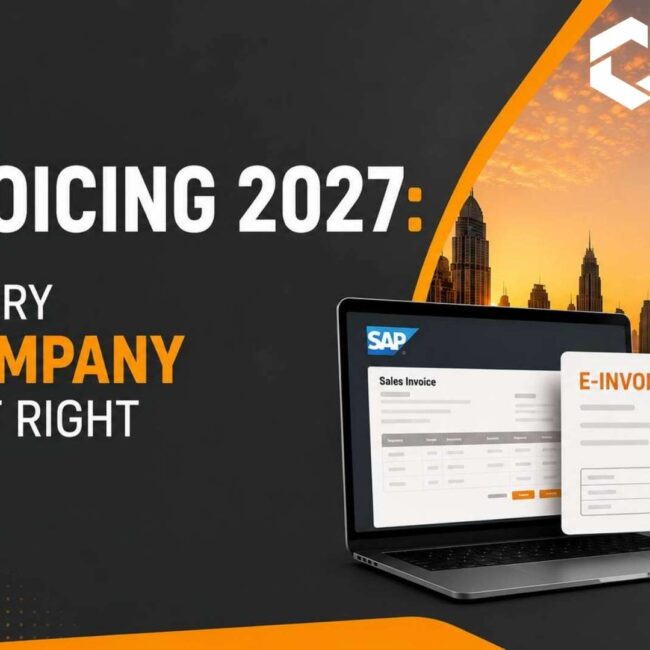
How Accutech Achieved UAE E-Invoicing Readiness in SAP
Case Study: Client Overview
- Company: Accutech
- Region: Dubai, United Arab Emirates
- Industry: Engineering Spares & Projects
- Key Stakeholders: Riyaz, Hussaifah, Mohammed
- System Landscape: SAP

Business Context
Accutech is a fast-growing engineering spares and project solutions company operating in Dubai, handling:
- High-volume B2B transactions
- Project-based billing cycles
- Complex customer/vendor structures
- Tight dispatch timelines
With the upcoming UAE e-invoicing mandate under the Federal Tax Authority, Accutech leadership identified a critical risk:
“Our SAP system generates invoices—but will they be legally valid in the new UAE framework?”
The Challenge: Hidden Risk in a “Working” SAP System
At first glance, everything seemed operational.
But a detailed assessment revealed structural gaps:
| Area | Before Implementation |
| Invoice Validity | Generated in SAP but not externally validated |
| Master Data | Inconsistent VAT details and address formats |
| Process Flow | Invoice generated after dispatch without validation |
| Error Handling | No mechanism for failed invoices |
| Compliance Visibility | No tracking of accepted vs rejected invoices |
| Scalability | Not ready for multi-country e-invoicing models |
Business Risk Identified
- Invoice rejection risk under UAE framework
- Dispatch delays due to validation failure
- Revenue recognition delays
- Compliance exposure during audits
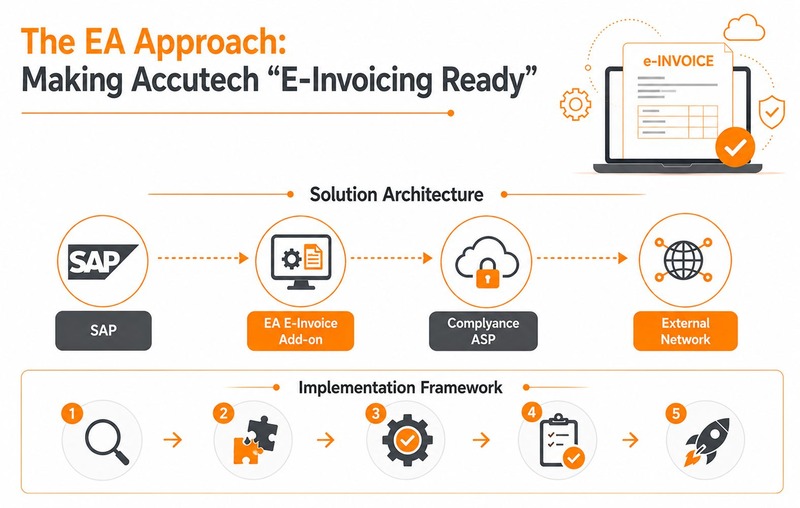
The EA Approach: Making Accutech “E-Invoicing Ready”
Emerging Alliance implemented its exclusive SAP E-Invoice Add-on, integrated with Complyance ASP, aligned to the expected Peppol framework.
Solution Architecture
SAP + EA E-Invoice Add-on + Complyance ASP + External Network
Implementation Framework (EA 5-Layer Model)
1. Compliance Layer
- Interpreted UAE e-invoicing model and validation requirements
- Configured compliance-ready invoice structures
- Enabled real-time validation checkpoints
2. Data Layer
- Standardized:
- Customer VAT structures
- Address formats
- Item classifications
- Cleansed legacy master data
3. Process Layer
- Redesigned Order-to-Cash flow:
Before:
Sales → Delivery → Billing → Dispatch
After:
Sales → Delivery → Billing →
👉 Pre-validation (EA Add-on) →
👉 Submission via Complyance ASP →
👉 Approval → Dispatch
4. Integration Layer
- EA Add-on handled:
- XML/JSON transformation
- Secure transmission to Complyance ASP
- Real-time communication with external validation network
- Built retry and failure handling mechanisms
5. Governance Layer
- Implemented dashboards for:
- Invoice status tracking
- Failed vs accepted invoices
- Real-time alerts
- Defined SLAs and ownership for issue resolution
How the EA E-Invoice Add-on Works
The proprietary EA solution ensured:
- Zero disruption to end users
- Same SAP billing interface
- Backend automation for:
- Validation
- Submission
- Status tracking
Key Capability
Users continue invoicing in SAP exactly as before—while compliance happens seamlessly in the background.
| Area | Before EA Implementation | After EA Implementation |
| Invoice Validation | Not available | Real-time pre-validation enabled |
| Compliance Readiness | Not compliant | UAE-ready (Peppol aligned) |
| Error Handling | Manual & reactive | Automated & proactive |
| Dispatch Dependency | Independent | Controlled by invoice approval |
| Visibility | Limited | Full dashboard & audit trail |
| Scalability | UAE-specific risk | Multi-country ready architecture |
Quantified Business Impact
Within the first phase of implementation:
- 100% invoice validation before submission
- 0 invoice rejection at dispatch stage
- 40–60% reduction in manual correction effort
- Faster invoice approval cycles (real-time validation)
- Improved cash flow predictability
- Audit-ready compliance visibility
Strategic Outcome
Accutech moved from:
“We generate invoices in SAP”
to:
“We control, validate, and track every invoice across the compliance lifecycle”
Leadership Perspective

Stakeholders (Riyaz, Hussaifah, Mohammed) aligned on one key realization:
“E-invoicing is not an IT change.
It is a business control system.”
Key Takeaways for UAE Businesses
- SAP invoice generation ≠ compliance
- Data quality directly impacts invoice acceptance
- E-invoicing failures show in revenue—not systems
- Integration layer is your risk control point
- Governance defines long-term success
FAQs
1. Is SAP alone sufficient for UAE e-invoicing compliance?
No. SAP generates invoices but does not ensure external validation, approval, and transmission. Compliance requires an integration layer, structured data, and network connectivity beyond standard SAP capabilities.
2. What role does the EA E-Invoice Add-on play?
The EA Add-on enables real-time validation, structured invoice generation, seamless integration with Complyance ASP, and automated submission—ensuring compliance without disrupting existing SAP billing processes.
3. Will users experience changes in SAP invoicing?
No. End users continue using the same SAP billing interface. All validation, submission, and compliance processes are handled in the backend, ensuring zero operational disruption.
4. What happens if an invoice fails validation?
The system blocks submission, triggers real-time alerts, and routes the issue for correction before dispatch—preventing compliance risks, delays, and revenue impact.
5. Can this solution scale beyond UAE?
Yes. The architecture is designed for multi-country compliance, supporting different formats, validation rules, and networks—making it scalable for regions like Saudi Arabia and Europe.