
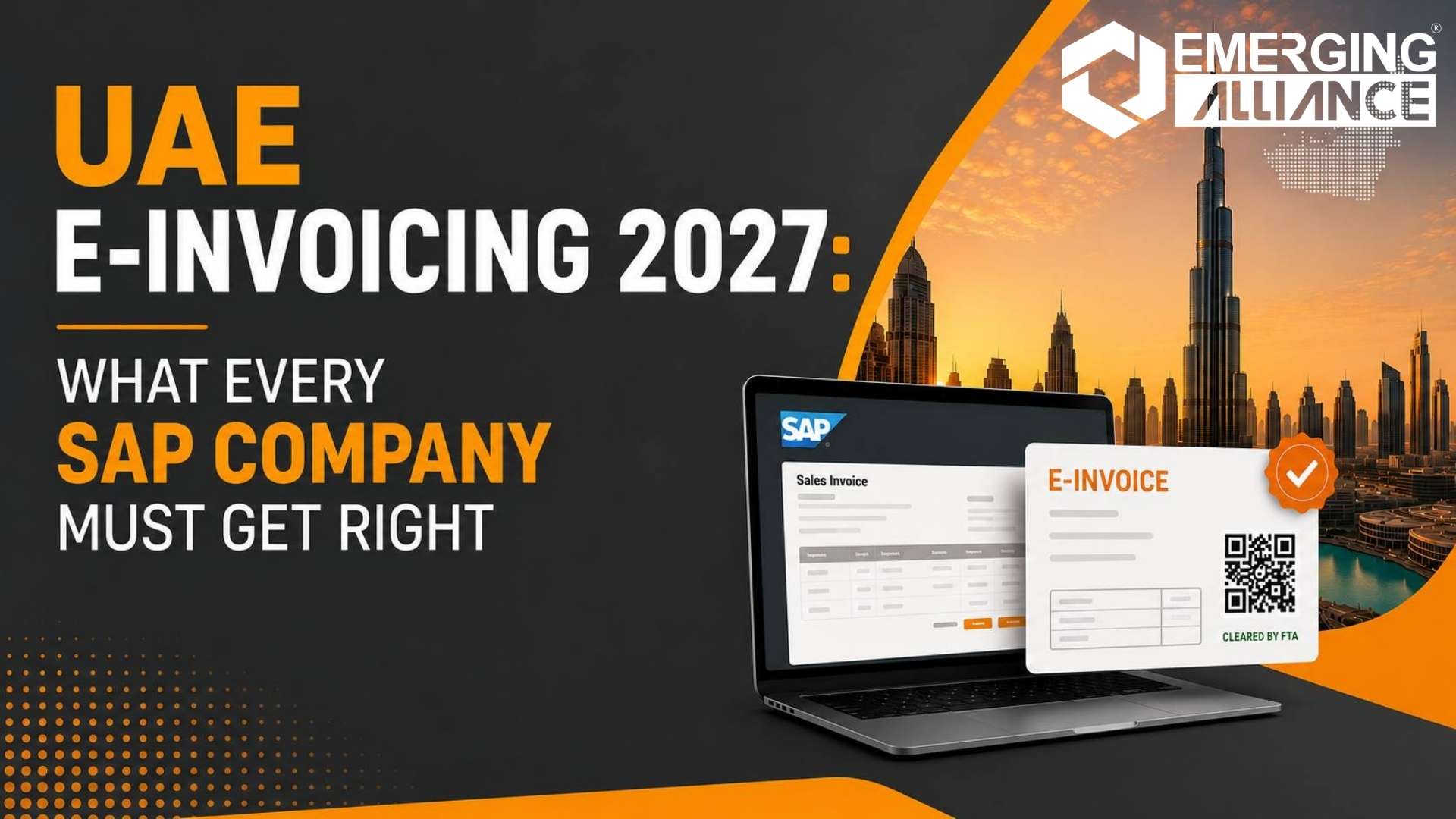
UAE E-Invoicing 2027: What Every SAP Company Must Get Right
SAP E-Invoicing Readiness Is Now a Business Priority
If your SAP system is generating invoices today, that capability alone will not matter in 2027.
Because in the UAE, an invoice will no longer be considered valid just because it is created inside SAP.
It must be:
- Validated externally
- Approved through regulated systems
- Transmitted via authorized networks
- Stored in compliance-ready formats
And here’s the uncomfortable truth:
Most SAP environments today are not designed for this shift.
When companies ignore this reality, the consequences are not technical—they are business-critical:
- Invoice rejections
- Dispatch delays
- Cash flow disruption
- Compliance exposure
This is not an IT upgrade.
This is a business risk.
The UAE E-Invoicing Shift: What Is Really Changing
Under the guidance of the Federal Tax Authority, the UAE is moving toward a structured e-invoicing framework expected to align with the Peppol model—already operational in regions like Europe and Singapore.
What this means for SAP-driven businesses:
Invoices will no longer be:
- Generated → Sent → Completed
Instead, they will be:
- Digitally structured (XML/JSON)
- Validated in real time
- Transmitted through regulated networks
- Accepted before becoming legally valid
So the real question is no longer:
“Are we compliant?”
It is:
“Is our SAP system ready for this operational shift?”
Common Misconceptions That Will Cost You
Across SAP landscapes, the same flawed assumptions keep repeating:
1. “We handled GST in India. We’re fine.”
Wrong.
India uses a centralized IRP model.
UAE is expected to follow a decentralized exchange model via Peppol.
Completely different architecture.
2. “Our SAP partner will handle everything”
Most partners will:
- Enable integration
- Configure compliance
But they will NOT:
- Fix process gaps
- Clean master data
- Redesign order-to-cash
3. “It’s just API integration”
If you think this is a simple system connection, you are already behind.
This is process + data + compliance engineering.
4. “Once implemented, we’re done”
E-invoicing is not a one-time project.
It is a continuous compliance system that evolves with regulations.
Where SAP Implementations Fail in E-Invoicing
This is where things become critical.
❌ Treating it as a one-time project
Regulations evolve. Formats change. Validations increase.
❌ Ignoring master data quality
Invoices fail due to:
- Incorrect VAT details
- Poor address structures
- Wrong item classifications
Bad data = rejected invoices
❌ No pre-validation
Invoices are sent first, validated later → failures occur → manual corrections follow.
❌ No exception handling
What happens if:
- Validation fails?
- Network fails?
- Submission fails?
Most companies have no defined response.
❌ Broken integration with logistics
Invoice fails after dispatch → operational chaos + compliance risk.
❌ No audit visibility
If you cannot answer:
- Which invoices failed?
- Which were accepted?
You are exposed.
❌ No scalability
Today UAE. Tomorrow Saudi Arabia.
Different rules. Same SAP system.
How E-Invoicing Actually Works in SAP
Let’s simplify the architecture:
Core Flow:
Sales Order → Delivery → Billing → E-Invoice Generation → Validation → Submission → Approval
Key Components:
- Structured data (XML/JSON)
- Validation engine
- External transmission network (Peppol)
- Acknowledgement and status tracking
SAP Landscape Considerations:
- SAP ECC → requires additional integration layers
- SAP S/4HANA → offers more native capabilities
Middleware Role:
- Data transformation
- Network connectivity
- Retry handling
- Error management
Important Insight:
If your SAP process is weak, e-invoicing will not fix it.
It will expose it.
The Exclusive Emerging Alliance Approach: EA E-Invoicing Readiness Framework
At Emerging Alliance, we approach this through a structured 5-layer model.
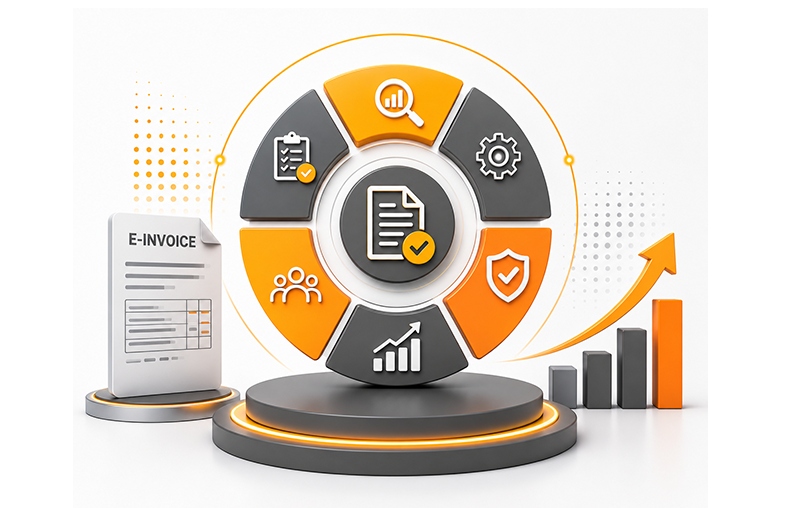
1. Compliance Layer
Understand:
- Regulatory model
- Validation rules
- Submission flow
Mistake here = wrong system design from day one.
2. Data Layer
Ensure:
- Clean customer master
- Accurate tax data
- Standardized formats
E-invoicing does not tolerate poor data.
3. Process Layer
Define:
- When invoices are generated
- When validation happens
- What happens on failure
These are business decisions—not technical ones.
4. Integration Layer
This is your bridge to the external world.
Must handle:
- Real-time communication
- Error handling
- Retry mechanisms
Once invoice leaves SAP → control shifts here.
5. Governance Layer
The most ignored—but most critical.
You need:
- Dashboards
- Audit trails
- Ownership
- SLAs
Because compliance is not about sending invoices.
It is about proving control.
Business Impact: Why This Matters More Than You Think
E-invoicing is NOT:
- Just a tax initiative
- Just a compliance requirement
It directly impacts:
- Revenue recognition
- Cash flow
- Customer experience
Final Reality: If your invoice is delayed… your revenue is delayed.
Self-Diagnostic: Are You Ready for UAE E-Invoicing?
Ask yourself:
- Do we validate invoices before submission?
- Do we handle errors in real time?
- Can we scale to another country quickly?
- Do we have full visibility of invoice status?
- Is our SAP order-to-cash process standardized?
If the answer to even one is uncertain…
You are at risk.
What Should You Do Next
UAE e-invoicing is not optional by 2027.
The companies that act early will:
- Avoid disruption
- Maintain seamless operations
- Gain compliance confidence
The ones that delay will:
- Face operational breakdowns
- Deal with revenue leakage
- Scramble under pressure