

Losing Track of Your Dealer Network? Salesforce DMS Built for Growth

Salesforce DMS for Complete Dealer Network Visibility
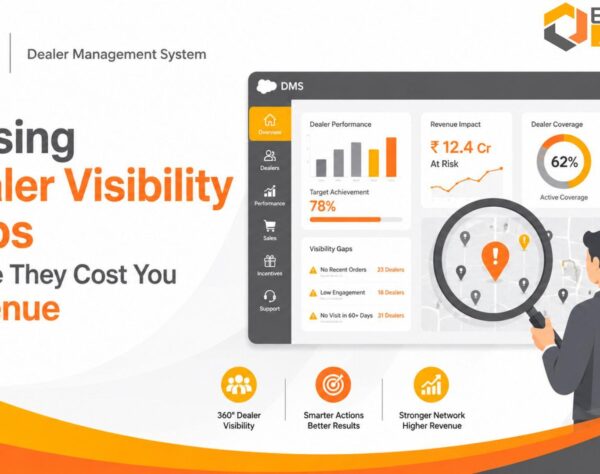
As dealer networks grow, Salesforce DMS becomes essential for maintaining visibility across sales, inventory, service operations, and dealer performance. What begins as a manageable distribution model gradually evolves into a complex ecosystem of regional dealers, distributors, inventory locations, sales teams, service centers, and customer touchpoints. Without a centralized dealer management platform, leadership loses the ability to monitor operations consistently across the network.
Many organizations still manage dealer operations through disconnected CRM systems, ERP applications, spreadsheets, emails, and manual reporting. The result is delayed decisions, inconsistent dealer experiences, inventory imbalances, and missed revenue opportunities. These issues rarely emerge overnight—they accumulate as the business scales.
Salesforce DMS provides a centralized platform that connects every dealer, customer interaction, inventory movement, and business process into a single operational ecosystem. Instead of reacting to problems after they occur, executives gain real-time visibility that supports faster decisions, stronger governance, and sustainable growth.
Why Growing Dealer Networks Lose Visibility Over Time
Dealer visibility becomes increasingly difficult because every new dealer introduces additional operational data, customer interactions, inventory movements, and reporting requirements. Without standardized processes and centralized information, complexity grows faster than control.
Expansion Creates Information Silos
Business expansion often introduces new regions, independent dealer groups, franchise partners, and distribution channels. Each dealer may adopt different reporting methods, operational processes, and communication practices.
As a result, sales, inventory, warranty information, and customer records become fragmented across multiple systems. Leadership struggles to obtain a single, reliable view of dealer performance.
Manual Reporting Slows Decision-Making
Many dealer networks continue relying on spreadsheets and periodic reports for operational updates. By the time data reaches management, it is often outdated.
Delayed visibility affects:
- Sales forecasting
- Inventory planning
- Production scheduling
- Dealer performance management
- Customer service responsiveness
Instead of making proactive decisions, management reacts after problems have already impacted business performance.
Inconsistent Dealer Operations
When dealers follow different workflows, organizations lose operational consistency.
Variations in order processing, pricing approvals, warranty handling, promotions, and customer engagement create unnecessary complexity that becomes increasingly difficult to govern at scale.
The Hidden Business Costs of Limited Dealer Visibility
Poor dealer visibility is not simply an operational inconvenience. It directly affects revenue growth, inventory efficiency, customer satisfaction, and executive decision-making.
Organizations often recognize these costs only after financial performance begins to decline.
Revenue Leakage Across the Dealer Network
Without centralized visibility, leadership cannot easily identify where sales opportunities are being lost.
Common issues include:
- Delayed lead follow-up
- Missed customer enquiries
- Inconsistent pricing
- Duplicate sales activities
- Poor dealer engagement
- Untracked opportunities
Individually, these issues appear minor. Collectively, they create significant revenue leakage.
Inventory Imbalances Increase Operational Costs
Disconnected dealer operations frequently lead to excess inventory in one region while another location experiences stock shortages.
This creates higher carrying costs, emergency replenishment, delayed deliveries, and reduced customer satisfaction.
Real-time inventory visibility enables organizations to optimize stock allocation across the dealer network before shortages affect sales.
Limited Executive Visibility
Executives require accurate information to make strategic decisions.
When dealer data exists across multiple systems, leadership spends valuable time consolidating reports instead of evaluating business performance and identifying growth opportunities.
As dealer ecosystems expand, operational visibility becomes a strategic capability rather than an operational convenience.
Many organizations begin by assessing their existing dealer workflows before starting a Salesforce DMS implementation. Identifying process gaps early helps reduce implementation risk while maximizing long-term business value.
How Salesforce DMS Connects the Entire Dealer Ecosystem
Salesforce DMS centralizes dealer operations into a single digital platform, enabling manufacturers and distributors to manage their entire dealer ecosystem through real-time information rather than fragmented reports.
Instead of relying on multiple disconnected applications, every stakeholder works from the same trusted data.
Centralized Dealer Operations
A modern Dealer Management System Salesforce solution connects every major operational function, including:
- Dealer onboarding
- Lead management
- Sales operations
- Inventory visibility
- Order management
- Warranty processing
- Service requests
- Customer engagement
- Dealer performance tracking
This unified environment improves collaboration while reducing manual coordination between departments.
Real-Time Dealer Performance Visibility
A Salesforce DMS platform provides executives with live dashboards covering:
- Regional sales performance
- Dealer productivity
- Inventory movement
- Customer enquiries
- Open opportunities
- Service performance
- Warranty trends
- Forecast accuracy
Instead of waiting for monthly reports, leadership gains continuous operational intelligence.
Intelligent Workflow Automation
A modern Salesforce dealer automation system replaces repetitive manual activities with automated workflows.
Examples include:
- Automatic lead assignment
- Order approvals
- Inventory alerts
- Warranty approvals
- Dealer onboarding
- Escalation management
- Service scheduling
This level of Salesforce automation for dealers improves efficiency while ensuring every dealer follows standardized business processes.
Built Around Your Dealer Operations
No two dealer networks operate identically. One of the greatest advantages of Salesforce DMS customization is the ability to align the platform with existing business operations rather than forcing organizations into rigid software processes.
Businesses can customize Salesforce for dealer workflow by supporting territory structures, pricing models, dealer hierarchies, approval workflows, incentive programs, warranty policies, and service operations while maintaining enterprise-wide governance.
This flexibility allows organizations to modernize dealer operations without disrupting established business models.
Before investing in technology, many executive teams benefit from a dealer network assessment that identifies automation opportunities, integration requirements, and operational bottlenecks. This provides a clearer roadmap for achieving measurable business outcomes rather than simply deploying new software.
Building a Scalable Salesforce DMS for Enterprise Growth
A successful Dealer Management System Salesforce implementation is not simply a technology project—it is a business transformation initiative. The objective is to create a scalable operating model that supports future expansion without increasing operational complexity.
Organizations that approach implementation strategically gain faster adoption, better data quality, and long-term operational value.
Integrate Dealer Operations Across the Enterprise
Dealer management cannot operate in isolation. A scalable Salesforce DMS should integrate with the broader enterprise technology landscape, including:
- ERP for financial and inventory management
- CRM for customer engagement
- Marketing automation platforms
- Customer service applications
- Business intelligence and reporting tools
- Supply chain and logistics systems
Integrated systems eliminate duplicate data entry, improve reporting accuracy, and provide leadership with a unified view of business performance.
Design Around Business Processes
Technology should support business operations—not force businesses to redesign successful workflows.
With Salesforce DMS customization, organizations can configure:
- Multi-level dealer hierarchies
- Territory-based sales structures
- Approval workflows
- Pricing policies
- Incentive management
- Warranty processes
- Service workflows
- Dealer scorecards
The ability to customize Salesforce for DMS ensures that the platform reflects how the business actually operates while maintaining governance across the entire dealer ecosystem.
Evaluate Cost Through Business Value
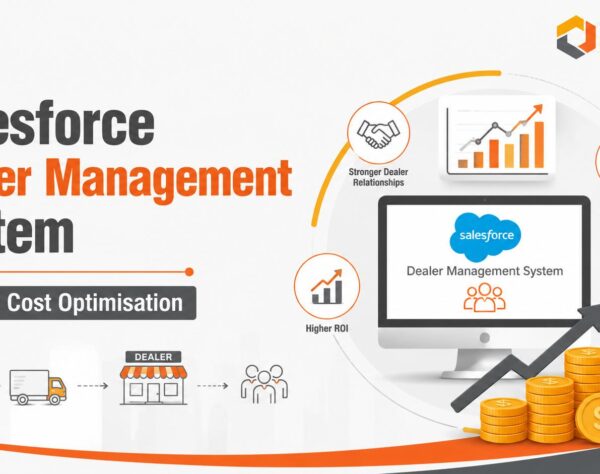
A meaningful Salesforce DMS cost analysis goes beyond software licensing. Decision-makers should evaluate the long-term financial impact of improved operational efficiency, faster decision-making, and reduced manual effort.
Key areas to assess include:
- Lower administrative costs
- Improved inventory utilization
- Faster dealer onboarding
- Reduced reporting effort
- Better sales forecasting
- Higher dealer productivity
- Increased customer retention
When measured against these outcomes, the investment often delivers value far beyond the initial implementation cost.
Preparing Your Dealer Network for the Future of Distribution
Dealer networks are evolving rapidly. Customer expectations, digital channels, connected products, and data-driven decision-making are redefining how manufacturers and distributors collaborate with their partners.
The Future of Dealer Management Systems is centered on intelligent automation, real-time insights, and seamless connectivity across the entire distribution ecosystem.
AI-Driven Decision Making
Modern dealer platforms are moving beyond reporting to predictive intelligence. By combining operational data with advanced analytics, organizations can identify trends before they become business challenges.
Capabilities include:
- Sales forecasting
- Inventory demand prediction
- Dealer performance benchmarking
- Customer buying behavior analysis
- Predictive service planning
These insights enable leadership to make faster and more informed strategic decisions.
Mobile-First Dealer Engagement
Dealer teams increasingly require access to business information wherever they operate. Mobile-enabled dealer platforms improve responsiveness by providing real-time access to customer data, inventory availability, sales opportunities, and service updates.
This flexibility supports higher productivity while enhancing the overall dealer experience.
A Platform That Grows With the Business
The most effective Salesforce automotive solutions are designed to support business growth rather than limit it. Whether expanding into new regions, launching additional product lines, or managing a larger dealer ecosystem, the platform can scale without requiring organizations to replace their existing operational foundation.
This adaptability makes Salesforce a strategic investment for organizations planning long-term digital transformation.
Business Outcomes Executive Teams Can Expect from Salesforce DMS
Technology investments are ultimately measured by business outcomes. For executive leadership, success is defined by stronger visibility, faster execution, lower operational risk, and sustainable growth—not by software features alone.
A well-designed Salesforce DMS delivers measurable improvements across every level of the dealer network.
Greater Operational Visibility
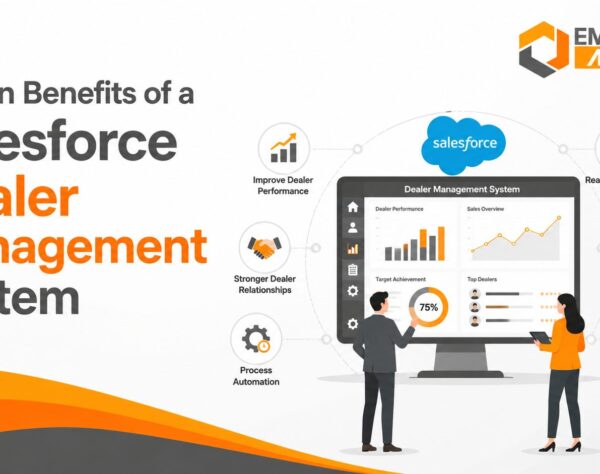
Executives gain a single source of truth for dealer sales, inventory, service operations, customer interactions, and regional performance. Real-time dashboards eliminate the need to consolidate information from multiple systems, enabling faster and more confident decision-making.
Higher Dealer Productivity
Automation reduces repetitive administrative work, allowing dealer teams to focus on customer engagement and revenue generation. Standardized workflows also improve consistency across the network, leading to smoother day-to-day operations.
Improved Customer Experience
Connected dealer operations ensure that customers receive consistent service, accurate product information, and faster response times regardless of location. This strengthens customer trust and reinforces brand reputation.
Lower Business Risk
Centralized governance improves compliance with pricing policies, approval processes, warranty management, and operational standards. Leadership gains greater confidence that dealer activities align with corporate objectives while reducing the likelihood of costly operational errors.
Scalable Growth
Perhaps the greatest advantage of Salesforce DMS is its ability to support expansion without creating additional complexity. As the dealer network grows, the platform continues to provide the visibility, automation, and governance required to maintain operational excellence.
Transform Dealer Operations Into a Competitive Advantage
Disconnected dealer operations often conceal inefficiencies that limit growth, reduce visibility, and increase operational costs. Addressing these challenges requires more than incremental process improvements—it requires a connected platform that brings every dealer, customer, and business process together.
With Salesforce DMS, organizations can build a more agile, data-driven dealer ecosystem that supports faster decisions, stronger collaboration, and sustainable business growth.
Frequently Asked Questions
1. What business challenges does Salesforce DMS solve for growing dealer networks?
Salesforce DMS addresses fragmented dealer operations by centralizing sales, inventory, service, customer interactions, and reporting. It provides real-time visibility that helps organizations improve operational control and make faster business decisions.
2. When should an organization consider Salesforce DMS implementation?
Organizations should consider implementation when dealer operations become difficult to manage through spreadsheets, disconnected systems, or manual reporting. Signs include delayed reporting, inconsistent dealer performance, and limited visibility across regions.
3. Can Salesforce DMS integrate with existing ERP and CRM systems?
Yes. Salesforce DMS is designed to integrate with ERP, finance, inventory, customer service, and business intelligence platforms. Integration enables seamless data flow, reduces duplication, and improves reporting accuracy.
4. How flexible is Salesforce DMS customization?
Salesforce DMS offers extensive customization capabilities. Businesses can tailor dealer hierarchies, workflows, approval processes, pricing structures, warranty management, and reporting to match their operational requirements.
5. What should be included in a Salesforce DMS cost analysis?
A comprehensive cost analysis should include software licensing, implementation, integration, user training, ongoing support, and expected operational improvements such as reduced manual effort, better inventory utilization, and higher dealer productivity.
6. How does Salesforce automation benefit dealers?
Automation streamlines routine activities such as lead assignment, order approvals, inventory notifications, warranty requests, and service scheduling. This improves efficiency while reducing manual errors and administrative overhead.
7. Is Salesforce DMS suitable only for automotive businesses?
No. While it is widely used in the automotive sector, Salesforce DMS also supports manufacturers, industrial equipment companies, consumer goods organizations, electronics businesses, and any enterprise operating through dealer or distributor networks.
8. How does Salesforce DMS improve executive decision-making?
Executives gain access to real-time dashboards, standardized reporting, and centralized operational data. This enables faster decisions based on accurate information rather than delayed or fragmented reports.
9. How does Salesforce DMS support future business growth?
The platform is built to scale with expanding dealer networks, new markets, and evolving business models. Its flexible architecture supports additional users, locations, products, and workflows without requiring a complete system replacement.
10. What factors should organizations evaluate when selecting the best Dealer Management System for automotive or manufacturing?
Organizations should prioritize scalability, integration capabilities, workflow flexibility, automation, analytics, security, and long-term vendor support. The right solution should strengthen operational visibility while adapting to future business requirements rather than simply meeting current needs.
Get started with Emerging Alliance—fill out the form, and our experts will contact you shortly.