
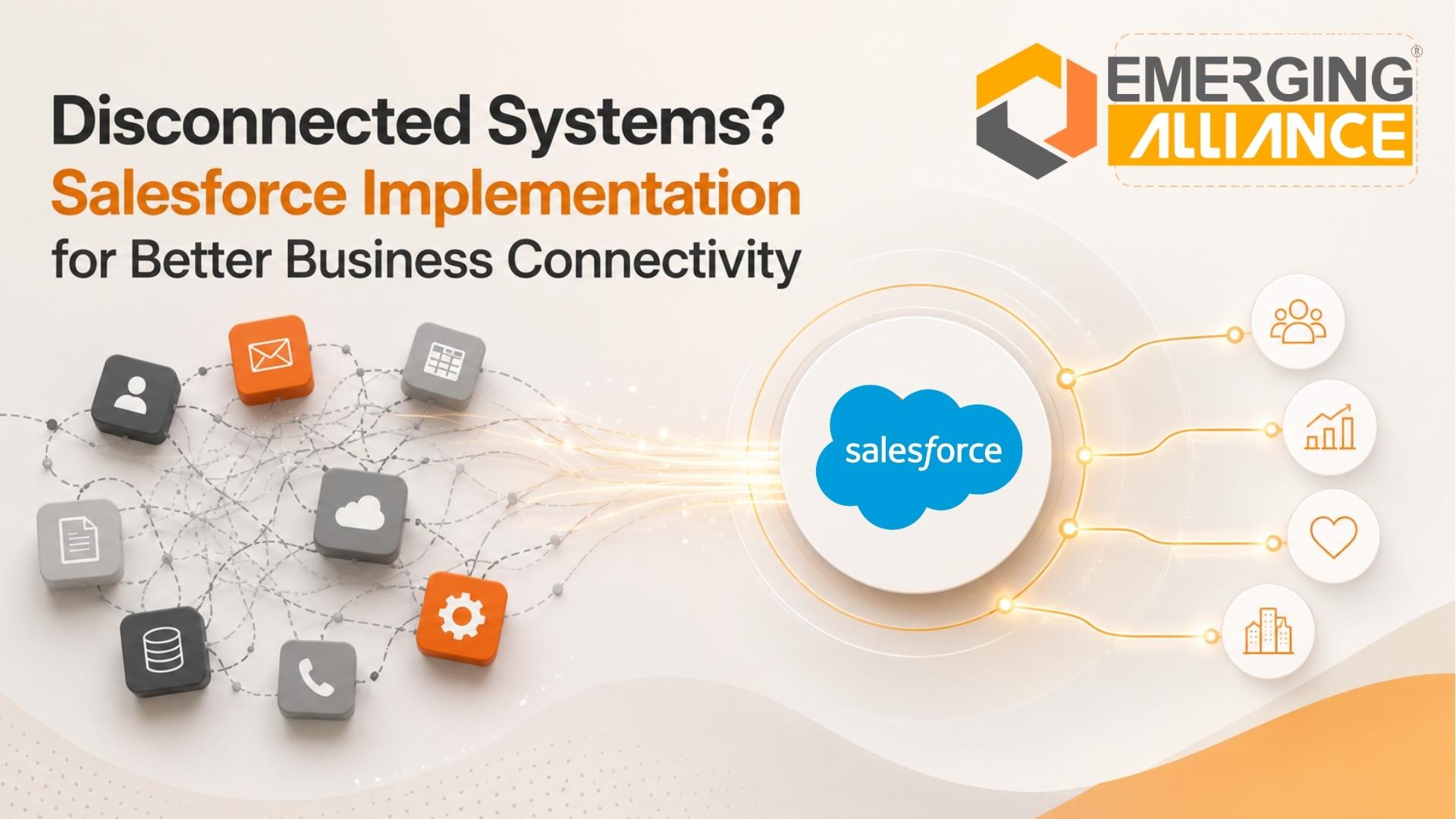
Disconnected Systems? Salesforce Implementation for Better Business Connectivity
Salesforce Implementation for Connected Enterprise Systems
Business growth often creates a technology landscape where CRM, ERP, finance, customer support, and marketing systems evolve independently. While each application may perform well individually, disconnected systems create operational blind spots that slow decisions, increase manual work, and reduce customer satisfaction. A well-planned Salesforce implementation is more than deploying a CRM platform. It creates a connected business environment where information flows seamlessly across departments, enabling leaders to make faster decisions with greater confidence.
Why Do Disconnected Enterprise Systems Become a Business Risk?
Disconnected enterprise systems create fragmented data, duplicate processes, and inconsistent customer information. As organizations scale, these issues become operational risks rather than simple IT inconveniences.
Many organizations experience similar challenges:
- Sales teams work with outdated customer information.
- Finance manually reconciles transactions between systems.
- Customer service lacks complete account visibility.
- Operations depend on spreadsheets instead of real-time dashboards.
- Leadership receives conflicting reports from multiple departments.
The result is slower execution, reduced productivity, and delayed strategic decisions.
Modern enterprises require a connected digital ecosystem where every department works from a single, trusted source of information.
Why Salesforce Implementation Is About Business Integration, Not Just CRM
A successful Salesforce implementation connects people, processes, and enterprise applications into one operational framework. The objective extends beyond improving sales performance—it creates organizational alignment.
Rather than operating as isolated platforms, systems such as ERP, accounting, procurement, inventory, customer service, and marketing exchange information automatically.
This enables:
- Real-time customer visibility
- Faster quote-to-cash processes
- Consistent business reporting
- Reduced manual data entry
- Better cross-functional collaboration
This is where Enterprise Salesforce implementation delivers measurable business value. Instead of creating another application to manage, it becomes the operational hub connecting enterprise workflows.
Salesforce Implementation Challenges That Delay Business Value
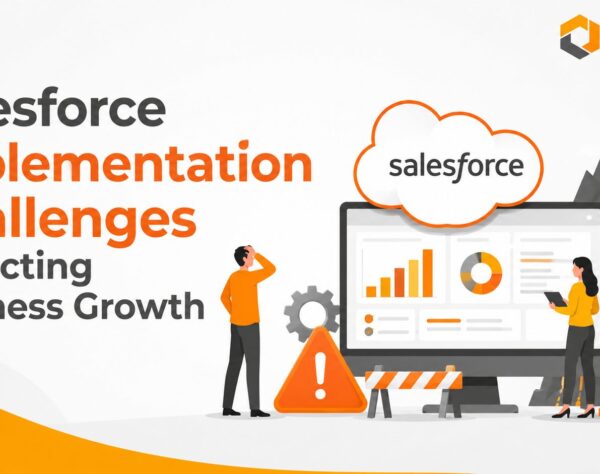
Many implementation projects struggle because technology receives more attention than business processes. Organizations often underestimate integration complexity, governance, and user adoption.
Salesforce implementation challenges include:
Legacy System Complexity
Older ERP and finance applications frequently contain inconsistent data structures, making integration difficult without careful planning.
Poor Data Quality
Migrating duplicate or inaccurate customer information simply transfers existing problems into the new platform.
Unclear Business Requirements
Projects often begin with technical requirements while overlooking operational objectives and executive priorities.
Limited User Adoption
Even well-designed systems fail when employees continue relying on spreadsheets and manual processes.
Weak Integration Architecture
Without robust Salesforce business integration, departments continue operating in silos despite implementing Salesforce.
Before beginning implementation, many organizations benefit from a structured integration assessment that identifies process gaps, system dependencies, and potential operational risks. Addressing these early significantly reduces project delays.
How Salesforce Business Integration Creates Unified Enterprise Operations
Salesforce business integration enables every department to access consistent, real-time information regardless of the systems involved. Instead of moving data manually, information flows automatically between business applications.
Typical enterprise integrations include:
- ERP systems
- Accounting software
- Marketing automation platforms
- Customer support applications
- E-commerce platforms
- Document management systems
- Inventory and warehouse management
When properly implemented, Salesforce integration services eliminate redundant work while improving data accuracy throughout the organization.
Executives gain a comprehensive operational view instead of relying on disconnected departmental reports.
Choosing Salesforce Implementation Solutions That Scale With Your Business
Not every implementation approach delivers long-term business value. The best Salesforce implementation solutions are designed around business strategy rather than software features.
A scalable implementation typically includes:
Business Process Assessment
Current workflows are analyzed before technology decisions are made.
Integration Planning
Every enterprise application is evaluated to ensure seamless communication after deployment.
Data Governance
Customer information, ownership, security, and compliance standards are established before migration.
Automation Strategy
Routine tasks are automated to improve operational efficiency without increasing complexity.
Adoption Planning
Training, governance, and continuous optimization ensure sustained business value.
Rather than focusing solely on implementation timelines, executive teams should evaluate how effectively the solution supports future growth.
Why the Right Salesforce Implementation Partner Matters
Technology alone does not guarantee transformation. An experienced Salesforce implementation partner understands both enterprise operations and system architecture.
Beyond technical deployment, the right partner helps organizations:
- Align CRM with business strategy
- Prioritize high-impact integrations
- Reduce implementation risk
- Improve user adoption
- Build scalable governance models
- Support continuous optimization
Strong Salesforce consulting services combine technical expertise with operational insight, ensuring technology investments generate measurable business outcomes.
If your organization operates multiple business systems today, a consultation focused on integration readiness often identifies opportunities to accelerate implementation while avoiding unnecessary complexity.
Measuring ROI From Enterprise Salesforce Implementation
The success of an Enterprise Salesforce implementation should be measured through business outcomes rather than deployment milestones.
Executive teams typically evaluate improvements across several performance areas:
| Business Objective | Expected Outcome |
| Operational Efficiency | Reduced manual processing and duplication |
| Customer Experience | Faster response times and better visibility |
| Executive Reporting | Single source of real-time business intelligence |
| Revenue Growth | Improved pipeline management and forecasting |
| Risk Reduction | Greater data consistency and compliance |
| Scalability | Easier expansion into new markets and business units |
Organizations that integrate CRM with enterprise systems create a stronger operational foundation for long-term growth rather than solving isolated departmental issues.
Conclusion
Disconnected systems rarely fail all at once—they gradually reduce efficiency, increase operational costs, and limit business visibility. Over time, these hidden inefficiencies affect customer experience, decision-making, and organizational agility.
A strategic Salesforce implementation creates far more than a CRM platform. It establishes a connected enterprise where data, processes, and people operate as one unified ecosystem, enabling leaders to scale with confidence.
Frequently Asked Questions
1. How can we determine whether our organization is ready for Salesforce implementation?
Begin by assessing business processes, existing applications, data quality, and integration requirements. Organizations that define operational objectives before selecting technical solutions typically achieve faster adoption and stronger ROI.
2. What enterprise systems are most commonly integrated with Salesforce?
Salesforce is commonly integrated with ERP, finance, HR, marketing automation, customer support, inventory, procurement, and e-commerce platforms. The specific integration strategy depends on business priorities and operational workflows.
3. Why do Salesforce implementation projects exceed timelines?
Timeline overruns often result from unclear business requirements, poor data quality, underestimated integration complexity, and changing project scope. Early planning significantly reduces these risks.
4. Should integration be completed before or after Salesforce deployment?
Integration planning should begin during project discovery. While deployment phases may vary, designing integrations early prevents costly architectural changes later.
5. How important is data cleansing before migration?
It is essential. Migrating inaccurate or duplicate information reduces user confidence and negatively impacts reporting, automation, and customer experience from day one.
6. What should executives expect from Salesforce consulting services?
Consulting services should provide business process evaluation, solution architecture, integration planning, governance recommendations, adoption strategies, and measurable success metrics—not simply technical configuration.
7. How does Salesforce business integration improve executive reporting?
Integrated systems eliminate conflicting departmental reports by creating consistent, real-time business data. Executives gain faster access to reliable operational and financial insights.
8. How can organizations reduce user resistance after implementation?
Successful adoption combines intuitive system design, structured training, executive sponsorship, and ongoing process optimization. Employees adopt systems more readily when they simplify daily work.
9. What qualities define a reliable Salesforce implementation partner?
Look for proven enterprise integration experience, industry knowledge, structured implementation methodology, governance expertise, and long-term optimization capabilities rather than technical certifications alone.
10. How should ROI from Salesforce implementation be measured?
Measure improvements in operational efficiency, reporting accuracy, customer response time, process automation, sales productivity, data quality, and executive visibility rather than focusing only on deployment completion.
If disconnected systems are slowing your business, it’s time to act.
Complete the form below to request a Salesforce implementation demo and explore how a unified system can improve your operations.