
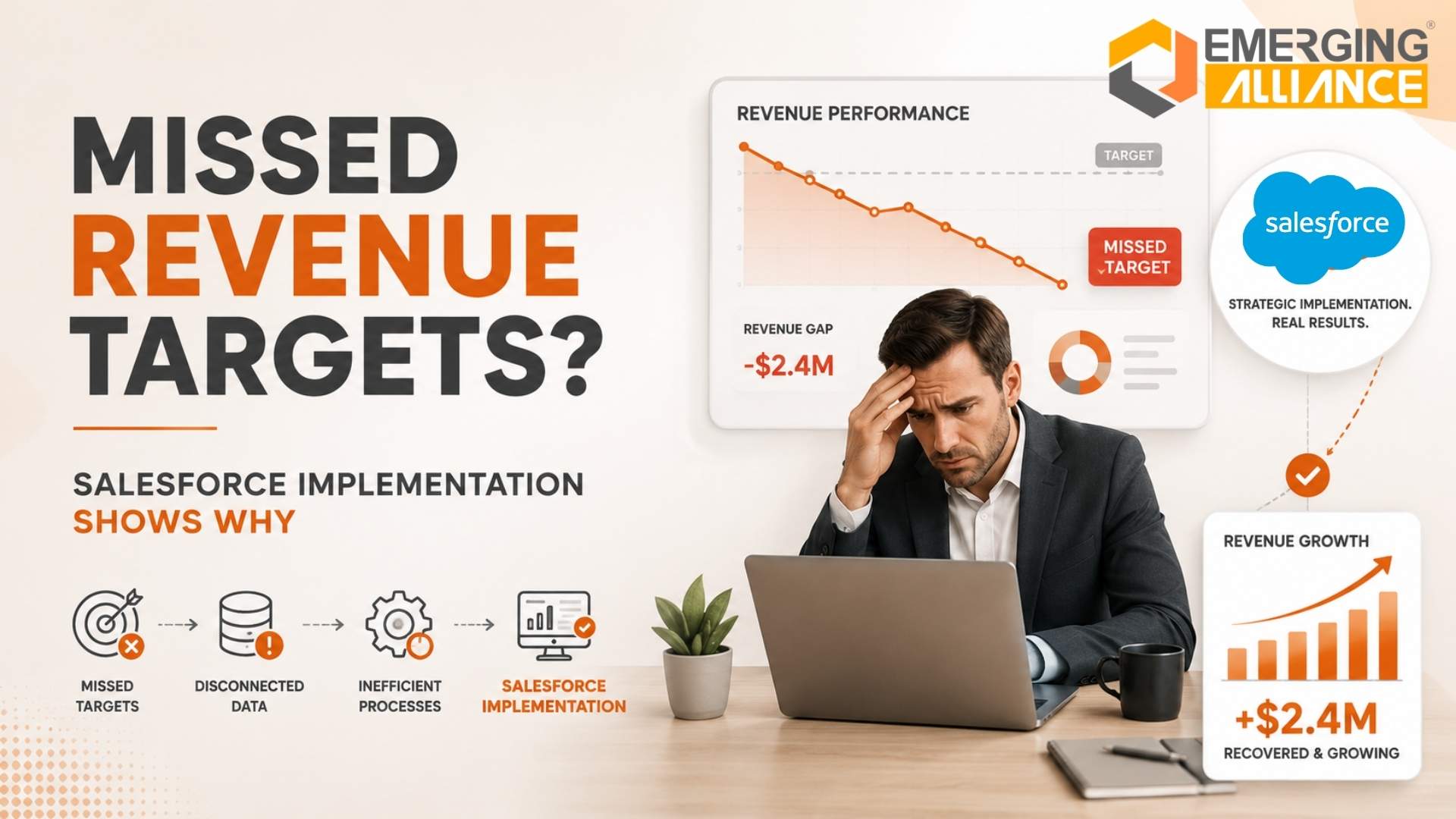
Missed Revenue Targets? Salesforce Implementation Shows Why
Salesforce Implementation Uncovers Bottlenecks and Accelerates Revenue Performance
Many organizations miss revenue targets despite investing heavily in sales teams, marketing programs, and customer acquisition initiatives. The problem is often not market demand. It is the lack of operational visibility, disconnected processes, poor data quality, and inefficient customer engagement workflows. Salesforce Implementation helps enterprises identify and eliminate these hidden barriers to growth. When properly aligned with business objectives, Salesforce becomes more than a CRM platform. It becomes a revenue operating system that connects sales, marketing, service, finance, and leadership teams around a single source of truth.
The real question is not whether Salesforce can improve performance. The question is whether the current business model can continue scaling without the visibility, automation, and intelligence Salesforce provides.
Revenue Leakage Often Starts Long Before Sales Performance Declines
Most organizations focus on revenue results after problems become visible. By then, pipeline quality has deteriorated, conversion rates have dropped, and forecasting accuracy has suffered.
A strategic Salesforce CRM implementation helps uncover operational inefficiencies that silently impact revenue performance.
Common indicators include:
- Inconsistent lead qualification processes
- Sales teams managing opportunities in spreadsheets
- Poor visibility into pipeline health
- Delayed follow-ups and customer engagement
- Disconnected sales and marketing teams
- Manual reporting consuming management time
- Inaccurate forecasting and revenue projections
These issues rarely appear as technology problems. They appear as missed revenue targets, slower growth, and declining customer experience.
A well-executed Salesforce implementation process creates transparency across the entire customer lifecycle, helping leadership identify where revenue is being lost and how to recover it.
Salesforce CRM Implementation Creates Enterprise-Wide Visibility
Revenue growth becomes difficult when different departments operate using different data sources.
Sales believes deals are progressing.
Marketing believes campaigns are performing.
Operations believes orders are on track.
Finance sees a different reality.
This lack of alignment creates decision-making delays and inaccurate business forecasts.
Through a structured Salesforce CRM implementation, organizations gain:
Unified Customer Intelligence
Every customer interaction, opportunity, service request, and campaign activity is captured within centralized Salesforce CRM systems.
Real-Time Executive Dashboards
Leadership teams gain instant visibility into:
- Pipeline performance
- Sales velocity
- Forecast accuracy
- Customer retention trends
- Revenue opportunities
- Service performance metrics
Improved Cross-Functional Collaboration
Sales, marketing, customer service, and finance teams work from the same customer data, reducing communication gaps and operational friction.
When visibility improves, decision-making becomes faster, more accurate, and more scalable.
Salesforce Clouds Drive Automation Across Critical Business Functions
Many enterprises continue relying on manual processes that create delays, errors, and compliance risks.
A modern Enterprise Salesforce Implementation enables workflow automation across multiple departments.
Sales Automation
Sales teams spend less time updating records and more time engaging customers.
Key benefits include:
- Automated lead assignment
- Opportunity progression workflows
- Activity tracking
- Approval automation
- Pipeline management
Marketing Automation with Salesforce Marketing Cloud
Marketing teams gain greater control over customer engagement.
Capabilities include:
- Campaign automation
- Lead nurturing programs
- Customer segmentation
- Journey orchestration
- Campaign performance tracking
Customer Service Optimization with Salesforce Service Cloud
Customer retention often depends on service responsiveness.
Salesforce Service Cloud enables:
- Faster case resolution
- Service-level monitoring
- Knowledge management
- Omnichannel customer support
- Customer satisfaction tracking
Organizations that automate critical workflows reduce operational overhead while improving customer experience.
Why Salesforce Projects Fail Without the Right Implementation Partner
Many Salesforce deployments fail to deliver expected outcomes because organizations focus on software deployment instead of business transformation.
Technology alone cannot solve process inefficiencies.
The most successful projects are led by experienced Salesforce implementation partners who understand both technology and operational strategy.
A strong Salesforce consulting partner helps organizations:
- Define measurable business objectives
- Align CRM architecture with growth plans
- Improve process standardization
- Design scalable automation frameworks
- Establish governance and compliance controls
- Integrate critical business systems
For example:
A manufacturing company may require integration between Salesforce CRM, ERP systems, inventory platforms, and customer service operations.
A healthcare organization may require compliance-focused workflows and secure customer engagement processes.
A distribution company may require territory management and channel partner visibility.
Each implementation requires a business-first strategy rather than a technology-first approach.
This is where certified Salesforce consultants deliver long-term value.
Salesforce Support Services Protect Long-Term ROI
Implementation is only the beginning.
As organizations grow, business processes evolve. New products, markets, acquisitions, and customer expectations introduce new operational requirements.
Without ongoing optimization, CRM performance can decline over time.
Comprehensive Salesforce Support Services and Salesforce managed services help enterprises continuously improve platform performance.
Key areas include:
Salesforce Application Support
Ensures platform stability and user adoption.
Salesforce Admin Support
Maintains workflows, reports, permissions, and system configurations.
Salesforce Development Services
Supports custom enhancements, integrations, and automation initiatives.
Salesforce Issue Detection and Resolution
Proactively identifies performance bottlenecks before they impact users.
Salesforce Technical Support Service
Provides expertise for platform optimization and troubleshooting.
Organizations that invest in ongoing Salesforce support services typically achieve greater long-term business value than those treating implementation as a one-time project.
Emerging Alliance: Your Strategic Salesforce Transformation Partner
At Emerging Alliance, we believe Salesforce success is not measured by deployment completion.
It is measured by business outcomes.
Our approach combines business process consulting, enterprise architecture expertise, automation strategy, and CRM transformation services to help organizations maximize the value of their Salesforce investment.
As a trusted Salesforce implementation partner, we help enterprises:
- Improve revenue visibility
- Eliminate operational bottlenecks
- Automate critical workflows
- Strengthen customer engagement
- Enhance forecasting accuracy
- Improve scalability and governance
- Accelerate digital transformation initiatives
Whether you are planning a new Salesforce CRM implementation or optimizing an existing environment, our team helps align technology investments with measurable business goals.
Ready to Turn Salesforce Into a Revenue Growth Engine?
If your organization is struggling with visibility gaps, inconsistent forecasting, workflow inefficiencies, or missed revenue targets, the issue may not be your sales team.
The issue may be the systems and processes supporting them.
Emerging Alliance helps enterprises design, implement, optimize, and scale Salesforce environments that drive measurable business outcomes.
Frequently Asked Questions
1. How long does an enterprise Salesforce implementation typically take?
Implementation timelines depend on process complexity, integrations, customization requirements, and organizational readiness. Most enterprise projects are completed in phases to reduce risk and improve adoption.
2. What factors influence Salesforce implementation pricing?
Salesforce implementation pricing depends on user volume, cloud products, integrations, customization requirements, data migration complexity, and governance needs.
3. Can Salesforce CRM implementation integrate with ERP systems?
Yes. Salesforce can integrate with ERP platforms, finance systems, inventory management solutions, HR applications, and industry-specific business systems.
4. How does Salesforce improve revenue forecasting accuracy?
Salesforce centralizes opportunity management, pipeline tracking, and reporting, allowing leadership teams to make decisions based on real-time business data.
5. What industries benefit most from Salesforce deployment services?
Manufacturing, healthcare, pharmaceuticals, distribution, professional services, financial services, technology, and retail organizations commonly benefit from Salesforce implementations.
6. What is the role of a Salesforce implementation consultant?
A Salesforce implementation consultant helps align CRM capabilities with business goals, process design, user adoption, integration strategy, and long-term scalability.
7. How do Salesforce managed services improve ROI?
Managed services provide continuous optimization, support, governance, and automation improvements that help organizations maximize platform value over time.
8. Can Salesforce Marketing Cloud support complex customer journeys?
Yes. Salesforce Marketing Cloud enables advanced segmentation, automated engagement, personalized communication, and multi-channel customer journey management.
9. What are the biggest challenges during Salesforce CRM migration projects?
Common challenges include poor data quality, user adoption issues, process misalignment, integration complexity, and insufficient governance planning.
10. How does Salesforce help organizations improve compliance and governance?
Salesforce provides role-based access controls, audit trails, workflow governance, reporting visibility, and standardized business processes that support compliance initiatives.
Schedule a Salesforce strategy consultation today to identify operational bottlenecks, improve automation, and unlock greater revenue performance.