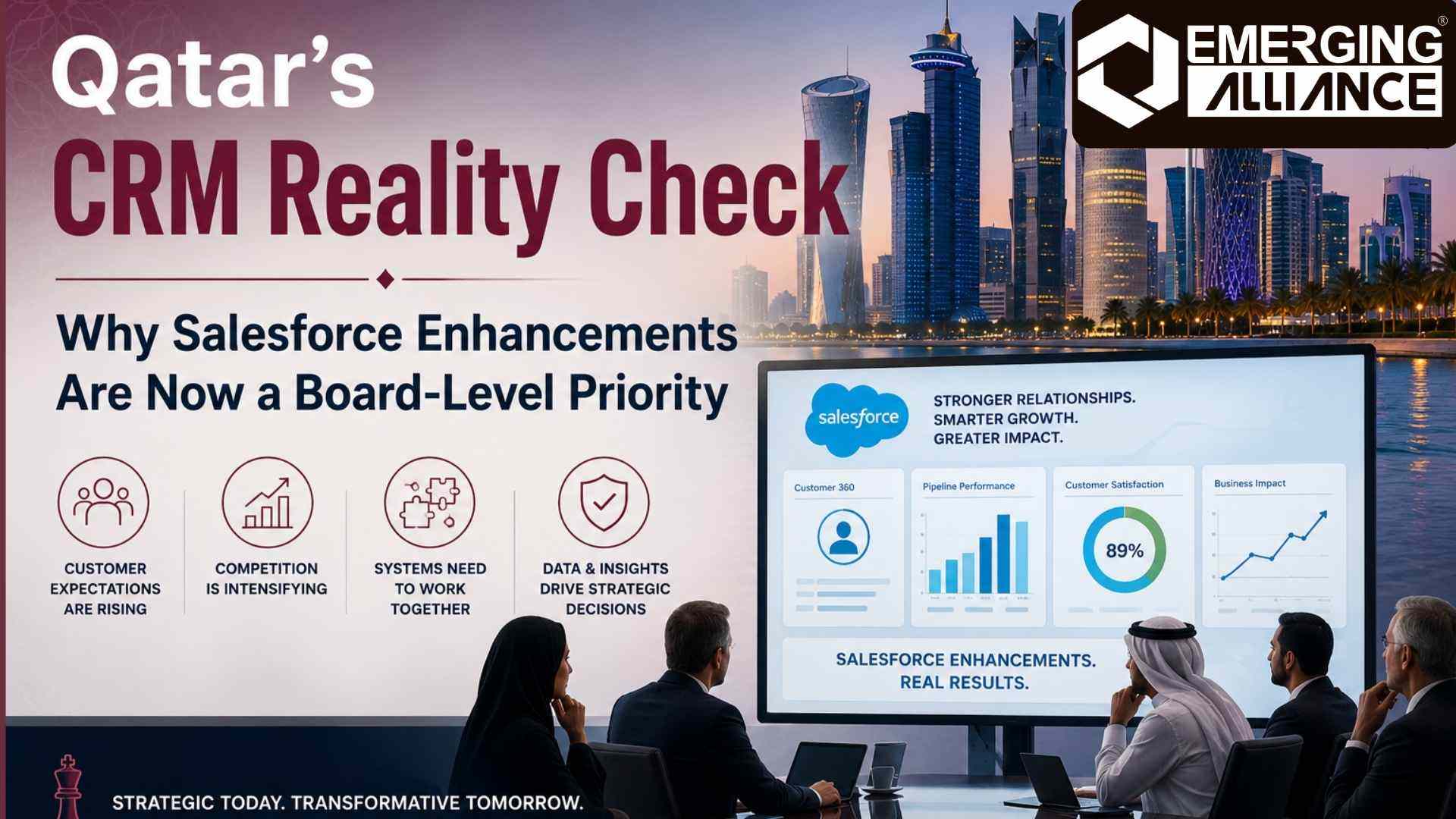
Qatar’s CRM Reality Check Why Salesforce Enhancements Are Now a Board-Level Priority
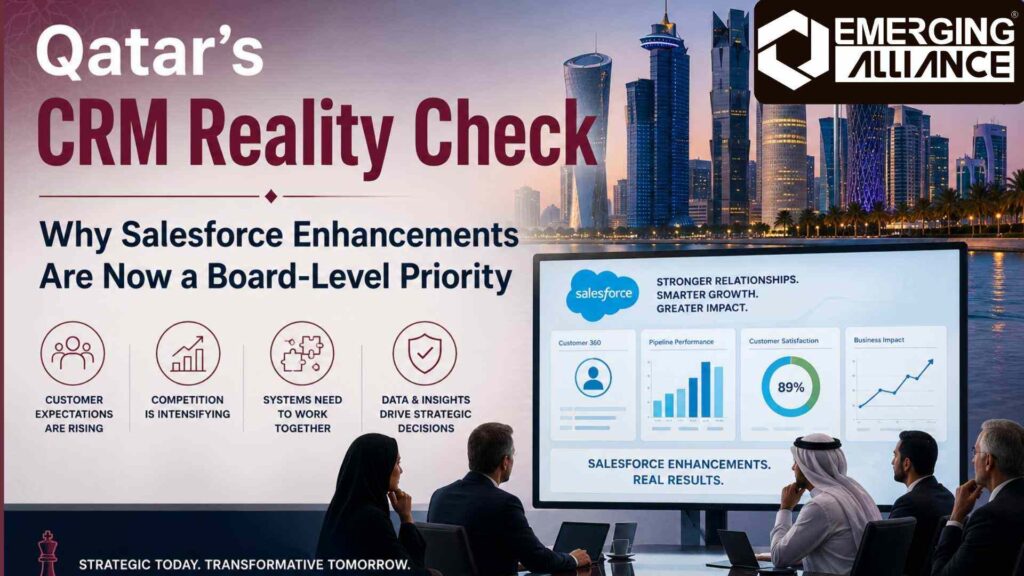
Qatar businesses are prioritizing Salesforce Enhancements to improve growth, visibility, and efficiency
Salesforce Enhancements Qatar is becoming a strategic priority for enterprises facing operational inefficiencies, disconnected reporting, workflow bottlenecks, and limited customer visibility. As businesses in Qatar scale across regions and departments, traditional CRM environments often struggle to support automation, governance, and enterprise-wide coordination.
Many organizations now realize that having Salesforce alone is not enough. The real challenge is whether the CRM ecosystem can support long-term growth, faster decision-making, and operational scalability.
At Emerging Alliance, we help enterprises modernize Salesforce into an intelligent business platform that improves visibility, automation, customer engagement, and enterprise performance.
Current Industry Challenge: CRM Complexity Is Increasing Faster Than Operational Visibility
As enterprises expand, customer engagement models become significantly more complex.
Sales teams operate across multiple regions. Service teams manage growing ticket volumes. Finance teams require real-time commercial visibility. Leadership expects predictive reporting. Marketing teams demand personalization. Operations teams require workflow consistency.
Unfortunately, many CRM ecosystems evolve without architectural alignment.
This creates challenges such as:
- Duplicate customer records across departments
- Delayed approvals impacting sales cycles
- Manual reporting dependencies
- Inconsistent workflow execution
- Poor integration between ERP, finance, and CRM systems
- Limited visibility into pipeline quality
- Disconnected customer communication channels
- Scalability constraints during expansion
For many enterprises in Qatar, CRM inefficiencies are no longer small operational inconveniences. They directly impact forecasting accuracy, customer retention, deal velocity, and revenue predictability.
This is where strategic Salesforce Enhancements in Qatar become essential.
Hidden Operational Risks Inside Enterprise CRM Environments
The most dangerous CRM problems are rarely visible immediately.
Many organizations continue operating with systems that appear functional on the surface while silently creating operational instability underneath.
Workflow Bottlenecks That Slow Revenue Execution
In large enterprises, approvals often pass through multiple departments including finance, operations, procurement, compliance, and sales leadership.
Without intelligent workflow automation, enterprises experience:
- Delayed quotations
- Missed follow-ups
- Slow deal approvals
- Escalation dependency
- Customer dissatisfaction
- Reduced sales productivity
A CRM platform without optimized workflow architecture creates friction instead of acceleration.
Data Fragmentation Creates Strategic Blind Spots
Leadership teams depend on CRM dashboards for forecasting, customer intelligence, and growth planning.
However, disconnected systems create reporting inaccuracies.
For example:
A sales leader may see strong pipeline growth while finance teams struggle with delayed collections. Operations teams may experience delivery delays that never appear inside CRM reports. Customer service escalations may remain disconnected from sales account visibility.
Without integrated enterprise intelligence, executive decisions become reactive instead of predictive.
Compliance and Governance Risks Continue Growing
As businesses scale, governance expectations increase.
Enterprises in regulated sectors must maintain:
- Controlled approval workflows
- Customer interaction traceability
- Role-based access management
- Audit-ready reporting
- Secure data movement across systems
Traditional CRM deployments often lack the governance maturity required for enterprise-scale operations.
This creates long-term risk exposure across customer management, finance coordination, and operational accountability.
Why Traditional Systems Fail Modern Enterprise Growth
Many organizations initially implemented CRM systems for departmental requirements rather than enterprise transformation.
As a result, businesses now operate with fragmented CRM architectures that struggle to support growth.
Standard CRM Deployments Cannot Handle Enterprise Complexity
Out-of-the-box implementations often fail to address:
- Multi-entity operations
- Industry-specific workflows
- Enterprise approval structures
- Omnichannel customer journeys
- ERP synchronization requirements
- Complex pricing models
- Multi-location sales coordination
This is why many enterprises eventually require customized Salesforce workflows and enterprise-grade CRM optimization strategies.
Legacy Processes Continue Operating Outside the CRM
One of the biggest enterprise inefficiencies occurs when teams continue relying on spreadsheets, emails, WhatsApp approvals, and disconnected tools outside the CRM environment.
This creates:
- Version control issues
- Manual dependency
- Reporting inconsistencies
- Slow decision-making
- Limited accountability
- Poor customer lifecycle visibility
Without centralized workflow governance, scalability becomes difficult.
How Salesforce Enhancement Qatar Solves the Problem
A strategic Salesforce Enhancement Qatar initiative focuses on transforming CRM from a sales tracking platform into an enterprise-wide operational intelligence layer.
This involves far more than interface changes or workflow edits.
It requires alignment between business strategy, automation architecture, operational governance, and enterprise scalability.
Enterprise Workflow Automation
Modern Salesforce workflow automation enables enterprises to streamline:
- Sales approvals
- Lead assignment
- Customer onboarding
- Contract management
- Escalation workflows
- Service request routing
- Quote approvals
- Customer communication workflows
This significantly reduces manual dependency while improving execution speed.
Integrated Enterprise Visibility
Advanced Salesforce integration services allow organizations to connect CRM with:
- ERP platforms
- Finance systems
- Inventory systems
- Marketing automation tools
- Customer support platforms
- Procurement applications
- Analytics environments
Integrated systems improve forecasting accuracy, operational visibility, and enterprise-wide coordination.
AI-Powered CRM Optimization
Modern enterprises are increasingly leveraging AI-powered CRM solutions to improve customer engagement and operational intelligence.
Enhanced Salesforce environments can support:
- Predictive opportunity scoring
- Intelligent lead prioritization
- Automated service recommendations
- Customer behavior analysis
- Workflow optimization insights
- Sales performance intelligence
AI is no longer a future enhancement. It is becoming central to enterprise CRM strategy.
Scalable CRM Architecture for Enterprise Expansion
Organizations expanding across Qatar and international markets require CRM environments capable of supporting operational scale without creating complexity.
Strategic Salesforce deployment and optimization ensures:
- Multi-business scalability
- Role-based governance
- Standardized workflows
- Controlled integrations
- High-performance reporting
- Enterprise security alignment
This allows CRM systems to support growth rather than slow it down.
Key Business Benefits of Salesforce Enhancements in Qatar
Improved Operational Efficiency
Automated workflows reduce delays, manual intervention, and repetitive administrative tasks across departments.
Better Executive Visibility
Integrated dashboards improve decision-making through real-time operational intelligence and customer lifecycle visibility.
Stronger Customer Experience
Unified engagement workflows help enterprises deliver faster, more personalized, and more consistent customer interactions.
Faster Sales Execution
Sales process automation reduces approval bottlenecks and improves deal movement across the pipeline.
Reduced Revenue Leakage
Improved forecasting, workflow accountability, and integrated reporting help enterprises reduce operational inefficiencies that impact profitability.
Enterprise Scalability
Customized Salesforce solutions allow organizations to scale operations without losing governance, consistency, or visibility.
Why Enterprises Choose Emerging Alliance
At Emerging Alliance, we approach Salesforce transformation as a business modernization initiative — not simply a software deployment project.
Our approach combines:
- Salesforce consulting and strategy
- Enterprise workflow automation
- Salesforce cloud migrations
- CRM optimization
- Salesforce support and maintenance
- Enterprise system integration
- Custom Salesforce configuration
- Salesforce deployment and optimization
- Mobile CRM enablement
- End-to-end Salesforce solutions
We work closely with enterprise stakeholders to align CRM architecture with operational goals, governance requirements, scalability plans, and customer engagement strategies.
Our focus is not just implementation.
It is enterprise transformation through intelligent CRM engineering.
Conclusion
The demand for Salesforce Enhancement Qatar initiatives is growing because enterprises now recognize that CRM performance directly influences operational efficiency, customer engagement, and executive decision-making.
Traditional CRM environments are no longer sufficient for organizations navigating rapid growth, complex workflows, and increasing governance expectations.
Modern enterprises require intelligent CRM ecosystems capable of supporting automation, scalability, integration, and real-time visibility across the business.
Organizations that invest in CRM modernization today will be significantly better positioned to achieve sustainable enterprise growth in the years ahead.
FAQs About Salesforce Enhancements in Qatar
1. How do Salesforce Enhancements in Qatar improve customer engagement and retention?
Salesforce Enhancements in Qatar help enterprises create more connected and personalized customer experiences through workflow automation, omnichannel communication, real-time customer insights, and faster service response. This improves customer satisfaction, strengthens retention, and supports long-term business growth.
2. How do Salesforce consulting services in Qatar improve operational efficiency?
Salesforce consulting services help enterprises redesign workflows, automate approvals, improve customer lifecycle management, and integrate systems for faster operational execution and better decision-making.
3. Can Salesforce workflow automation reduce manual business processes?
Yes. Salesforce workflow automation can streamline approvals, lead management, customer onboarding, escalations, reporting, and service coordination while reducing manual dependency.
4. What industries benefit most from Salesforce business solutions in Qatar?
Industries such as construction, manufacturing, healthcare, logistics, distribution, energy, financial services, and professional services commonly benefit from customized Salesforce solutions.
5. How does Salesforce integration services improve enterprise visibility?
Salesforce integration services connect CRM with ERP, finance, inventory, marketing, and analytics platforms to create unified reporting and real-time operational intelligence.
6. What are the common challenges during Salesforce cloud migrations?
Typical challenges include data inconsistency, workflow disruption, legacy system compatibility, user adoption concerns, and integration complexity. Strategic migration planning helps minimize these risks.
7. How does Salesforce CRM support enterprise sales automation?
Salesforce CRM supports automated lead routing, quote approvals, sales forecasting, opportunity management, customer tracking, and pipeline visibility for improved sales execution.
8. Why do enterprises require customized Salesforce workflows?
Standard CRM setups often cannot support industry-specific processes, complex approval structures, or enterprise operational requirements. Customized workflows improve scalability and efficiency.
9. What is the ROI of Salesforce deployment and optimization?
ROI typically comes from improved operational efficiency, faster sales cycles, reduced manual processes, better customer retention, improved reporting accuracy, and stronger executive visibility.
10. How do Salesforce support and maintenance services help long-term scalability?
Ongoing Salesforce support ensures system stability, performance optimization, governance control, security management, workflow improvements, and adaptation to changing business requirements.
Your CRM should accelerate growth — not create operational blind spots.
Connect with Emerging Alliance to streamline workflows, improve visibility, and build a scalable Salesforce enhancement strategy for enterprise growth.