
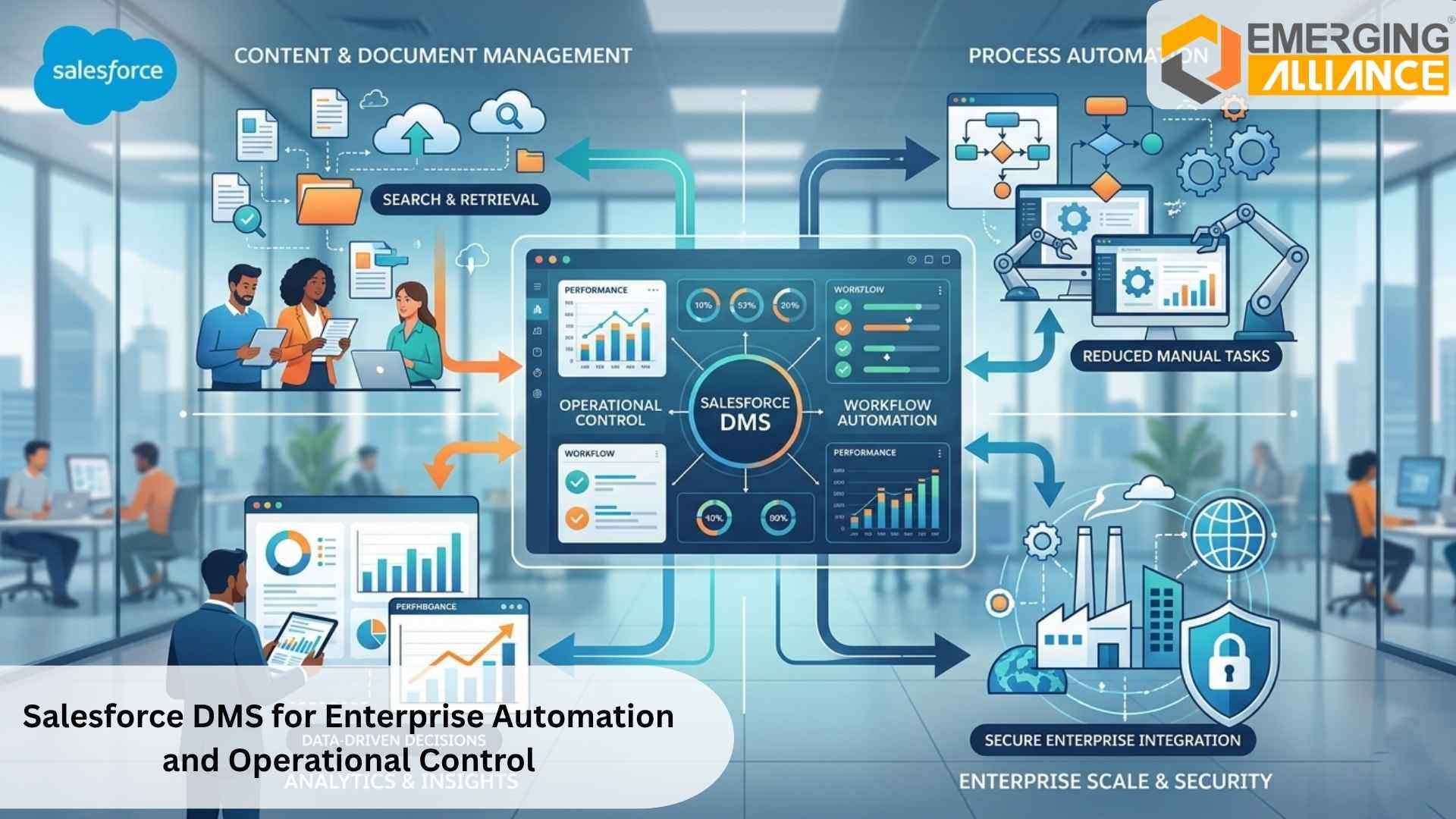
Salesforce DMS for Enterprise Automation and Operational Control
Operational Leakage Is Costing Growth — Salesforce DMS Fixes It Fast
Salesforce DMS for Enterprise profitability is not lost through poor sales alone, but through operational leakage — disconnected systems, fragmented inventory visibility, manual workflows, delayed approvals, and inconsistent reporting across dealer networks.
As dealer ecosystems grow, operational control becomes harder to maintain. That is why automotive enterprises are adopting Salesforce DMS platforms to centralize operations, automate workflows, improve visibility, reduce costs, and build scalable governance across dealerships.
The Hidden Cost of Fragmented Dealer Operations
Most operational inefficiencies remain invisible because they are distributed across departments.
Enterprises often underestimate how much revenue leakage occurs through:
- Manual dealer coordination
- Delayed inventory updates
- Approval bottlenecks
- Duplicate reporting activities
- Inconsistent pricing controls
- Disconnected CRM systems
- Non-standardized dealer workflows
- Delayed financial reconciliation
- Poor inventory forecasting
Individually, these inefficiencies appear manageable.
At enterprise scale, they become major operational liabilities.
For multi-location automotive businesses, fragmented operations directly impact:
- Profit margins
- Working capital efficiency
- Inventory turnover
- Customer retention
- Executive decision-making
- Expansion scalability
- Governance consistency
This is where Salesforce DMS creates measurable operational transformation.
Salesforce DMS Automation: The Core Driver of Operational Efficiency
Automation is no longer optional for enterprise dealer operations.
Automotive organizations managing multiple dealerships cannot scale efficiently while relying on manual workflows, disconnected approvals, and spreadsheet-driven coordination.
Salesforce DMS automation enables enterprises to create a centralized operational framework across the entire dealer ecosystem.
Key Areas of Salesforce DMS Automation
Dealer Workflow Automation
Salesforce automates critical dealership workflows including:
- Lead allocation
- Vehicle booking approvals
- Dealer onboarding
- Test drive scheduling
- Warranty approvals
- Service escalation management
- Financial approval routing
- Incentive tracking
- Sales pipeline monitoring
This reduces operational delays while improving accountability.
Automated Inventory Visibility
Salesforce DMS provides real-time inventory intelligence across dealer locations.
Enterprises gain automated visibility into:
- Inventory aging
- Fast-moving stock
- Slow-moving vehicles
- Regional demand trends
- Allocation efficiency
- Procurement forecasting
This significantly improves working capital optimization.
CRM and Customer Lifecycle Automation
Disconnected customer journeys reduce retention and service consistency.
Salesforce enables enterprises to automate:
- Customer follow-ups
- Service reminders
- Campaign workflows
- Lead nurturing
- Dealer communication
- Complaint escalation
- Loyalty management
This creates a unified customer engagement ecosystem.
Executive Reporting Automation
Manual reporting delays strategic decisions.
Salesforce DMS enables automated:
- Executive dashboards
- Dealer performance analytics
- Revenue tracking
- KPI monitoring
- Operational reporting
- Forecasting visibility
- Compliance reporting
Leadership teams gain real-time operational intelligence instead of delayed reporting cycles.
Salesforce DMS for Multi-Location Dealer Scalability
Operational complexity increases exponentially as dealer networks expand.
Without centralized governance, enterprises struggle to maintain:
- Process consistency
- Inventory control
- Reporting standards
- Financial visibility
- Dealer accountability
- Customer experience quality
Salesforce DMS provides a scalable cloud architecture that enables enterprises to standardize operations across:
- Regional dealer groups
- Franchise ecosystems
- Distributor networks
- Service centers
- OEM operations
- Multi-brand dealership environments
This creates long-term scalability without operational fragmentation.
Measurable Business Impact of Salesforce DMS
Enterprise leaders increasingly prioritize measurable transformation outcomes.
A properly implemented Salesforce DMS environment can help organizations achieve:
- Reduced operational overhead
- Faster dealer response cycles
- Improved inventory turnover
- Better customer retention
- Lower manual processing effort
- Faster reporting cycles
- Higher workflow accountability
- Improved forecasting accuracy
- Better executive decision-making
The long-term value extends beyond software modernization.
Salesforce DMS helps enterprises build operational agility.
Why Enterprises Choose Emerging Alliance for Salesforce DMS Transformation
Successful Salesforce DMS implementation requires far more than software deployment.
It requires operational redesign.
Emerging Alliance works with enterprises to transform fragmented dealership operations into scalable, automation-driven digital ecosystems.
The focus extends beyond platform implementation.
Emerging Alliance helps organizations:
- Standardize enterprise dealer workflows
- Improve operational governance
- Design scalable automation frameworks
- Enable ERP-integrated ecosystems
- Build executive reporting structures
- Improve cross-functional visibility
- Reduce operational complexity
- Align digital transformation with business outcomes
This positions Salesforce DMS as a strategic operational platform rather than just a dealership application.
Ready to Eliminate Operational Fragmentation Across Your Dealer Network?
Dealer operations become increasingly difficult to control as enterprise ecosystems expand.
Organizations that modernize dealership operations early gain a major advantage in:
- Operational visibility
- Cost optimization
- Workflow efficiency
- Customer experience
- Scalability
- Governance control
If your enterprise is evaluating Salesforce DMS for operational transformation, automation, or dealer standardization, now is the time to assess your operational maturity.
FAQs About Salesforce for DMS
1. How does Salesforce DMS improve dealer network visibility?
Salesforce DMS helps enterprises centralize dealer operations, customer interactions, inventory tracking, and service workflows into a unified platform, enabling real-time visibility across distributed dealership networks.
2. How long does Salesforce DMS implementation typically take?
Salesforce DMS implementation timelines depend on business complexity, integration requirements, customization scope, and the number of dealer locations involved. Enterprise implementations generally require phased deployment strategies.
3. Can Salesforce DMS integrate with ERP systems?
Yes. Salesforce DMS supports ERP integration for dealers, enabling synchronization between finance systems, procurement platforms, CRM environments, inventory systems, and reporting frameworks.
4. Is Salesforce DMS suitable for multi-location dealership operations?
Yes. Salesforce DMS is designed to support distributed dealer ecosystems with centralized visibility, standardized workflows, role-based access control, and scalable cloud architecture.
5. What are the benefits of Salesforce DMS customization?
Salesforce DMS customization enables enterprises to align workflows, reporting structures, approval hierarchies, and operational processes with unique business requirements.
6. How does dealer workflow automation improve operational efficiency?
Dealer workflow automation reduces manual intervention, improves process consistency, accelerates approvals, minimizes reporting delays, and enhances accountability across departments.
7. Can Salesforce for automotive dealers improve customer retention?
Yes. Salesforce for automotive dealers enables unified customer engagement through centralized CRM data, improving communication consistency, after-sales service coordination, and relationship management.
8. What industries benefit most from cloud-based dealer management software?
Industries with distributed dealer or distributor ecosystems — including automotive, heavy equipment, manufacturing, and mobility businesses — benefit significantly from cloud-based dealer management software.
9. What reporting capabilities are available in Salesforce DMS?
Salesforce DMS supports enterprise dashboards, real-time analytics, operational KPIs, inventory insights, sales performance reporting, and executive-level decision intelligence.
10. What should enterprises evaluate before migrating to Salesforce DMS?
Organizations should assess current operational bottlenecks, integration requirements, scalability goals, workflow inefficiencies, compliance needs, and long-term digital transformation priorities before migration.
Connect with Emerging Alliance Contact Team to explore how Salesforce DMS can help your organization reduce operational leakage, automate dealer workflows, and build a scalable enterprise ecosystem.