
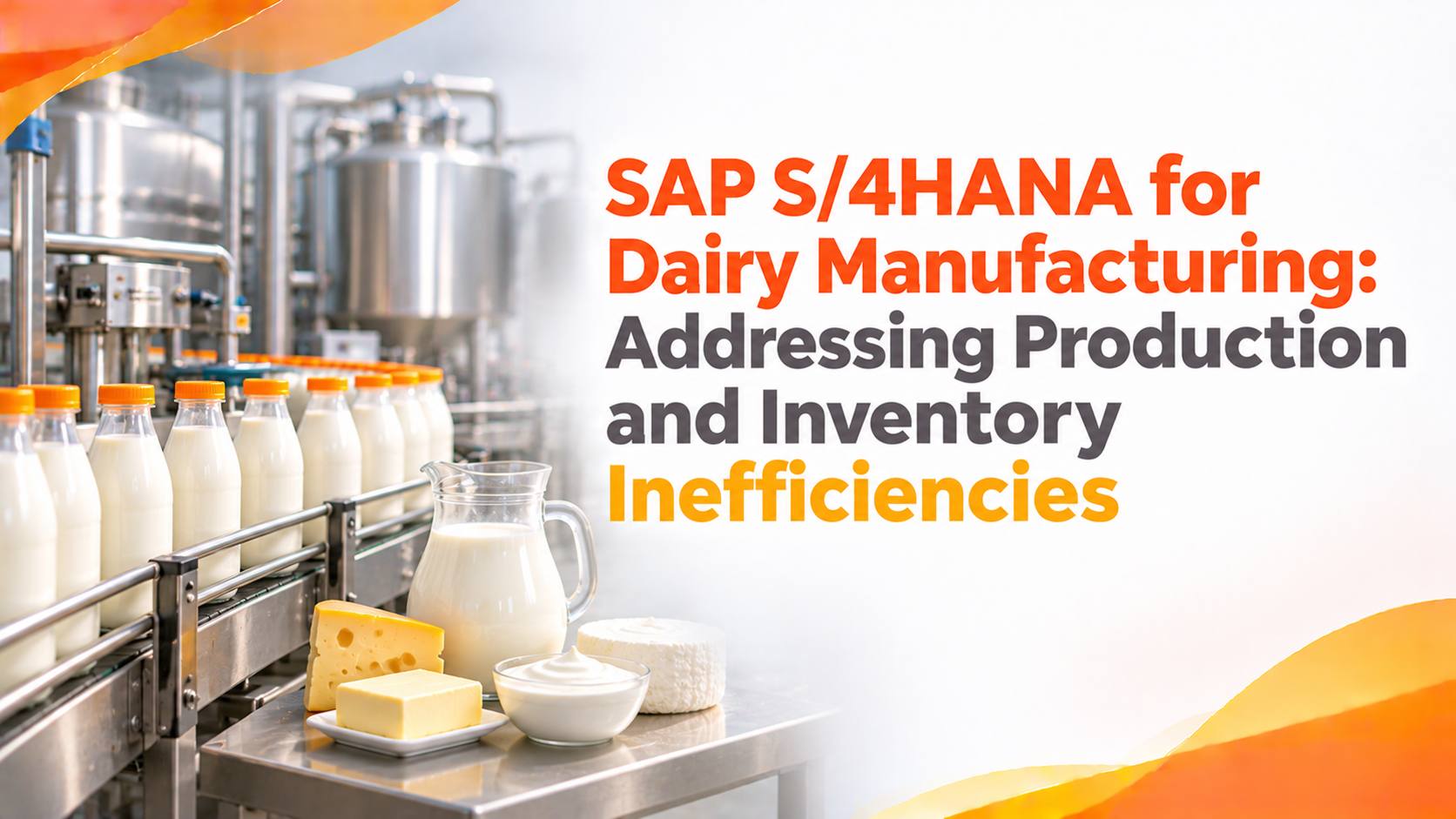
SAP S/4HANA for Dairy Manufacturing: Addressing Production and Inventory Inefficiencies
Quick Answer: How SAP S/4HANA Solves Dairy Production and Inventory Inefficiencies
SAP S/4HANA helps dairy manufacturers connect milk procurement, production planning, inventory management, quality control, batch traceability and financial reporting. By integrating operational data, businesses can improve production visibility, reduce inventory discrepancies, monitor product shelf life, control manufacturing costs and make better decisions across processing, storage and distribution.
Production and Inventory Inefficiencies Affecting Dairy Manufacturing
Dairy manufacturing depends on the coordination of raw milk procurement, processing, packaging, quality testing, storage and distribution. Each stage affects the next. A delay in raw milk procurement can disrupt production schedules, while inaccurate inventory records can affect material availability, product quality and order fulfilment.
These challenges become more difficult to manage as a dairy business expands its product portfolio, processing capacity, supplier network, warehouses and distribution channels.
Many manufacturers still depend on disconnected applications, spreadsheets and manual reporting to coordinate operational activities. Procurement teams may maintain supplier records separately, production teams may use independent planning tools, and warehouse teams may update stock movements without immediate visibility for finance or management.
This fragmentation creates several business risks:
- Inaccurate raw milk and ingredient inventory records.
- Production delays caused by material shortages or planning errors.
- Limited visibility into batch-wise production and consumption.
- Excess inventory and avoidable product expiry.
- Difficulty tracking quality issues across production batches.
- Inconsistent manufacturing cost calculations.
- Delayed operational and financial reporting.
For business leaders, these are not isolated departmental problems. They affect production capacity, working capital, product availability, customer commitments and profitability.
SAP S/4HANA provides an integrated ERP environment for coordinating these processes. Its value depends on how the system is configured, integrated and aligned with the manufacturer’s actual operating model.
Raw Milk Procurement and Inventory Reconciliation Gaps
Raw milk procurement is one of the most important operational activities in dairy manufacturing. Manufacturers often collect milk from multiple farmers, cooperatives, collection centres or suppliers. The quantity received, quality parameters, purchase price and acceptance status must be recorded accurately.
When procurement records are maintained separately from inventory and finance, discrepancies can arise between the quantity purchased, quantity accepted, quantity available for processing and amount payable to suppliers.
For example, a collection centre may record the quantity received while the quality team records fat content, solids-not-fat (SNF) and acceptance results in another application. If these records are not connected, procurement and finance teams may struggle to reconcile supplier payments with accepted quantities and agreed pricing.
SAP S/4HANA can support an integrated procurement and inventory process through purchasing, goods receipt, inventory management and financial accounting capabilities. Depending on the implementation design, businesses can establish controls for:
- Supplier and procurement contract information.
- Purchase orders and goods receipt records.
- Accepted and rejected material quantities.
- Quality inspection and acceptance status.
- Inventory updates following approved receipts.
- Supplier invoice verification and payment processing.
Dairy-specific requirements may also involve integrating weighing systems, milk analysers, collection centre applications and laboratory equipment. These integrations should be assessed during solution design rather than assumed to be available automatically.
Production Planning and Manufacturing Yield Control
Dairy production requires coordination between raw material availability, processing capacity, production schedules, recipes, packaging materials and customer demand.
Manufacturers producing milk, curd, butter, cheese, paneer, ghee and other dairy products must manage different processing requirements. Production planning becomes more complex when product demand changes, raw material quality varies or multiple production lines share resources.
Disconnected planning systems can create a gap between what sales teams promise and what production teams can realistically manufacture.
Common inefficiencies include:
- Production schedules that do not reflect current material availability.
- Delays caused by missing ingredients or packaging materials.
- Manual production order updates.
- Inconsistent recording of material consumption.
- Limited visibility into planned versus actual output.
- Difficulty identifying production losses and yield variations.
SAP S/4HANA supports production planning and manufacturing execution processes through capabilities such as production orders, material requirements planning, bills of material, routings and production confirmations. Process manufacturing requirements can be addressed through relevant process-oriented planning and execution capabilities, depending on the selected SAP solution and implementation scope.
A dairy manufacturer can use these processes to coordinate production requirements with material availability, define planned quantities and record actual consumption and output.
For example, a cheese manufacturer may need to coordinate milk availability, cultures, processing inputs, packaging materials and production capacity. If actual consumption and output are recorded consistently, operations teams can compare planned and actual production results.
The business can then investigate deviations instead of relying on estimates or delayed spreadsheet reports.
Monitoring Production Yield and Material Consumption
Production yield is an important indicator of manufacturing efficiency. Differences between planned and actual output can result from raw material variation, process conditions, handling losses, equipment performance or recording inaccuracies.
An integrated production process can help manufacturers compare:
- Planned raw material consumption against actual consumption.
- Expected output against confirmed production.
- Production quantities across shifts and lines.
- Material losses and process deviations.
- Production order costs against actual costs.
However, accurate yield analysis requires reliable operational data. If production quantities, losses or consumption are not captured correctly, an ERP system cannot independently correct the underlying process.
Perishable Inventory Management and Shelf-Life Risks
Dairy products have different storage conditions and shelf-life requirements. Raw milk, pasteurised milk, yoghurt, butter, cheese and other products cannot be managed using one generic inventory approach.
Inventory accuracy is particularly important because stock that remains physically available may not be suitable for sale or further processing. Expiry dates, storage conditions, batch status and product quality all influence whether inventory can be used.
Manual stock updates and disconnected warehouse systems can create several risks:
- Expired or near-expiry products remaining in available stock.
- Incorrect stock quantities across warehouses.
- Poor visibility into batch locations.
- Inappropriate picking sequences.
- Excess raw material or finished goods inventory.
- Delayed identification of slow-moving products.
SAP S/4HANA provides inventory management and warehouse-related capabilities that can be configured to support stock visibility, batch management, shelf-life information and warehouse processes. Depending on the business requirements, warehouse execution may involve SAP Extended Warehouse Management or other integrated warehouse solutions.
Manufacturers can establish inventory rules around manufacturing dates, shelf-life expiration dates, batch status and storage locations. First-expired, first-out (FEFO) picking can be designed into warehouse processes where applicable.
For example, a dairy distributor holding multiple batches of packaged products needs to identify which batches should be dispatched first. Warehouse personnel should be able to work with reliable batch and shelf-life information instead of depending on manual checks.
Inventory planning should also account for demand patterns, replenishment requirements, production schedules and distribution commitments.
Improving Inventory Accuracy Across Warehouses
Dairy businesses operating multiple processing facilities, cold-storage locations and distribution centres need consistent stock records.
An integrated inventory process can help teams monitor:
- Raw materials and ingredients.
- Packaging materials.
- Work-in-progress inventory.
- Finished dairy products.
- Batch-wise quantities and stock status.
- Inter-warehouse stock transfers.
- Inventory adjustments and valuation.
Barcode scanning, mobile warehouse applications and automated data capture can further improve transaction accuracy when properly integrated with the ERP environment.
Quality Management and Batch Traceability Gaps
Quality management is central to dairy manufacturing because product acceptance depends on raw material quality, processing conditions, testing results, packaging and storage.
A quality issue identified in one batch may require the manufacturer to determine which suppliers, raw materials, production orders, finished goods and customers are connected to that batch.
If these records are maintained in separate systems, investigation can become time-consuming. Teams may need to collect information from procurement records, laboratory reports, production logs and warehouse documents before identifying the affected material.
SAP S/4HANA can support quality management processes through inspection planning, inspection lots, results recording, usage decisions and quality-related stock controls, subject to the selected configuration and scope.
Batch management can provide a structured way to identify and track materials and finished products throughout relevant business processes.
A traceability design should connect the appropriate records, including:
- Raw milk supplier and receipt details.
- Incoming material inspection results.
- Ingredients and packaging material batches.
- Production orders and consumption records.
- Processing and quality inspection information.
- Finished product batch numbers.
- Warehouse movements and dispatch records.
- Customer or distribution details where recorded.
For example, if a finished product batch fails a quality test, the manufacturer should be able to investigate the associated production order, consumed materials, inspection results and stock locations.
The ability to perform this investigation depends on complete transaction capture, consistent batch identification and the integration of relevant operational systems.
Connecting Quality Decisions With Inventory Status
Quality results must influence material availability appropriately. Materials awaiting inspection, rejected materials and released stock should not be treated as interchangeable.
An integrated process can help establish controls that prevent restricted or rejected materials from being used or dispatched without the required approval.
Laboratory information management systems, testing equipment and production systems may need integration where quality data is generated outside the ERP environment.
Supply Chain Coordination Across Dairy Operations
Dairy manufacturing involves a supply chain that extends from suppliers and collection centres to processing facilities, warehouses, distributors and customers.
Each participant generates information that influences production and delivery decisions. When this information is fragmented, procurement teams may not have an accurate view of demand, warehouse teams may not know which orders have priority, and sales teams may lack reliable product availability information.
SAP S/4HANA can connect procurement, inventory, production, sales and financial processes within an integrated ERP environment.
This helps manufacturers coordinate activities such as:
- Procurement planning based on material requirements.
- Production planning based on demand and available capacity.
- Inventory updates following goods movements.
- Finished goods availability for sales orders.
- Delivery planning and goods issue.
- Billing and financial posting.
Dairy manufacturers with temperature-sensitive products may also require integrations with cold-chain monitoring systems, transport applications and distribution platforms. These capabilities should be evaluated according to the business’s operating model and technology landscape.
An ERP implementation should distinguish between information SAP S/4HANA manages directly and information that must be received from external systems.
For example, temperature monitoring may be performed by connected sensors or a specialist platform. The ERP environment may receive relevant alerts or records through an integration, but the monitoring capability should not be assumed to exist simply because SAP S/4HANA has been implemented.
Financial Visibility and Product-Level Cost Control
Production and inventory inefficiencies have a direct financial impact. Excess inventory ties up working capital, material losses increase production costs, and inaccurate consumption records can distort product costing.
When operational transactions are not connected to finance, management may receive financial reports without enough detail to identify the operational reasons behind cost variations.
SAP S/4HANA integrates operational transactions with financial processes, helping businesses connect procurement, inventory movements, production activities, sales and accounting records.
Depending on the costing design, dairy manufacturers can evaluate:
- Raw material procurement costs.
- Ingredient and packaging consumption.
- Production order costs.
- Manufacturing overhead allocation.
- Inventory valuation.
- Variances between planned and actual costs.
- Product-level profitability.
- Warehouse and distribution-related expenses.
For example, if the actual cost of producing a particular dairy product increases, finance and operations teams need to investigate whether the change resulted from procurement prices, material consumption, production yield, packaging costs or overhead allocation.
An integrated data environment can make these investigations more structured, provided the company has defined appropriate costing methods and captures the necessary operational information.
Management reporting can also combine financial and operational indicators, helping decision-makers understand the relationship between production performance, inventory levels and profitability.
How SAP S/4HANA Connects Dairy Manufacturing Operations
The main value of SAP S/4HANA for dairy manufacturing is not the presence of individual ERP functions. It is the ability to connect business transactions across departments and create a consistent operational and financial information environment.
A typical integrated process may involve the following sequence:
- Procurement: Supplier requirements, purchase orders and procurement records are managed through purchasing processes.
- Goods receipt: Received materials are recorded against the relevant purchasing documents.
- Quality inspection: Required inspection results and acceptance decisions are recorded through the configured quality process.
- Inventory update: Accepted materials become available according to the defined stock and quality controls.
- Production planning: Production requirements are planned based on demand, material availability and manufacturing capacity.
- Production execution: Production orders, material consumption and output confirmations are recorded.
- Finished goods management: Produced batches are received into inventory with relevant batch and shelf-life information.
- Sales and distribution: Available products are allocated, delivered and billed through connected sales processes.
- Financial reporting: Relevant transactions update financial records and support management reporting.
The exact workflow depends on the SAP S/4HANA edition, release, configuration, licensing, integrations and implementation scope.
SAP S/4HANA Capabilities Relevant to Dairy Manufacturing
| Business requirement | Relevant SAP capability |
|---|---|
| Supplier purchasing and material receipts | Materials Management and procurement |
| Production planning and execution | Production Planning and process manufacturing capabilities |
| Raw material and finished goods stock | Inventory Management |
| Quality inspection and acceptance | Quality Management |
| Batch identification and tracking | Batch Management |
| Warehouse operations | Warehouse Management or SAP EWM, where applicable |
| Sales orders and distribution | Sales and Distribution |
| Costing and financial visibility | Financial Accounting and Controlling |
| Operational reporting | Embedded analytics and configured reporting |
These capabilities should be mapped to actual business requirements. Not every dairy manufacturer needs the same modules, integrations or customisations.
Implementation Considerations for Dairy Manufacturers
Selecting SAP S/4HANA is an important technology decision, but implementation quality determines whether the system addresses the operational problems that motivated the investment.
A dairy manufacturer should assess its existing processes before defining the ERP scope. Implementing a new system without resolving unclear workflows, inconsistent master data or weak transaction controls can transfer existing problems into a new environment.
Evaluate Existing Procurement and Production Processes
Document how raw milk and other materials are purchased, received, tested, accepted and consumed. Identify where manual records, duplicate entries and reconciliation delays occur.
Production workflows should also be reviewed across planning, processing, packaging, material consumption and output confirmation.
Establish Reliable Master Data
Material masters, supplier records, bills of material, recipes, production versions, batches, units of measurement and warehouse information must be governed consistently.
Incorrect or incomplete master data can affect planning, stock accuracy, procurement and product costing.
Define Batch and Shelf-Life Requirements
Identify which materials and finished products require batch tracking, expiry-date controls, inspection status and specific stock handling rules.
The design should reflect the actual production and distribution requirements of each product category.
Assess Integration Requirements
Determine which external systems must exchange information with SAP S/4HANA. These may include:
- Milk weighing and collection systems.
- Fat and SNF testing equipment.
- Laboratory or quality management applications.
- Manufacturing execution or plant-floor systems.
- Barcode and warehouse scanning applications.
- Cold-chain monitoring platforms.
- Transport and distribution systems.
- E-invoicing and other business applications.
Each integration should have defined data ownership, validation rules, exception handling and monitoring responsibilities.
Plan User Adoption and Process Governance
Procurement, production, quality, warehouse, sales and finance teams must understand their responsibilities within the integrated process.
Training should focus on the transactions users perform, the information they must capture and the controls they are expected to follow.
Implementation principle: Define the operational problem first, map the required process controls, and then determine the SAP configuration, integration and customisation needed to support them.
Evaluating ERP Readiness for Growing Dairy Manufacturers
Dairy businesses should evaluate ERP readiness based on the operational problems that limit their current performance.
A manufacturer may be ready to consider SAP S/4HANA when it experiences recurring production planning delays, inconsistent inventory records, limited batch visibility, disconnected quality processes or slow financial reporting.
Before selecting an implementation approach, management should assess the following areas:
| Evaluation area | Questions for management |
|---|---|
| Procurement | Can the business reconcile received, accepted and invoiced raw milk quantities? |
| Production | Can production teams compare planned and actual material consumption and output? |
| Inventory | Can teams identify stock by location, batch, status and expiry date? |
| Quality | Can the business trace inspection results to materials and finished products? |
| Distribution | Can sales and warehouse teams access reliable product availability information? |
| Finance | Can management analyse production costs and inventory valuation accurately? |
| Integration | Can external equipment and applications exchange validated information with the ERP? |
| Reporting | Are operational and financial reports available in time to support decisions? |
The answers help identify whether the business needs process standardisation, improved system integration, stronger data governance or a broader ERP transformation.
The implementation roadmap should prioritise the highest-impact operational gaps instead of attempting to automate every activity at once.
For organisations already using SAP or another ERP platform, the assessment should also consider existing investments, data migration requirements, integration dependencies and the business case for moving to SAP S/4HANA.
Frequently Asked Questions About SAP S/4HANA for Dairy Manufacturing
Improve Production and Inventory Control With SAP S/4HANA
Production inefficiencies, inaccurate inventory records and disconnected operational systems can restrict a dairy manufacturer’s ability to control costs and respond to changing business requirements.
An integrated ERP environment can help connect procurement, production, inventory, quality and finance processes while providing management with more consistent operational information.
Emerging Alliance works with businesses on SAP ERP implementation, integration, customisation and related enterprise solutions. Dairy manufacturers evaluating SAP S/4HANA can discuss their current process gaps, integration requirements and ERP roadmap with the team.
Request a Consultation to evaluate your dairy manufacturing requirements and identify the right SAP S/4HANA approach.