
Fertilizer Manufacturing Challenges? ERP for Smarter Production, Inventory & Cost Control
.ea-fertilizer-challenges-wrapper {
font-family: ‘Montserrat’, sans-serif !important;
color: #404042 !important;
line-height: 1.8 !important;
width: 100% !important;
max-width: 100% !important;
margin: 0 !important;
padding: 0 !important;
text-align: left !important;
background-color: #ffffff !important;
box-sizing: border-box !important;
}
.ea-fertilizer-challenges-wrapper * {
box-sizing: border-box !important;
}
.ea-fertilizer-challenges-wrapper h2 {
font-family: ‘Montserrat’, sans-serif !important;
font-weight: 700 !important;
color: #000000 !important;
font-size: 1.6rem !important;
margin-top: 40px !important;
margin-bottom: 20px !important;
border-bottom: 3px solid #fd8338 !important;
padding-bottom: 8px !important;
text-align: left !important;
}
.ea-fertilizer-challenges-wrapper h3 {
font-family: ‘Montserrat’, sans-serif !important;
font-weight: 700 !important;
color: #000000 !important;
font-size: 1.25rem !important;
margin-top: 25px !important;
margin-bottom: 12px !important;
text-align: left !important;
}
.ea-fertilizer-challenges-wrapper p {
font-family: ‘Montserrat’, sans-serif !important;
font-size: 15px !important;
font-weight: 500 !important;
color: #404042 !important;
margin: 0 0 20px 0 !important;
text-align: left !important;
line-height: 1.8 !important;
}
.ea-card-hover {
transition: transform 0.25s ease, box-shadow 0.25s ease, border-color 0.25s ease !important;
}
.ea-card-hover:hover {
transform: translateY(-3px) !important;
box-shadow: 0 8px 20px rgba(253, 131, 56, 0.12) !important;
border-color: #fd8338 !important;
}
.ea-step-hover {
transition: transform 0.2s ease, background-color 0.2s ease, border-color 0.2s ease !important;
}
.ea-step-hover:hover {
transform: scale(1.03) !important;
background-color: #fffbf0 !important;
border-color: #fd8338 !important;
}
.ea-table-row:hover td {
background-color: #fff8f3 !important;
}
@media (max-width: 768px) {
.ea-flow-container {
flex-direction: column !important;
align-items: stretch !important;
}
.ea-flow-arrow {
transform: rotate(90deg) !important;
align-self: center !important;
margin: 4px 0 !important;
}
}
Quick Answer: How Does ERP Help Fertilizer Manufacturers?
ERP for the fertilizer industry connects procurement, raw-material inventory, production planning, batch processing, quality control, costing, sales, and distribution within one integrated system.
For fertilizer manufacturers dealing with fluctuating raw-material prices, production complexity, inventory discrepancies, quality requirements, and margin pressure, ERP provides real-time operational and financial visibility. Solutions such as SAP can help manufacturers plan production more accurately, track material consumption, monitor batch-level operations, control inventory, and understand actual manufacturing costs.
The result is not simply better automation. It is stronger operational control across the fertilizer manufacturing lifecycle.
Why Fertilizer Manufacturing Is Becoming Harder to Control
Fertilizer manufacturing depends on the coordinated movement of raw materials, production capacity, quality processes, packaging, inventory, logistics, and finance.
As operations scale, spreadsheets and disconnected applications can make that coordination increasingly difficult.
A production team may plan a batch without complete visibility into raw-material availability.
Procurement may place additional orders even when usable stock exists elsewhere.
Finance may calculate profitability based on standard costs while actual material consumption has already increased.
Management may see sales performance without understanding production yield, inventory exposure, or actual manufacturing margins.
These are not isolated software problems.
They are process visibility and control problems.
An integrated ERP system creates a common operational platform so procurement, production, inventory, quality, finance, and management can work from consistent business data.
What Is ERP for the Fertilizer Industry?
ERP for the fertilizer industry is an integrated business management system designed to connect manufacturing operations such as procurement, inventory, production planning, material consumption, quality management, costing, sales, distribution, and finance.
Instead of maintaining separate records across departments, ERP creates a centralized flow of transactional and operational information.
For fertilizer manufacturers, this can help answer critical questions such as:
• What raw materials are currently available?
• What quantities are committed to production?
• Which purchase orders are still open?
• What is required for upcoming production?
• How much material was actually consumed?
• What was the production yield?
• Which batch produced specific finished goods?
• What is the actual cost of production?
• Where is inventory currently located?
• Which products or customers are generating stronger margins?
This level of visibility becomes increasingly important as manufacturing volumes, product varieties, warehouses, plants, and distribution networks expand.
Key Challenges in Fertilizer Manufacturing
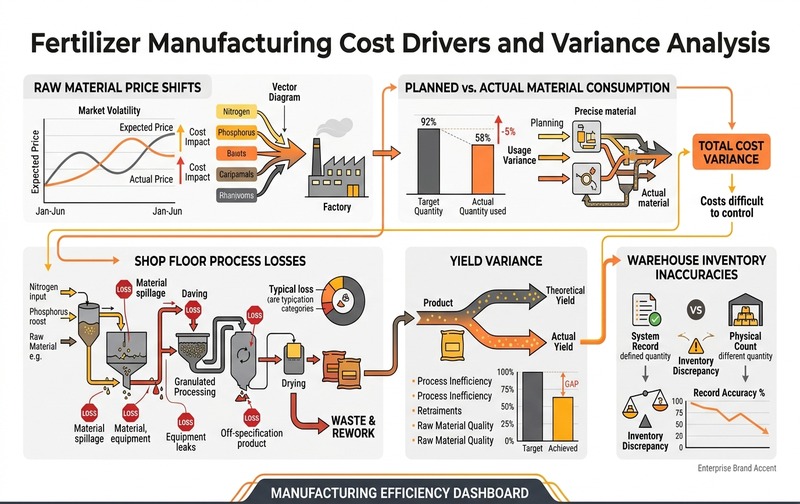
Fertilizer manufacturing operations face compounding cost pressures across raw material volatility, consumption variance, shop-floor yield losses, and multi-location inventory discrepancies.
1. Raw-Material Price Volatility
Raw materials can represent a significant portion of fertilizer production costs.
Changes in prices for major inputs can quickly affect manufacturing margins. If purchasing, inventory, production, and finance operate independently, management may not see the financial impact until after production is completed.
ERP helps connect procurement prices, stock values, production consumption, and finished-product costs.
This allows management to compare planned and actual costs more effectively.
2. Limited Raw-Material Inventory Visibility
A fertilizer manufacturer may hold materials across multiple warehouses, plants, storage areas, or locations.
Without centralized inventory visibility, teams may encounter:
- unnecessary purchasing
- material shortages
- excess inventory
- duplicate stock records
- production delays
- inaccurate stock valuation
ERP provides real-time inventory information so production and procurement teams can understand stock availability before making planning or purchasing decisions.
3. Production Planning Complexity
Production planning involves much more than determining how much fertilizer needs to be manufactured.
Teams must consider:
- demand
- existing finished-goods inventory
- raw-material availability
- open purchase orders
- production capacity
- product formulations
- packaging availability
- customer commitments
When these variables are managed manually, production schedules can become reactive.
ERP and material requirements planning can provide structured information about what needs to be produced, which materials are required, and where shortages may occur.
How ERP Improves Fertilizer Production Planning
ERP can link sales demand, inventory levels, production requirements, bills of material or formulations, and procurement information through a structured operational sequence:
➔
➔
➔
➔
➔
➔
➔
➔
This integrated flow reduces dependence on manually updated spreadsheets and disconnected departmental reports. Production teams can see expected requirements earlier, while procurement teams gain better visibility into upcoming material needs.
4. Formulation and Bill of Material Management
Fertilizer production may involve defined recipes, formulations, raw-material ratios, packaging materials, and production standards.
If product structures are maintained outside the main business system, inconsistencies can develop between what production is expected to consume and what is actually consumed.
ERP can maintain structured bills of material or production formulations for different products. This creates a baseline for:
- production planning
- raw-material requirements
- standard consumption
- production costing
- variance analysis
When actual usage differs from planned usage, the difference can be analyzed rather than remaining hidden within manual records.
5. Material Consumption and Yield Variance
One of the most important questions for a manufacturing organization is: Did we consume what we expected to consume?
Even relatively small variances can become financially significant when production volumes are high.
✔ Planned Material Consumption vs. Actual Material Consumption
✔ Planned Production Output vs. Actual Production Output
This helps management identify recurring operational issues such as:
- excess material usage
- process losses
- incorrect production standards
- scrap
- rework
- yield variations
Instead of analyzing only total production volume, management gains better visibility into production efficiency.
6. Batch and Lot Traceability
Batch-level visibility is important in many process manufacturing environments.
ERP can help connect raw-material receipts, production activity, finished-goods batches, warehouse movements, and customer deliveries.
➔
➔
➔
➔
This provides a more structured way to investigate production or quality-related issues. If a specific input or production batch needs to be reviewed, teams can trace related transactions more quickly instead of manually searching across multiple records.
7. Quality Control Across Manufacturing
Quality cannot be treated as a final inspection activity alone.
Quality requirements may exist at multiple points, including:
- incoming materials
- production stages
- finished products
- packaging
- dispatch
An integrated ERP environment can help connect quality activities with purchasing, production, inventory, and batch information.
For example, material receipt can be linked to inspection requirements before material becomes available for production. Similarly, finished goods may follow predefined quality workflows before release.
The objective is to make quality part of the operational process rather than a disconnected administrative activity.
Fertilizer Manufacturing ERP Capability Matrix
The matrix below illustrates how integrated ERP capabilities map directly to the operational and financial challenges encountered by fertilizer manufacturing enterprises:
How SAP Can Support Fertilizer Manufacturing
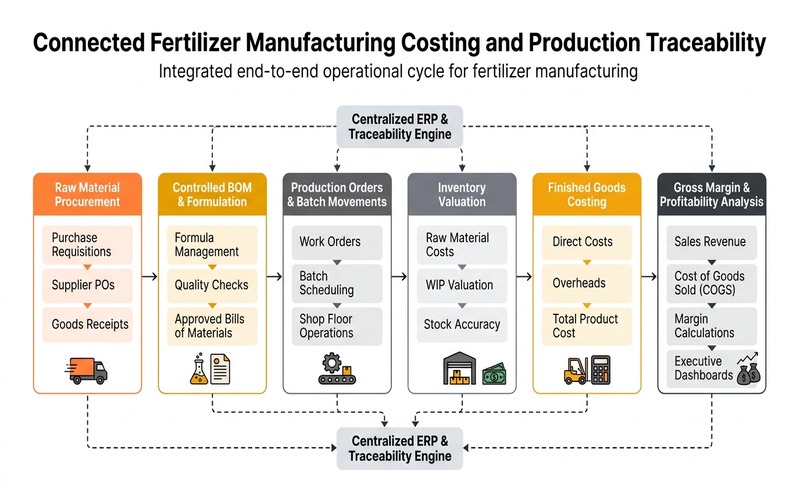
An integrated ERP environment links procurement, formulation BOMs, batch production, inventory valuation, and production costing into an auditable operational cycle.
SAP solutions can connect the major operational and financial processes required by fertilizer manufacturers.
Rather than treating procurement, production, inventory, sales, and finance as separate systems, SAP provides an integrated business environment where transactions can flow across departments.
Procurement Management
SAP can help manage:
- supplier records
- purchase requests
- purchase orders
- approval processes
- goods receipts
- supplier pricing
- outstanding purchase commitments
This provides procurement teams with better visibility into purchasing activity and upcoming material requirements.
Inventory and Warehouse Management
ERP-based inventory management helps manufacturers track:
- raw materials
- packaging materials
- work-in-progress where applicable
- finished goods
- warehouse transfers
- stock availability
- batch-managed inventory
Centralized inventory visibility can reduce unnecessary purchases and improve coordination between procurement, production, and sales.
Production Management
Production functionality can help manage:
- bills of material
- production orders
- material issues
- production receipts
- planned quantities
- actual quantities
- material consumption
- production output
The objective is to provide better control over what was planned, what was issued to production, and what was actually produced.
Production Costing
A business can show strong revenue while still losing manufacturing margin.
That happens when costs such as raw-material price changes, excess material consumption, scrap, rework, or production variances are not identified quickly enough.
ERP helps connect operational transactions with finance. Management can therefore evaluate production costs using actual transaction data rather than relying only on manually prepared reports.
Planned Cost vs Actual Cost
Consider a simplified scenario. A fertilizer product has a predefined standard material requirement. The system calculates an expected production cost based on raw-material quantities, material prices, packaging, and additional production costs.
After production, actual transactions show higher material consumption. ERP allows management to compare:
➔
➔
➔
➔
That variance becomes actionable management information. Without integrated ERP, the same difference may remain hidden inside separate production, warehouse, and finance spreadsheets.
8. Supply-Chain and Distribution Visibility
Manufacturing does not end when production is completed.
Finished fertilizer products must move through warehouses, distributors, dealers, or customers.
ERP can connect:
- customer orders
- available inventory
- committed stock
- picking
- dispatch
- invoicing
- receivables
Sales teams gain better visibility into product availability while operations teams can understand upcoming customer commitments.
This reduces situations where sales promises inventory that is unavailable or production manufactures goods without sufficient demand visibility.
9. Multi-Plant and Multi-Warehouse Control
As fertilizer businesses grow, complexity often increases faster than revenue.
Additional plants, warehouses, product lines, business units, and locations create more transactions and more opportunities for information gaps.
ERP provides centralized visibility while still allowing operational transactions to be recorded by location. Management can analyze:
- inventory by warehouse
- purchases by supplier
- production by plant
- sales by region
- inventory value
- product profitability
- outstanding orders
- financial performance
This is particularly valuable when management cannot depend on manually consolidated reports from every location.
10. Management Reporting and Decision-Making
ERP reporting should not simply tell management what happened. It should help management identify what requires attention.
Useful fertilizer manufacturing KPIs may include:
When operational and financial information comes from the same ERP environment, management spends less time reconciling conflicting reports.
Typical ERP Workflow for Fertilizer Manufacturing
An integrated ERP platform connects all stages of fertilizer manufacturing so information generated in one process becomes instantly available to the next:
➔
➔
➔
➔
➔
➔
➔
➔
➔
➔
➔
➔
➔
➔
➔
➔
When Should a Fertilizer Manufacturer Consider ERP?
ERP becomes increasingly important when operational complexity starts exceeding the capabilities of spreadsheets or disconnected applications.
Warning signs can include:
The presence of several of these issues usually indicates that the problem is no longer simply departmental.
It has become a systems integration problem.
ERP Selection Checklist for Fertilizer Manufacturers
Before selecting an ERP solution, fertilizer manufacturers should evaluate more than software features.
Can the ERP support the organization’s actual production process?
Can product structures and material requirements be maintained accurately?
Can materials be traced from receipt through manufacturing and delivery?
Can the system provide accurate inventory information by warehouse and location?
Can demand, available stock, production, and procurement requirements be connected?
Can management compare planned and actual production costs?
Can inspection and quality processes be integrated with operational transactions?
Can the ERP support additional plants, products, users, and locations?
Can it integrate with existing business applications or required external systems?
Can decision-makers access meaningful operational and financial information without manually consolidating spreadsheets?
Does the implementation partner understand manufacturing processes as well as ERP configuration?
This last point is critical.
A technically correct ERP implementation can still fail to create business value if existing manufacturing problems are simply recreated inside the new system.
SAP Business One or SAP S/4HANA for Fertilizer Manufacturing?
The appropriate SAP platform depends on business size, operational complexity, organizational structure, process requirements, and long-term growth plans.
SAP Business One
SAP Business One can be considered by growing small and mid-sized organizations seeking an integrated platform for functions such as:
- finance
- purchasing
- inventory
- sales
- production
- warehouse management
- reporting
It can provide growing fertilizer manufacturers with a centralized alternative to fragmented applications and spreadsheet-based management.
SAP S/4HANA
Larger and more complex fertilizer enterprises may require broader enterprise capabilities involving:
- multiple entities
- sophisticated manufacturing
- enterprise supply chains
- complex financial structures
- advanced planning
- extensive integrations
- large transaction volumes
The right choice should therefore be based on process complexity rather than selecting software based only on company size.
ERP Implementation: What Should Fertilizer Manufacturers Prepare?
ERP implementation should begin with process understanding, not software configuration.
Important preparation areas include:
Review: item codes, product descriptions, suppliers, customers, warehouses, bills of material, units of measure.
Poor-quality master data can undermine even a well-configured ERP system.
Validate: BOMs, formulations, material quantities, production stages, scrap assumptions, yield assumptions.
Identify: opening inventory, batch information, warehouse locations, inventory valuation, slow-moving stock.
Define approval requirements for: purchasing, pricing, discounts, inventory movements, financial transactions.
Identify management KPIs before implementation rather than attempting to design all reports after go-live.
Common ERP Implementation Mistakes to Avoid
Fertilizer manufacturers should avoid treating ERP implementation as a simple software installation.
Common mistakes include:
- Migrating inaccurate master data.
- Recreating inefficient manual processes inside ERP.
- Ignoring production-floor requirements.
- Failing to define inventory ownership.
- Using inaccurate BOMs or formulations.
- Neglecting user training.
- Overcustomizing the system unnecessarily.
- Defining reports too late.
- Focusing only on finance instead of end-to-end operations.
- Going live without clear process ownership.
ERP delivers stronger results when technology, processes, data, and people are addressed together.
How ERP Supports Better Cost Control in Fertilizer Manufacturing
Cost control requires visibility into more than purchase prices.
Manufacturing cost can be influenced by:
- raw-material prices
- material consumption
- yield
- wastage
- packaging
- transportation
- production overhead
- inventory holding costs
- rework
ERP creates transactional connections between these operational activities and financial reporting.
That enables management to move from asking:
“How much did we spend?”
to:
“Where did the variance occur, why did it happen, and which product or production activity caused it?”
That is a much stronger foundation for operational decision-making.
Business Benefits of ERP for the Fertilizer Industry
When correctly implemented, ERP can help fertilizer manufacturers achieve:
The purpose of ERP is not merely to digitize existing work.
It is to create a more controlled and measurable operating model.
From Fertilizer Manufacturing Complexity to Operational Control
Fertilizer manufacturing complexity increases as products, production volumes, suppliers, warehouses, plants, customers, and transactions grow.
The challenge is not simply producing more.
It is maintaining control while the organization scales.
An integrated ERP environment can connect production, inventory, procurement, quality, sales, and finance so decision-makers have a clearer understanding of what is happening across the business.
For fertilizer manufacturers evaluating ERP, the most important question is therefore not: “Which software has the most features?”
It is: “Which ERP can accurately support our production processes, provide reliable operational visibility, and help us control inventory and manufacturing costs as we grow?”
Frequently Asked Questions
Looking to Improve Control Across Fertilizer Manufacturing?
Emerging Alliance helps manufacturing businesses evaluate and implement SAP solutions aligned with operational requirements across production, inventory, procurement, costing, finance, and reporting.
If your fertilizer operations still depend heavily on spreadsheets, disconnected applications, delayed inventory reports, or manual production costing, an ERP assessment can help identify where integrated systems can create stronger control.