
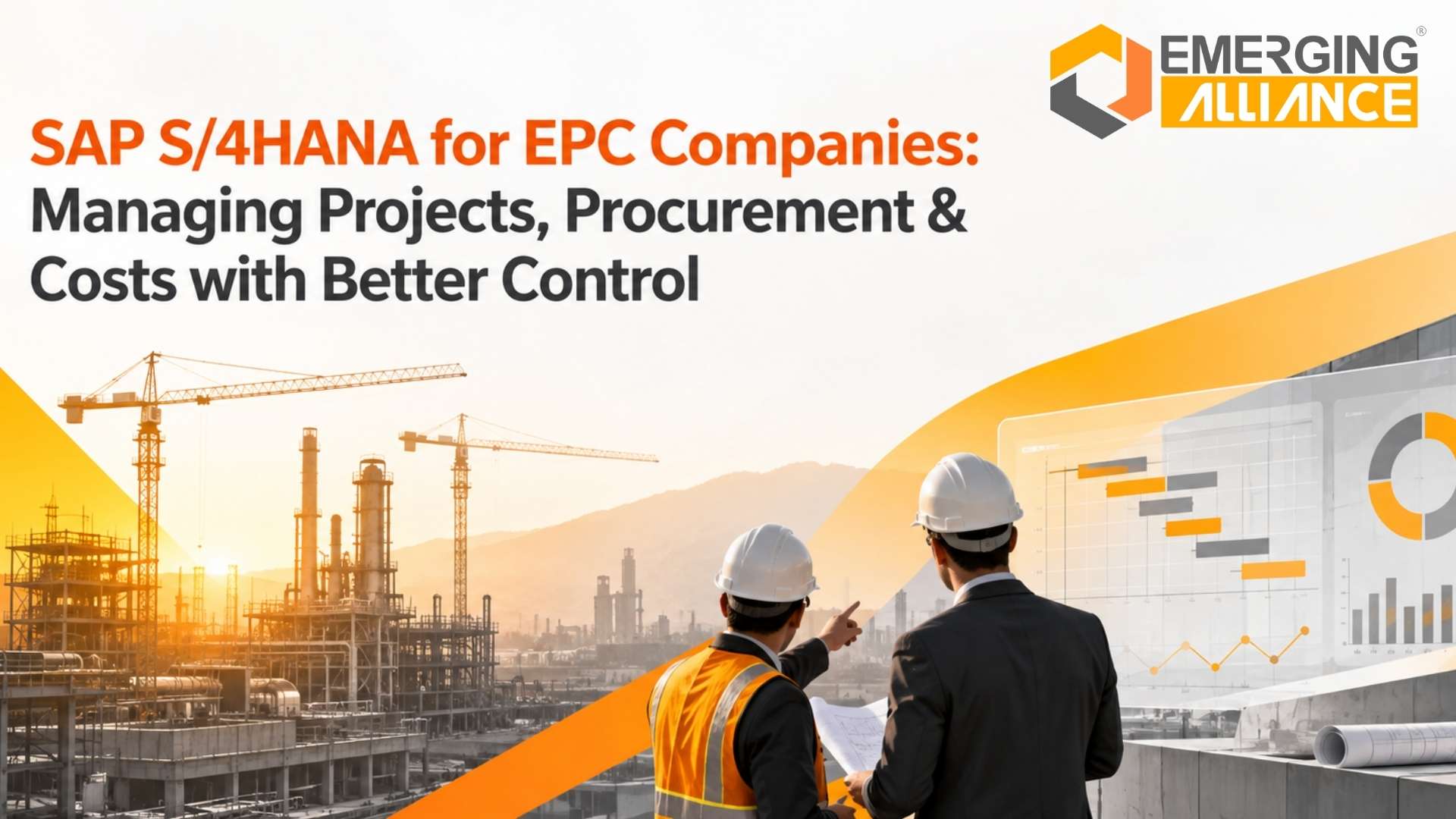
SAP S/4HANA for EPC Companies: Managing Projects, Procurement & Costs with Better Control
Quick Answer
SAP S/4HANA for EPC companies connects project planning, procurement, materials, financial commitments, actual costs, and reporting within a unified ERP environment. This gives EPC leaders better visibility into project budgets, purchasing commitments, cost variances, material requirements, and profitability—helping teams identify financial and execution risks before they significantly affect project margins.
For Engineering, Procurement and Construction companies, project success depends on more than completing engineering and construction activities on schedule. Every design decision can influence procurement. Every procurement decision can affect cash flow. Every material delay or scope change can alter the final project cost.
The problem becomes more difficult when project teams, procurement teams, finance teams, warehouses, and site operations work from separate systems and spreadsheets.
That is where SAP S/4HANA for EPC companies can provide value.
Instead of treating project management, purchasing, materials, finance, and cost control as disconnected processes, SAP S/4HANA can bring their financial and operational information together so management has a clearer view of what is happening across the project lifecycle.
Why EPC Companies Struggle to Maintain Project Control
EPC businesses operate in one of the most difficult environments for enterprise control.
A single project may involve thousands of materials, multiple engineering disciplines, contractors, suppliers, purchase orders, construction activities, milestones, payment terms, project locations, and cost categories.
At the beginning of a project, management may have a clear approved budget and expected margin.
As execution begins, that picture starts changing.
Engineering teams revise specifications. Material quantities change. Procurement teams place purchase orders. Suppliers revise delivery schedules. Subcontractors submit service claims. Site teams consume materials. Additional requirements emerge. Customer billing progresses according to contractual milestones.
Each event affects the project’s financial position.
The challenge is therefore not simply:
“Are we completing the project?”
Management also needs to know:
- Are project costs still within budget?
- What purchase commitments have already been created?
- What costs have actually been posted?
- Which materials are still required?
- Are procurement delays affecting execution?
- Which project areas are exceeding budget?
- What will the project cost when it is completed?
- Is the expected project margin still achievable?
- How is project execution affecting cash flow?
When these answers require information from multiple spreadsheets, emails, procurement systems, accounting reports, and site teams, decisions become slower.
More importantly, cost problems may only become visible after they have already affected profitability.
SAP S/4HANA addresses this control problem by connecting project structures with operational and financial transactions.
SAP’s project capabilities support analysis of planned and actual project costs at project and WBS-element level, while project financial reporting can also include commitments and budget information.
The objective is not simply more data.
It is earlier visibility into project performance.
The EPC Control Model: Projects, Procurement and Costs
A practical ERP model for EPC companies should connect three fundamental areas.
Project Control
Project control establishes what the organization intends to deliver.
It includes:
- Project structures
- Work breakdown structures
- Project activities
- Responsibilities
- Budgets
- Resources
- Milestones
- Progress
- Project schedules
- Financial planning
Without a structured project foundation, procurement and costs become difficult to allocate accurately.
Procurement Control
Procurement converts project requirements into external commitments.
This includes:
- Material requirements
- Purchase requisitions
- Supplier sourcing
- Purchase orders
- Service procurement
- Contract purchasing
- Delivery schedules
- Goods receipts
- Service confirmations
Every purchase decision may create a future financial obligation for the project.
Cost Control
Cost control shows what the project is consuming financially and whether the expected economics remain achievable.
Management needs visibility into:
- Approved budgets
- Planned costs
- Procurement commitments
- Actual costs
- Variances
- Forecasts
- Revenues
- Cash requirements
- Expected profitability
These three areas should operate as one connected cycle:
Project requirement → Procurement commitment → Material or service receipt → Actual project cost → Financial performance → Project profitability
SAP’s commitment-management model is especially relevant here. Purchase requisitions and purchase orders can represent future costs, while those commitments can be assigned to projects or WBS elements.
For EPC companies, this matters because waiting for invoices to arrive before evaluating project expenditure is often too late.
SAP S/4HANA for EPC Project Management
Project management is the foundation of EPC control.
SAP S/4HANA can use structured project objects, including Work Breakdown Structure (WBS) elements, to represent different areas of a project and collect relevant costs and revenues.
SAP documentation describes WBS structures as a mechanism for managing project costs and revenues through multilevel controlling structures.
Project Structure and Planning
A large EPC project should not exist inside the ERP system as one financial number.
It needs meaningful structure.
Depending on project design, WBS elements might represent:
- Engineering
- Procurement
- Civil works
- Mechanical works
- Electrical works
- Instrumentation
- Commissioning
- Individual project packages
- Project locations
- Contractual phases
This structure gives management a more useful level of control.
Instead of discovering that an entire project is over budget, management can determine which project area is creating the variance.
Budgets, responsibilities, procurement activities, and costs can then be assigned against appropriate project elements.
Project Execution Visibility
Once execution starts, project leaders need to compare what was expected against what is actually happening.
Relevant comparisons include:
- Planned cost vs actual cost
- Budget vs assigned value
- Budget vs commitments
- Expected progress vs actual progress
- Original scope vs revised requirements
SAP project-cost reporting supports analysis of planned and actual costs, including variance analysis across projects and WBS elements.
This improves management’s ability to identify deviations while corrective action is still possible.
Managing Project Changes
Change is common in EPC environments.
A customer revision may alter engineering specifications.
That may require:
- Additional materials
- Different equipment
- Revised purchase orders
- Additional subcontractor work
- Schedule changes
- Increased project expenditure
The business requirement is not merely to record the change.
Management should understand its commercial consequence.
When project structures, procurement transactions, and financial postings are connected, teams can evaluate changes in the context of their downstream cost impact.
SAP S/4HANA Procurement Management for EPC Companies
Once a project has been structured, procurement becomes the next major control point.
EPC procurement is not simply purchasing office supplies or standard inventory.
Materials and services are frequently linked to specific projects, engineering requirements, construction packages, WBS elements, and delivery deadlines.
From Project Requirement to Purchase Requisition
Procurement should begin with a clear requirement.
A project may require:
- Structural materials
- Pipes and fittings
- Electrical components
- Mechanical equipment
- Instrumentation
- Specialized machinery
- Engineering services
- Construction services
- Subcontractor packages
The stronger the connection between the requirement and the project structure, the easier it becomes to understand where project spending originates.
Supplier Sourcing and Purchase Orders
Once requirements are approved, procurement teams can move through sourcing and purchasing activities.
Depending on the organization’s SAP scope and processes, this may involve:
- Purchase requisitions
- Supplier quotations
- Supplier evaluation
- Purchase orders
- Contracts
- Approval workflows
- Delivery schedules
The critical EPC requirement is maintaining project context throughout this process.
A purchase order should not become an isolated procurement transaction.
Management should be able to understand which project requirement created it and which project budget it is consuming.
Project-Specific Procurement
Purchasing transactions can be account-assigned to projects or WBS elements.
This allows project-related procurement costs to remain connected with the financial structure of the project rather than disappearing into generic purchasing expenditure.
That linkage creates a foundation for meaningful project cost analysis.
Material Delivery and Availability
Issuing a purchase order does not guarantee project execution.
Materials still need to arrive when they are required.
Project and procurement teams therefore need visibility into:
- Open purchase orders
- Scheduled deliveries
- Goods receipts
- Delayed materials
- Material availability
- Project requirements
This is particularly important when a single delayed item can affect construction schedules or commissioning milestones.
Procurement Commitments
One of the most important concepts for EPC financial control is the commitment.
SAP defines commitments as future costs resulting from requested or ordered materials and services. Project commitments can be assigned directly to projects or WBS elements.
Consider an EPC project with an approved budget of ₹100 crore.
Actual costs posted today may be only ₹45 crore.
Looking only at actual costs might make the project appear financially comfortable.
But suppose another ₹42 crore has already been committed through purchase orders.
Management’s effective exposure is much higher.
That is why EPC leaders should evaluate:
Budget → Commitments → Actual costs → Remaining available budget
rather than actual expenditure alone.
SAP S/4HANA Cost Control for EPC Projects
Project cost control is where operational information becomes executive information.
The objective is not simply to record expenditure correctly.
The objective is to answer:
Are we still delivering this project within its approved economics?
Budget vs Commitment vs Actual Cost
These terms should not be treated as interchangeable.
- Budget represents the approved financial limit or allocation.
- Planned cost represents expected expenditure based on project planning.
- Commitment represents expected future expenditure created through procurement activity.
- Actual cost represents costs that have already been financially recorded.
SAP project financial analytics can provide budget, planned cost, actual cost, commitment, variance, and available-budget information.
Together, these values provide a much stronger picture than actual costs alone.
For example:
Project budget: ₹50 crore
Actual costs: ₹28 crore
Open commitments: ₹17 crore
Uncommitted budget: ₹5 crore
Looking only at actual costs suggests that ₹22 crore remains.
Looking at actuals plus commitments shows that only ₹5 crore remains unallocated.
That distinction can materially change a project manager’s next decision.
Cost Tracking by Project
An EPC organization may need to analyze cost at different levels, such as:
- Project
- WBS element
- Engineering discipline
- Material category
- Procurement package
- Contractor
- Project site
- Cost element
- Business unit
The objective is to move from:
“The project is over budget.”
to:
“This specific project package is driving the variance, and these commitments are responsible.”
That level of visibility makes corrective action more practical.
Variance Analysis
Variance analysis should identify exceptions before they become irreversible.
Management may examine:
- Planned cost – Actual cost
- Budget – Actual cost
- Budget – Actual cost – Commitments
- Forecast cost – Approved budget
SAP provides project reports for plan, actual, commitment, variance, forecasts, and related cost analysis.
This allows financial control to become part of ongoing project management rather than a retrospective accounting exercise.
Project Profitability
Ultimately, EPC leaders need to connect execution with margin.
A useful management view is:
Contract revenue – Expected total project cost = Expected project margin
But expected cost should not mean only what has already been invoiced.
It needs to consider:
- Actual expenditure
- Outstanding procurement commitments
- Remaining work
- Scope changes
- Expected future requirements
- Commercial risks
This turns ERP data into a management decision.
The executive question becomes:
“Based on what we know today, what margin are we likely to achieve when this project finishes?”
Connecting Engineering Changes to Procurement and Project Costs
Engineering changes create one of the most important control challenges in EPC businesses.
Consider a specification change.
- The engineering department may see it as a design revision.
- Procurement may see it as a different material requirement.
- The supplier may see it as a purchase-order amendment.
- The project manager may see it as a schedule risk.
- Finance may see it as additional expenditure.
Management sees the combined effect:
Potential margin erosion.
The complete impact chain may look like this:
Engineering change → Revised material requirement → Procurement change → Supplier commitment → Budget impact → Project cost impact → Profitability impact
That is why digital integration matters.
The goal is not to eliminate engineering change. That is unrealistic.
The goal is to make its downstream effects visible enough for the organization to respond intelligently.
When engineering, procurement, project structures, and financial control operate in disconnected systems, those consequences are difficult to trace.
With stronger ERP integration, management can establish clearer governance around change approvals and their financial impact.
Managing EPC Materials Across Projects and Sites
Materials represent both an execution dependency and a financial investment.
Poor material control can create two opposite problems.
- Too little material can delay execution.
- Too much material can lock cash into unused inventory.
EPC companies therefore need to manage materials according to project requirements rather than treating inventory as a standalone warehouse function.
Project Material Requirements
Material planning should answer:
- What does this project require?
- How much is required?
- When is it required?
- Has it been ordered?
- Has it arrived?
- Where is it stored?
- Has it been allocated?
- Has it been consumed?
- Is there excess material?
Central and Site Inventory
Large EPC organizations may manage:
- Central warehouses
- Project warehouses
- Temporary site stores
- Multiple plants
- Multiple project locations
Material movement between these locations should remain controlled.
Otherwise, inventory may physically exist somewhere in the company while still being unavailable to the project that needs it.
Project Allocation and Consumption
Materials should be traceable to the appropriate project context wherever the operating model requires it.
This improves visibility into:
- Project material costs
- Material consumption
- Unused material
- Project stock
- Site stock
- Procurement requirements
SAP project-budget analytics can include project-stock values alongside budget, commitments, planned costs, and actual costs, providing another dimension of project financial visibility.
For EPC companies, material management is therefore not merely inventory optimization.
It is part of schedule, cost, and working-capital control.
Subcontractor and Service Procurement Control
Materials are only part of EPC expenditure.
Construction, installation, specialized engineering, inspection, testing, and other activities may be performed by subcontractors and service providers.
These engagements create another control requirement.
Management needs to connect:
Contract value → Work completed → Work accepted → Amount invoiced → Amount paid → Remaining commitment
Without that connection, service expenditure can become difficult to reconcile with physical project progress.
A structured ERP process can help organizations manage:
- Service purchase orders
- Subcontractor agreements
- Service confirmations
- Progress-related quantities
- Invoice verification
- Project cost allocation
- Remaining commitments
The underlying principle remains the same:
A subcontractor transaction should not be viewed only as an accounts-payable transaction.
It is also a project-performance and cost-control transaction.
Project Billing, Revenue and Cash Flow Visibility
An EPC project can be profitable on paper and still experience serious cash-flow pressure.
Why?
Because project cash outflows and customer collections rarely occur at exactly the same time.
The company may need to pay for:
- Materials
- Equipment
- Contractors
- Site expenses
- Engineering resources
- Logistics
before receiving the corresponding customer payment.
That makes billing and cash visibility essential.
Depending on the commercial model, EPC contracts may involve:
- Advance payments
- Milestone billing
- Progress billing
- Retention
- Variation claims
- Final settlement
Management needs to understand both sides of the project:
Cash going out through procurement, subcontractors, payroll, logistics, and execution.
Cash coming in through customer billing and collections.
The project may therefore need to be evaluated across three related measures:
Profitability
Is the project expected to generate margin?
Liquidity
Can the business fund execution until collections occur?
Working capital
How much cash is tied up in inventory, receivables, and unfinished project activity?
ERP integration improves the organization’s ability to evaluate these questions using a common financial foundation.
Real-Time EPC Project Reporting with SAP S/4HANA
Reporting should not be designed as an afterthought.
The purpose of EPC reporting is to convert transactions into actionable management information.
Different executives require different views.
CEO or Managing Director
Leadership typically needs portfolio-level answers:
- Which projects are profitable?
- Which projects are at financial risk?
- Where is margin declining?
- Which projects have major cost exposure?
- Where are cash-flow risks increasing?
CFO
Finance may focus on:
- Budget utilization
- Actual project costs
- Open commitments
- Customer billing
- Receivables
- Cash requirements
- Revenue
- Forecast cost
- Expected margin
COO or Project Director
Operations may require:
- Execution progress
- Procurement status
- Material availability
- Project milestones
- Delayed requirements
- Cost variance
- Contractor status
Procurement Head
Procurement needs visibility into:
- Open requisitions
- Supplier commitments
- Purchase orders
- Delivery dates
- Material shortages
- Supplier performance
- Project-linked procurement
SAP documentation shows that project reporting can bring together planned costs, actual costs, commitments, budget, and available-budget measures, allowing financial controllers to analyze project performance from a connected view.
The important point is not having more dashboards.
It is ensuring that each decision-maker sees the information required to act.
SAP S/4HANA EPC Process Flow: From Project Award to Closure
A well-designed EPC ERP process should follow the commercial and operational lifecycle of the project.
1. Project Award
The company receives the contract and establishes the commercial framework.
2. Project and WBS Creation
The project is structured into controllable phases, packages, disciplines, or deliverables.
3. Budget Planning
Budgets and expected project expenditure are established against the relevant project structure.
4. Engineering Requirements
Engineering teams define materials, equipment, services, specifications, and other requirements.
5. Material and Service Planning
Requirements are translated into procurement and execution needs.
6. Procurement
Purchase requisitions, sourcing activities, purchase orders, and service contracts create financial commitments.
7. Material Receipt and Service Execution
Materials are received and services are confirmed against project requirements.
8. Project Cost Posting
Transactions become actual project expenditure against the appropriate project objects.
9. Progress Monitoring
Operational and financial progress is evaluated against the plan.
10. Customer Billing
Billing occurs according to project milestones, progress, or contractual terms.
11. Profitability Analysis
Revenue, actual costs, commitments, forecasts, and expected remaining expenditure are assessed together.
12. Project Closure
Remaining commitments, inventory, financial postings, claims, and contractual items are resolved before final project closure.
The value of SAP S/4HANA is strongest when these stages operate as a connected process rather than independent departmental activities.
What Better Control Looks Like After SAP S/4HANA
The objective of implementing SAP S/4HANA for an EPC business should not simply be replacing existing software.
The objective should be improving control.
Swipe horizontally to view full table →
| EPC Challenge | Better-Control Outcome |
|---|---|
| Disconnected project information | Structured project information within a common ERP environment |
| Cost overruns detected late | Earlier budget and variance visibility |
| Procurement disconnected from projects | Project-linked purchasing and commitments |
| Future expenditure difficult to see | Better commitment visibility |
| Material uncertainty | Stronger requirement, procurement and stock visibility |
| Engineering changes with unclear cost effects | Better downstream financial traceability |
| Manual cost consolidation | More integrated project financial reporting |
| Weak profitability visibility | Better project-level cost and margin analysis |
| Departmental spreadsheets | More consistent enterprise data |
| Reactive decision-making | Earlier identification of exceptions |
Technology alone does not create these outcomes.
They depend on process design, data quality, project structures, governance, user adoption, integrations, and implementation quality.
But SAP S/4HANA can provide the ERP foundation required to support them.
When Should an EPC Company Consider SAP S/4HANA?
Not every construction or engineering organization requires the same ERP architecture.
SAP S/4HANA becomes particularly relevant when operational complexity starts exceeding the organization’s existing systems.
Common indicators include:
- Multiple large EPC projects running simultaneously
- Increasing project values
- Multi-year project durations
- Complex procurement activity
- Large supplier ecosystems
- Extensive subcontractor management
- Multiple legal entities
- Multi-country operations
- Numerous warehouses and project sites
- Significant project-based inventory
- Weak visibility into procurement commitments
- Increasing spreadsheet dependence
- Slow project-cost reporting
- Difficulty identifying final project profitability
- Growing integration requirements
- Existing systems that cannot support future scale
The ERP decision should therefore be driven by business complexity and control requirements, not simply company size.
A ₹500 crore organization managing a few predictable processes may have different requirements from a similarly sized EPC organization managing dozens of simultaneous projects across countries.
SAP S/4HANA Implementation Priorities for EPC Companies
Successful ERP implementation begins with process design—not software configuration.
Priority 1: Define the Project Structure Correctly
Determine how projects should be represented.
Consider:
- Projects
- WBS structures
- Packages
- Cost collectors
- Responsibilities
- Reporting levels
Poor project structure leads to poor reporting regardless of how powerful the ERP system is.
Priority 2: Integrate Project and Procurement Processes
Procurement should maintain a clear relationship with project demand.
Determine how:
Requirement → Requisition → Purchase order → Receipt → Cost
will remain connected.
Priority 3: Establish Project Cost Governance
Define:
- Budget ownership
- Budget approvals
- Procurement approvals
- Commitment controls
- Variance thresholds
- Change controls
- Escalation rules
ERP should support governance rather than replace it.
Priority 4: Define Material and Subcontractor Processes
EPC businesses should explicitly design processes for:
- Project stock
- Site warehouses
- Material transfers
- Service procurement
- Subcontractor certification
- Material consumption
- Surplus materials
Priority 5: Design Executive Reporting Early
Do not wait until implementation is nearly finished before asking:
“What reports does management need?”
Start with executive decisions.
Then work backward to determine which transactions, data structures, and controls are necessary to support those decisions.
Priority 6: Minimize Unnecessary Customization
Customization should solve a genuine business requirement.
Before approving any customization, ask:
- Can standard SAP support the requirement?
- Can configuration solve it?
- Can the business process reasonably adapt?
- Is an extension or integration genuinely necessary?
- What will the customization cost to maintain?
The target should not be the most customized SAP environment.
It should be the minimum complete solution required for effective EPC control.
Questions EPC Leaders Should Ask Before Selecting or Implementing SAP S/4HANA
A productive SAP evaluation should move beyond feature demonstrations.
Executives should ask whether the proposed architecture can answer the questions that matter during project execution.
Can we see budget, actual costs and commitments together?
This determines whether project teams have forward-looking cost visibility rather than relying only on historical expenditure.
Can procurement transactions be linked directly to projects and WBS elements?
Project-based purchasing is critical when procurement represents a significant share of project cost.
Can engineering or scope changes be connected to financial consequences?
The organization should understand how approved changes affect requirements, procurement, budget, and expected margin.
Can we identify expected project profitability before project closure?
Management should not need to wait until final accounting to discover whether margin has deteriorated.
Can we monitor subcontractor commitments and service costs?
Service expenditure may represent a significant part of project economics.
Can we control material across multiple sites and projects?
Material availability, ownership, movement, and consumption should remain visible.
Can the architecture support our operating complexity?
Consider:
- Companies
- Countries
- Currencies
- Projects
- Plants
- Warehouses
- Sites
- Suppliers
- Integrations
What requires standard SAP, configuration, integration, extension or customization?
This question is particularly important for controlling implementation complexity and long-term support costs.
Conclusion: From Project Visibility to Project Control
The central challenge for an EPC company is not a lack of transactions.
It is maintaining control across thousands of connected transactions while project conditions continuously change.
Engineering influences materials.
Materials influence procurement.
Procurement creates commitments.
Commitments influence budget availability.
Execution creates actual costs.
Costs influence margin.
Billing and payments influence cash flow.
When these processes operate separately, management spends considerable effort reconstructing the truth.
SAP S/4HANA for EPC companies can provide a connected foundation for project management, procurement, material control, financial commitments, actual costs, and project reporting.
The goal is not simply digitization.
The goal is to know earlier:
- Where projects are deviating
- Where procurement exposure is increasing
- Where budget is being consumed
- Where materials may delay execution
- Where costs are exceeding expectations
- Where expected margins are changing
That is the difference between seeing project results after they happen and managing projects while there is still time to influence them.
Frequently Asked Questions
Bring Better Control to Your EPC Projects with SAP S/4HANA
Connect project costs, procurement, materials, commitments, and profitability through an integrated SAP S/4HANA environment designed for EPC operations.
Request an SAP S/4HANA Demo