
SAP S/4HANA for Food & Beverage: Traceability, Quality, and Scale
SAP S/4HANA for Food & Beverage: Traceability, Quality, and Scale
Quick Answer: How Does SAP S/4HANA Support Food and Beverage Operations?
SAP S/4HANA can help food and beverage businesses manage growing operational complexity by connecting batch-controlled inventory, production, quality, procurement, warehousing, sales, and finance within an integrated ERP environment.
For companies handling perishable materials, SAP batch-management capabilities can support forward and backward traceability, while shelf-life functionality can record manufacturing dates, expiration dates and remaining shelf life. Quality Management can also support inspections during procurement and production when appropriately configured.
The result is not simply more automation. The larger business value is better operational control as products, plants, customers, suppliers, transactions and compliance requirements increase.
Why Food and Beverage Growth Creates ERP Complexity
A food manufacturer operating one facility with a limited product portfolio may initially manage operations with relatively simple processes.
The challenge appears when the business expands.
A larger food and beverage operation may need to manage hundreds or thousands of raw materials and finished products across several plants or warehouses. Each material may have its own quality specifications, batch attributes, shelf-life rules, suppliers and production requirements.
A single sales order can therefore affect purchasing, production scheduling, batch allocation, warehouse execution, quality release, logistics and financial accounting.
If those activities are managed independently, management can lose visibility over the actual business process.
Common operational pressures include:
Inconsistent batch records
Excess or expiring inventory
Manual production scheduling
Disconnected quality information
Limited supplier visibility
Inefficient recalls
Inaccurate costing
Delayed management reporting
SAP S/4HANA addresses these problems by providing a common digital core across business functions.
Batch Traceability: From Ingredient Receipt to Customer Delivery
Batch traceability is one of the most important operational controls for many food and beverage manufacturers.
Businesses need to know where an ingredient came from, when it was received, which production process consumed it, which finished batches were created and where those finished products were subsequently delivered.
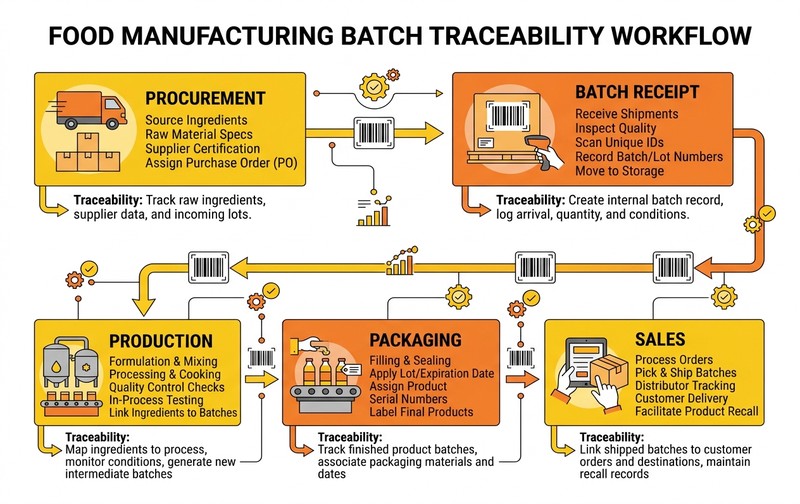
Food Manufacturing Batch Traceability Workflow: Mapping end-to-end material flow from supplier procurement and batch receipt to production, packaging, and sales distribution in SAP S/4HANA.
SAP batch-management capabilities can support both directions of this investigation.
Backward Traceability
Backward traceability helps a company start with a finished product and trace the materials and batches consumed during production.
Forward Traceability
Forward traceability can begin with a specific raw-material batch and identify the production orders, finished products and downstream deliveries affected by that material. SAP’s own S/4HANA learning documentation describes these top-down and bottom-up traceability scenarios for process manufacturing.
This becomes particularly valuable when a supplier reports a quality problem.
Instead of broadly assuming that every product is affected, the business can investigate the relevant batch genealogy and determine which production runs and deliveries require further action.
That can support faster, more controlled decisions during product holds, withdrawals or recalls.
Shelf-Life and Expiration-Date Control
Perishable inventory creates a different type of ERP challenge.
Stock quantity alone is not enough.
A warehouse may technically have 10,000 units in inventory while a significant percentage of those units have insufficient remaining shelf life for production or customer delivery.
SAP S/4HANA provides functionality for maintaining and checking shelf-life expiration dates for batch-managed materials.
Depending on configuration, businesses can capture manufacturing dates, total shelf life, best-before or shelf-life expiration dates and minimum remaining shelf-life requirements.
Manufacturing Dates
Precise batch production tracking
Total Shelf Life
Standard duration of usability
Best-Before / SLED
Shelf-life expiration date rules
Remaining Shelf Life
Minimum thresholds for receipt/dispatch
SAP documentation also describes expiration-date checks during goods receipt and the ability to analyze batches according to remaining shelf life.
This gives procurement, production and warehouse teams stronger control over perishable inventory.
Instead of treating all available stock as equal, inventory decisions can consider whether a batch has sufficient usable life for the next stage of the supply chain.
Expiration-date-driven batch determination and warehouse strategies can also support the operational principle of consuming stock approaching expiry before batches with longer remaining shelf life, where the relevant SAP processes are configured.
For food and beverage businesses, better shelf-life control can contribute to lower expiry exposure, stronger stock rotation and more reliable customer fulfilment.
Quality Management Integrated with Operations
Quality should not sit outside the ERP process.
When quality records are maintained separately from receiving, production and inventory, teams can struggle to determine whether materials have been inspected, released or restricted.
SAP Quality Management can integrate inspection processes with relevant operational events.
For example, SAP documentation describes inspection lots triggered for vendor receipts, internally produced materials and production activities. Inspection lots can contain specifications, inspection characteristics, processing status and recorded inspection results.
For a food manufacturer, that connection can help build stronger controls around incoming ingredients, production-stage inspections and finished-product release.
Distinguishing ERP Support for Compliance from Compliance Itself
It is important, however, to distinguish ERP support for compliance from compliance itself.
SAP S/4HANA does not automatically make a company compliant with HACCP, FDA, ISO, local food-safety regulations or customer-specific requirements. Compliance depends on the organization’s procedures, controls, master data, system configuration, documentation, validation, training and governance.
The ERP provides the digital controls and records that can support those processes.
Production and Recipe-Control Complexity
Food and beverage manufacturing is often process-oriented rather than simple discrete assembly.
The business may work with ingredients, formulas, recipes, process stages, yields, co-products, by-products and variable production quantities.
As the number of products increases, maintaining this information outside the central production system becomes risky.
SAP process-manufacturing capabilities can connect production planning and process execution with materials, batch information and quality requirements.
Inspection characteristics can also be linked with production or process-order activities, allowing quality checks to become part of manufacturing execution rather than a disconnected administrative activity.
The business benefit is greater consistency.
Production teams can work from governed master data rather than relying on separate versions of spreadsheets, documents and manually communicated instructions.
Procurement and Supplier Visibility
Food manufacturers frequently depend on agricultural inputs, ingredients, packaging suppliers, contract manufacturers and logistics partners.
A procurement decision can therefore affect much more than price.
Purchasing teams may also need to consider lead time, quality history, material availability, shelf-life requirements and production demand.
An integrated ERP environment connects procurement transactions with inventory, manufacturing, finance and quality processes.
This gives decision-makers a more complete view of purchasing rather than treating each purchase order as an isolated transaction.
When incoming materials require inspection, quality processes can also be triggered around goods receipts depending on the configured SAP Quality Management process.
Inventory Visibility Across Plants and Warehouses
Growth often creates inventory fragmentation.
The same ingredient may be stored across several warehouses. Finished products may move between plants, distribution centres and regional locations. Some stock may be unrestricted, while other batches may be restricted because of quality or shelf-life conditions.
Management therefore needs more than a total stock figure.
Batch-level visibility helps teams understand which stock is actually usable.
SAP’s batch-management capabilities include batch status, batch attributes, shelf-life information and batch-specific inventory visibility. SAP’s Batch Information Cockpit documentation also describes capabilities for analysing batch stock, attributes, shelf life and where-used information.
This information can help supply-chain teams make better replenishment and allocation decisions.
Connecting Operations with Finance
Operational inefficiency eventually becomes financial inefficiency.
Expired Inventory
Creates direct write-offs
Production Variance
Erodes product gross margin
Emergency Procurement
Increases material costs
Slow-Moving Stock
Locks up essential working capital
Quality Failures
Create rework, scrap & service costs
When operational systems and financial reporting are disconnected, management may understand these problems only after the accounting impact has already occurred.
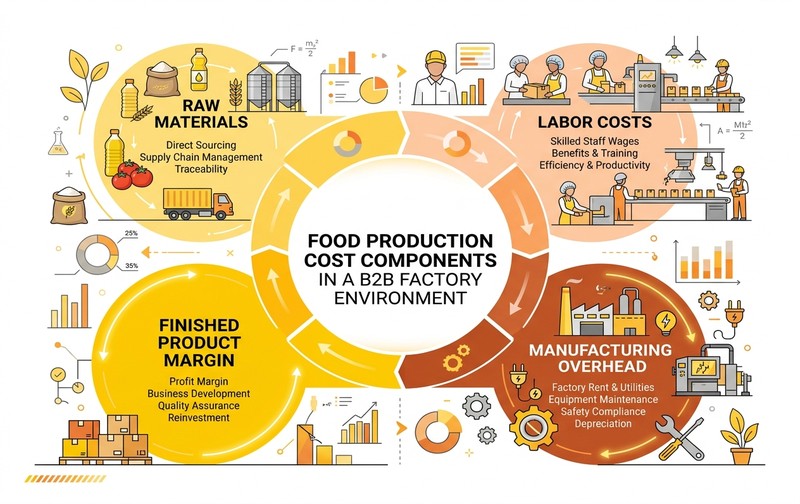
Food Production Cost Components: Connecting raw materials, labor, and manufacturing overhead directly to finished product margins and real-time financial reporting in SAP S/4HANA.
SAP S/4HANA connects core operational processes with financial transactions on an integrated ERP foundation.
This allows executives to evaluate operational performance together with its financial implications rather than treating manufacturing, procurement, inventory and accounting as separate reporting environments.
From Operational Data to Management Decisions
Food and beverage executives need answers to practical questions.
Answering these questions becomes difficult when data is distributed across applications and spreadsheets.
SAP S/4HANA’s value is the ability to connect transactions across core business processes and make that information available to operational and management reporting.
The objective is not simply having more dashboards.
It is reducing the time between an operational event and a management decision.
Where SAP S/4HANA Can Deliver the Most Value
These outcomes are dependent on implementation scope, configuration, master-data quality, process design and user adoption. ERP software should therefore be evaluated as part of an operating-model transformation rather than as a standalone technology installation.
When Should a Food and Beverage Company Consider SAP S/4HANA?
SAP S/4HANA becomes particularly relevant when operational complexity begins exceeding the capability of existing ERP systems, disconnected applications or spreadsheet-driven processes.
Business size alone should not determine the decision.
A relatively fast-growing food company with several plants, complex production, batch requirements and international operations may have greater ERP requirements than a much larger but operationally simpler organization.
The evaluation should therefore consider transaction volume, number of plants, batch complexity, production processes, intercompany requirements, quality controls, integrations, international operations, reporting requirements and future growth plans.
SAP S/4HANA Cloud Public Edition and private-cloud options also differ in standardization, extensibility and implementation approach, so deployment choice should be based on business-process requirements rather than simply choosing “cloud” as a generic strategy. SAP currently positions Public Edition around standardized, preconfigured cloud ERP processes, while its private offering emphasizes deeper enterprise process requirements and extensibility.
SAP S/4HANA Implementation Priorities for Food and Beverage Companies
A successful implementation should begin with business-process design rather than software configuration.
1. Define batch-traceability requirements. Establish exactly which raw materials, intermediate products and finished products require batch management and which attributes must be captured.
2. Standardize product and material master data. Clean material codes, units of measure, shelf-life parameters, recipes, quality specifications and supplier information before migration.
3. Design shelf-life controls. Determine minimum remaining shelf-life rules, receipt checks, stock-rotation policies and customer-specific shelf-life requirements.
4. Map quality checkpoints. Define incoming, in-process and finished-product inspections together with release and rejection processes.
5. Connect production and quality. Avoid designing manufacturing and quality as independent workstreams.
6. Define recall procedures. Test how quickly the organization can trace a problematic ingredient forward and a finished product backward.
7. Integrate operational and financial reporting. Identify the KPIs that management needs across procurement, inventory, production, waste, quality and margin.
8. Plan integrations carefully. Evaluate warehouses, manufacturing equipment, laboratory systems, logistics applications, planning tools, supplier platforms and third-party solutions.
9. Test using real food-industry scenarios. Generic ERP testing is not enough. Test short-dated inventory, rejected materials, batch splits, production variances, substitutions, blocked batches and recall scenarios.
10. Measure business outcomes after go-live. ERP success should be evaluated using improvements in inventory accuracy, expiry exposure, production reliability, quality performance, traceability and management visibility.
Common SAP S/4HANA Mistakes in Food and Beverage Implementations
Treating the Project as an IT Upgrade
S/4HANA affects business processes across production, finance, procurement, inventory, quality and logistics.
If functional teams are not involved in process design, the company may digitize existing inefficiencies rather than eliminate them.
Migrating Poor Master Data
A modern ERP cannot compensate for inconsistent material descriptions, incorrect units of measure, missing shelf-life parameters or poorly governed recipes.
Master-data readiness should therefore be treated as a critical workstream.
Designing Traceability Too Late
Batch management should not be added as an afterthought.
Traceability requirements influence material masters, production processes, warehouse transactions, quality controls and reporting.
Over-Customizing the Core
Not every historic process should be rebuilt exactly as it exists today.
Businesses should distinguish between processes that genuinely provide competitive differentiation and legacy practices that can be standardized.
Assuming Technology Automatically Creates Compliance
Software provides controls and evidence.
The organization remains responsible for defining appropriate procedures, validating processes, training users and meeting applicable regulatory obligations.
SAP S/4HANA vs SAP HANA: Why the Terminology Matters
SAP HANA and SAP S/4HANA are not interchangeable terms.
SAP HANA is the underlying in-memory database technology.
SAP S/4HANA is the ERP suite used to manage business processes such as finance, procurement, supply chain, manufacturing and sales.
For SEO, technical accuracy and executive credibility, food-and-beverage ERP content should therefore consistently use SAP S/4HANA when referring to the ERP solution rather than shortening the product name to “SAP HANA.”
Scaling Food and Beverage Operations Without Scaling Complexity
Growth should not require management teams to accept increasing levels of operational chaos.
As production volumes, plants, suppliers, products and markets expand, food and beverage businesses need stronger control over the processes connecting materials, production, quality, warehousing, sales and finance.
SAP S/4HANA can provide that integrated foundation.
Batch traceability helps businesses understand material genealogy.
Shelf-life controls help manage perishable inventory.
Quality Management connects inspections with operational transactions.
Integrated manufacturing, procurement and inventory processes improve operational visibility.
Financial integration helps management understand the economic impact of operational decisions.
The objective is not simply implementing a larger ERP system.
It is creating a more scalable operating model.