
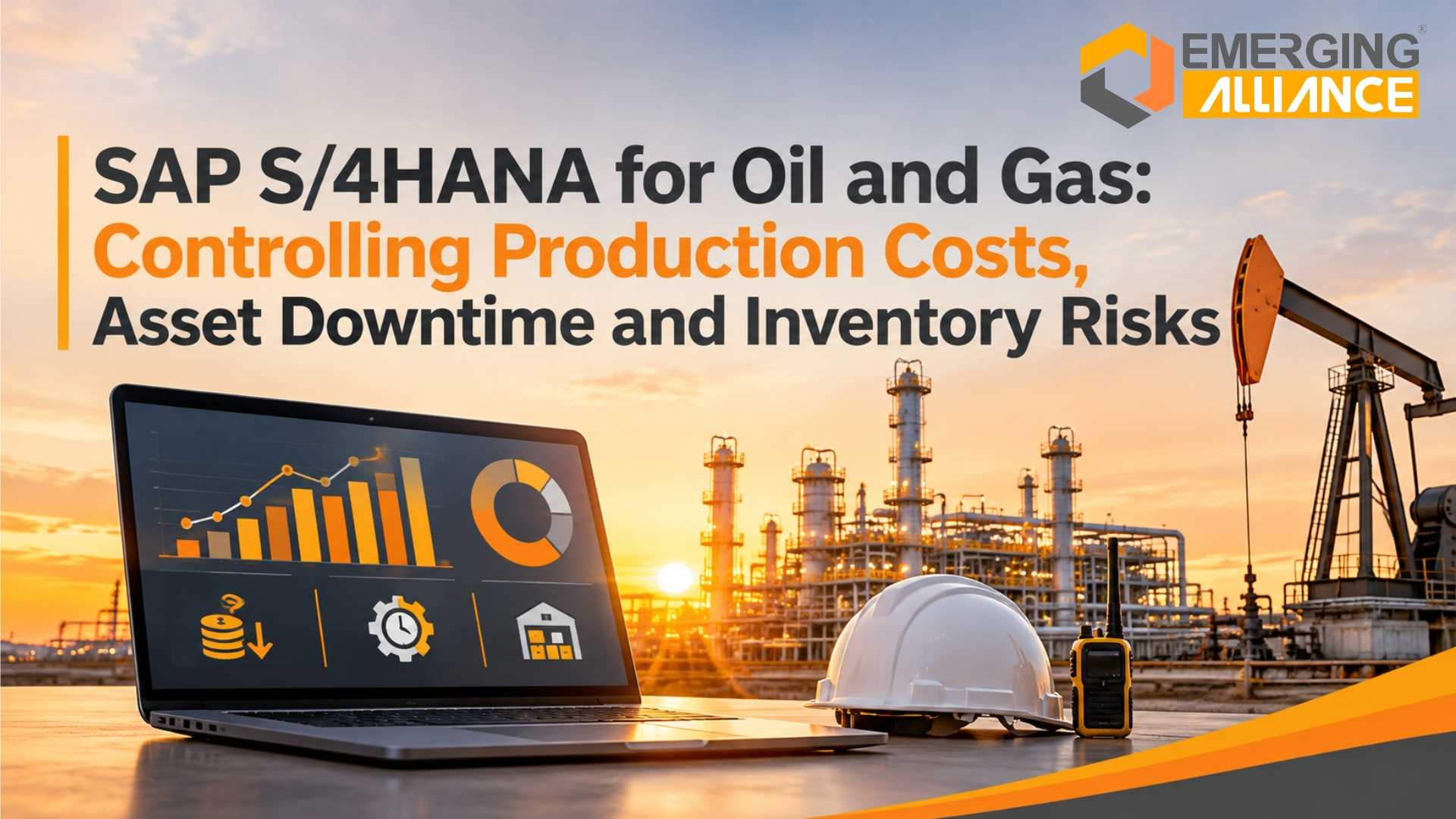
SAP S/4HANA for Oil and Gas: Controlling Production Costs, Asset Downtime and Inventory Risks
Quick Answer
SAP S/4HANA for Oil and Gas helps businesses connect financial management, procurement, inventory, maintenance and operational information within an integrated ERP environment. When appropriately configured and integrated with operational systems, it can improve production cost visibility, support asset maintenance planning, strengthen inventory control and give decision-makers more reliable information for managing operational and financial risks.
Why Oil and Gas Companies Need Stronger ERP Control
Oil and gas operations involve complex processes, significant capital commitments and assets that must remain available to support business continuity. Whether a company operates in upstream exploration and production, midstream transportation or downstream refining and distribution, its financial performance depends on how effectively it manages resources, equipment, materials and operational activities.
However, these processes do not always operate with consistent information. Production teams may maintain operational data in separate systems, maintenance teams may use independent work-order applications, and finance departments may receive cost information after operational activities have already taken place.
This separation creates management challenges. Decision-makers may struggle to understand the actual cost of production, identify the financial impact of equipment downtime, track materials across locations or evaluate whether procurement decisions reflect current operational requirements.
The issue is not simply the number of systems a company uses. It is whether those systems provide consistent, timely and usable information for business decisions.
SAP S/4HANA can support a more integrated ERP environment by connecting relevant business processes and financial information. Its value depends on the company’s operating model, implementation scope, data quality, integrations and the way employees use the system.
For oil and gas companies evaluating ERP improvements, the priority should be to identify where financial and operational information becomes disconnected and determine which controls can reduce the resulting business risks.
Production Cost Visibility Across Complex Operations
Production cost management is a major concern for oil and gas companies because operating expenses can arise across multiple locations, departments, contractors and production activities.
Costs may include equipment operation, maintenance, labour, materials, energy consumption, procurement, transportation and third-party services. When these expenses are recorded across disconnected systems, finance leaders may find it difficult to establish a consistent view of operational spending.
A delayed cost picture can affect budgeting, profitability analysis and investment decisions.
Identifying Cost Variations Before They Affect Margins
A production budget provides a financial reference point, but it does not automatically explain why actual spending differs from expectations.
For example, an operating location may experience higher maintenance expenses because equipment requires repeated repairs. Another location may incur additional procurement costs because critical materials were unavailable when required. If these expenses are recorded separately, management may identify the financial impact only after the reporting period.
An integrated ERP environment can help connect relevant procurement, inventory, maintenance and financial transactions. This gives authorised users a more consistent basis for reviewing expenditure and investigating cost variations.
Finance and operations teams should be able to evaluate:
- Budgeted costs against actual expenditure.
- Maintenance and repair expenses by asset or operational area.
- Material consumption and procurement costs.
- Contractor and service-related expenditure.
- Cost variations across business units and locations.
- Financial implications of operational delays.
The objective is not simply to produce more reports. It is to make cost information available in a format that helps managers identify the source of deviations and take corrective action.
Connecting Operational Spending With Financial Reporting
Cost information becomes more useful when operational transactions are reflected accurately in financial records.
For example, when a maintenance activity requires spare parts, external services and additional labour, the associated costs need to be recorded using the company’s defined financial and operational structures.
If the underlying data is incomplete or inconsistent, management reporting may not accurately represent the cost of maintaining an asset or operating a facility.
SAP S/4HANA can support integrated financial and operational processes, subject to the selected modules, configuration and connected systems. Businesses should define how costs are assigned, how transactions are approved and how operational data is reconciled with financial records.
This is particularly important for CFOs who need reliable cost information for budgeting, forecasting and profitability analysis.
Asset Downtime and Maintenance Cost Risks
Oil and gas companies depend on equipment and infrastructure to maintain operational continuity. Depending on the business segment, critical assets may include drilling equipment, pumps, compressors, pipelines, processing facilities, storage infrastructure and refinery machinery.
Unplanned equipment downtime can affect production schedules, maintenance budgets, delivery commitments and operating costs.
The financial impact may extend beyond the immediate repair. A failed component can require emergency procurement, additional contractor support, rescheduling and further inspection. If the failure affects a connected process, the disruption may also influence other operational activities.
Improving Asset Maintenance Planning
Maintenance teams need reliable information about equipment condition, maintenance history, work orders, spare parts and service requirements.
When this information is scattered across spreadsheets and independent applications, it can be difficult to establish a complete maintenance picture. Teams may not have consistent visibility into recurring failures, overdue work orders or the availability of required materials.
SAP S/4HANA Asset Management capabilities can support maintenance planning and execution processes, depending on the licensed scope and configuration.
A structured maintenance process should help businesses manage:
- Asset records and equipment hierarchies.
- Preventive maintenance schedules.
- Maintenance notifications and work orders.
- Spare-parts requirements.
- Maintenance-related costs.
- Equipment service history.
- Work completion and approval records.
These processes can improve maintenance coordination when they are supported by accurate asset data and clearly defined responsibilities.
However, an ERP system should not be treated as a substitute for equipment monitoring or specialist operational technology. Where businesses require condition monitoring, sensor information or predictive maintenance, the relevant operational systems and integration architecture must also be evaluated.
Understanding the Financial Impact of Equipment Failures
Maintenance teams may focus on restoring equipment availability, while finance teams focus on the cost of repairs. Senior management needs both perspectives.
A useful asset-performance review should connect maintenance activity with its financial implications.
For example, management may evaluate the frequency of equipment failures, repair expenditure, spare-parts consumption and the duration of downtime. These indicators can help identify assets that repeatedly require high maintenance spending.
The organisation can then assess whether its current maintenance approach is appropriate or whether additional preventive measures, replacement planning or operational reviews are necessary.
The exact performance indicators will vary by asset type and operating model. Businesses should avoid relying on a single maintenance metric to judge asset performance.
Inventory Risks Across Oil and Gas Supply Chains
Inventory management is particularly important in oil and gas because the materials required for operations may be expensive, specialised or difficult to source within short timeframes.
Spare parts, consumables, chemicals, safety materials, tools and other operational supplies may be held across warehouses, project locations and operating facilities.
Poor inventory visibility creates two opposing risks.
The first is insufficient stock. When critical materials are unavailable, maintenance or operational activities may be delayed.
The second is excess stock. Materials may remain unused, become obsolete or occupy working capital that could be allocated elsewhere.
Both situations can increase operating costs.
Preventing Stock Shortages and Excess Inventory
Inventory planning should reflect actual operational requirements rather than relying only on historical purchasing patterns.
For example, a maintenance team may require a specific spare part for a scheduled equipment inspection. If the inventory record does not reflect the correct quantity or warehouse location, procurement may be delayed or an unnecessary purchase may be raised.
An integrated ERP environment can support inventory visibility through defined material records, warehouse transactions, procurement processes and stock reporting.
Oil and gas companies should establish controls for:
- Material master-data accuracy.
- Stock quantities across warehouses and locations.
- Goods receipts and material issues.
- Stock transfers and adjustments.
- Critical spare-parts availability.
- Reorder and replenishment parameters.
- Slow-moving and obsolete inventory.
- Physical stock verification.
These controls help teams work from more consistent inventory information.
Connecting Procurement With Operational Demand
Procurement decisions should be based on verified business requirements.
When maintenance, inventory and purchasing teams work with separate information, purchase requests may be duplicated, delayed or raised without a complete understanding of existing stock.
A connected process can help authorised employees review material requirements, available inventory, purchase requests, supplier information and procurement transactions.
Before implementing these processes, businesses should define approval responsibilities, purchasing thresholds, supplier controls and the information required to validate material demand.
For management, the objective is to reduce avoidable purchasing, improve material availability and maintain better control over inventory investment.
Connecting Finance, Procurement and Operations
Oil and gas companies often manage several interdependent processes. Procurement affects inventory availability. Inventory affects maintenance readiness. Maintenance affects asset availability. Asset availability influences operational schedules and expenditure.
If each department works with different information, management may receive inconsistent reports and spend additional time reconciling transactions.
An integrated ERP environment can help connect these processes through shared business data and defined workflows.
Improving Financial and Operational Coordination
Finance teams need accurate information about purchasing, material consumption, maintenance expenditure and other operational transactions.
Procurement teams need visibility into approved requirements, existing stock and supplier commitments.
Operations teams need to understand whether the materials and services required for planned activities are available.
A coordinated ERP environment can support these requirements when the relevant processes are properly configured.
For example, a maintenance-related material request may move through a defined approval process before procurement takes place. Once materials are received and issued, the corresponding transactions can be recorded for inventory and financial reporting.
This helps reduce dependence on separate manual records, although the quality of the result still depends on transaction discipline and system integration.
Establishing Consistent Management Reporting
Senior management should not have to reconcile several departmental spreadsheets to understand the financial and operational position of the business.
A reporting framework should provide visibility into relevant indicators such as:
- Operational expenditure by business unit or location.
- Maintenance costs by asset or equipment category.
- Inventory value and material availability.
- Procurement commitments and purchasing trends.
- Budget variations and financial performance.
- Outstanding operational and financial approvals.
SAP S/4HANA reporting capabilities can support business analysis, but organisations must define the reporting requirements, data ownership and governance rules before implementation.
A dashboard is only useful when the underlying transactions are accurate and the indicators support an actual management decision.
ERP Integration Challenges in Oil and Gas Operations
An ERP implementation does not automatically connect every operational system used by an oil and gas business.
Companies may already use specialist applications for production monitoring, equipment management, engineering, logistics, laboratory operations, safety and other activities.
The challenge is to determine which information should move between these systems, how frequently it should be exchanged and which application should remain the source of truth for each data category.
Managing Data Across Connected Systems
Poorly planned integration can create duplicate records, inconsistent reporting and incomplete transactions.
For example, an operational system may record a maintenance event while the ERP environment contains a separate work-order or cost record. If the integration does not handle identifiers, timestamps, status changes and error conditions correctly, teams may struggle to reconcile the information.
Before integrating SAP S/4HANA with existing applications, businesses should assess:
- Which systems own specific operational and financial data.
- Which transactions require real-time or scheduled exchange.
- How material, asset, supplier and location identifiers are mapped.
- How failed transactions are identified and corrected.
- How duplicate or incomplete records are prevented.
- Which teams are responsible for integration monitoring.
- How access, security and audit requirements are maintained.
Integration design should be based on actual business workflows rather than simply connecting every available application.
Evaluating Legacy Systems and Data Migration
Many established oil and gas businesses operate with legacy applications, historical records and different data structures across departments.
Moving to a new ERP environment requires more than transferring records. The organisation must determine which data is relevant, which information needs correction and how historical transactions should be handled.
Data migration planning should cover asset records, material masters, supplier details, financial balances, open purchase orders, inventory quantities and other information within the approved implementation scope.
Data validation should take place before migration and after loading. Business owners must verify that important records are complete, consistent and usable.
Without this preparation, an ERP implementation may reproduce existing data problems in a new system.
What Business Leaders Should Evaluate Before Choosing SAP S/4HANA
Selecting an ERP platform is a long-term business and technology decision. Oil and gas companies should evaluate their operational requirements, implementation readiness and expected business outcomes before committing to a solution.
A product demonstration alone is not enough to establish whether a proposed ERP environment will address the organisation’s actual challenges.
Business Process and Industry Requirements
The ERP scope should reflect the company’s operating model.
An upstream exploration and production business may prioritise asset-intensive operations, project costs and procurement. A midstream organisation may focus on transportation, infrastructure, inventory and financial control. A downstream business may require stronger coordination across refining, distribution, procurement and sales processes.
Decision-makers should document their current processes and identify where information gaps create financial or operational risks.
Integration and Architecture Requirements
IT leaders should assess how the proposed ERP environment will interact with existing applications and operational technology.
The evaluation should include integration methods, data ownership, security, system availability, monitoring and future scalability.
Businesses should also identify which requirements can be addressed within the ERP platform and which depend on specialist third-party systems.
Implementation Scope and Total Cost
ERP investment includes more than software licensing.
Companies should evaluate implementation services, data migration, integrations, infrastructure, testing, training, support and ongoing maintenance.
The business case should distinguish between mandatory requirements and future enhancements. This helps prevent an implementation from becoming unnecessarily complex or exceeding the organisation’s priorities.
Partner Capability and Delivery Governance
The implementation partner should demonstrate experience relevant to the proposed ERP scope, technical architecture and business requirements.
Decision-makers should review the proposed project team, implementation methodology, industry understanding, integration experience, testing approach, documentation and post-go-live support model.
The organisation should also establish clear responsibilities for business owners, IT teams, external partners and system users.
A well-defined governance model helps manage scope changes, project risks and implementation decisions.
Building a Practical ERP Improvement Roadmap
Oil and gas companies do not need to approach ERP improvement as a single technology exercise. A phased roadmap can help prioritise the business issues that have the greatest financial and operational impact.
The first step is to assess existing processes and identify where disconnected information affects production costs, asset maintenance, inventory availability and financial reporting.
The next step is to define the required controls, data structures, integrations and reporting outcomes.
A practical roadmap should include:
| Roadmap Phase | Core Activities and Objectives |
|---|---|
| Operational assessment | Review existing workflows across finance, procurement, inventory, maintenance and operations. |
| Risk identification | Identify recurring cost variations, equipment downtime issues, inventory discrepancies and reporting delays. |
| Process definition | Establish approval workflows, data ownership, transaction controls and reporting requirements. |
| Integration assessment | Document the applications that must exchange information with the ERP environment. |
| Implementation planning | Define scope, responsibilities, migration requirements, testing and deployment priorities. |
| Performance measurement | Establish indicators to review operational and financial improvements after implementation. |
- Operational assessment: Review existing workflows across finance, procurement, inventory, maintenance and operations.
- Risk identification: Identify recurring cost variations, equipment downtime issues, inventory discrepancies and reporting delays.
- Process definition: Establish approval workflows, data ownership, transaction controls and reporting requirements.
- Integration assessment: Document the applications that must exchange information with the ERP environment.
- Implementation planning: Define scope, responsibilities, migration requirements, testing and deployment priorities.
- Performance measurement: Establish indicators to review operational and financial improvements after implementation.
This approach gives management a clearer basis for prioritising investment and measuring whether the ERP programme is addressing the problems it was intended to solve.
Conclusion: Strengthening Cost, Asset and Inventory Control
Oil and gas companies operate in an environment where production costs, equipment availability and material readiness influence business performance. Disconnected applications and inconsistent data can make these areas difficult to manage, particularly when decision-makers depend on delayed reports or manual reconciliation.
SAP S/4HANA can provide an integrated ERP foundation for relevant financial, procurement, inventory and asset-management processes. However, the business value depends on selecting the right scope, maintaining reliable master data, designing effective integrations and establishing clear operational controls.
For CEOs, CFOs, COOs and IT leaders, the important question is not simply whether to adopt a new ERP platform. It is whether the proposed environment will give the organisation better control over its costs, assets, materials and management decisions.
A structured assessment of current ERP processes and integration requirements can help identify the right next steps.
Frequently Asked Questions
Evaluate Your ERP Requirements for Oil and Gas Operations
Production cost variations, unexpected asset downtime and inventory discrepancies can affect operational efficiency and profitability. Evaluate whether your current ERP environment provides the visibility, integration and control needed to manage these challenges.
Emerging Alliance can help assess your ERP requirements and identify suitable solutions for improving operational and financial visibility.
Request a consultation to discuss your oil and gas business requirements.