
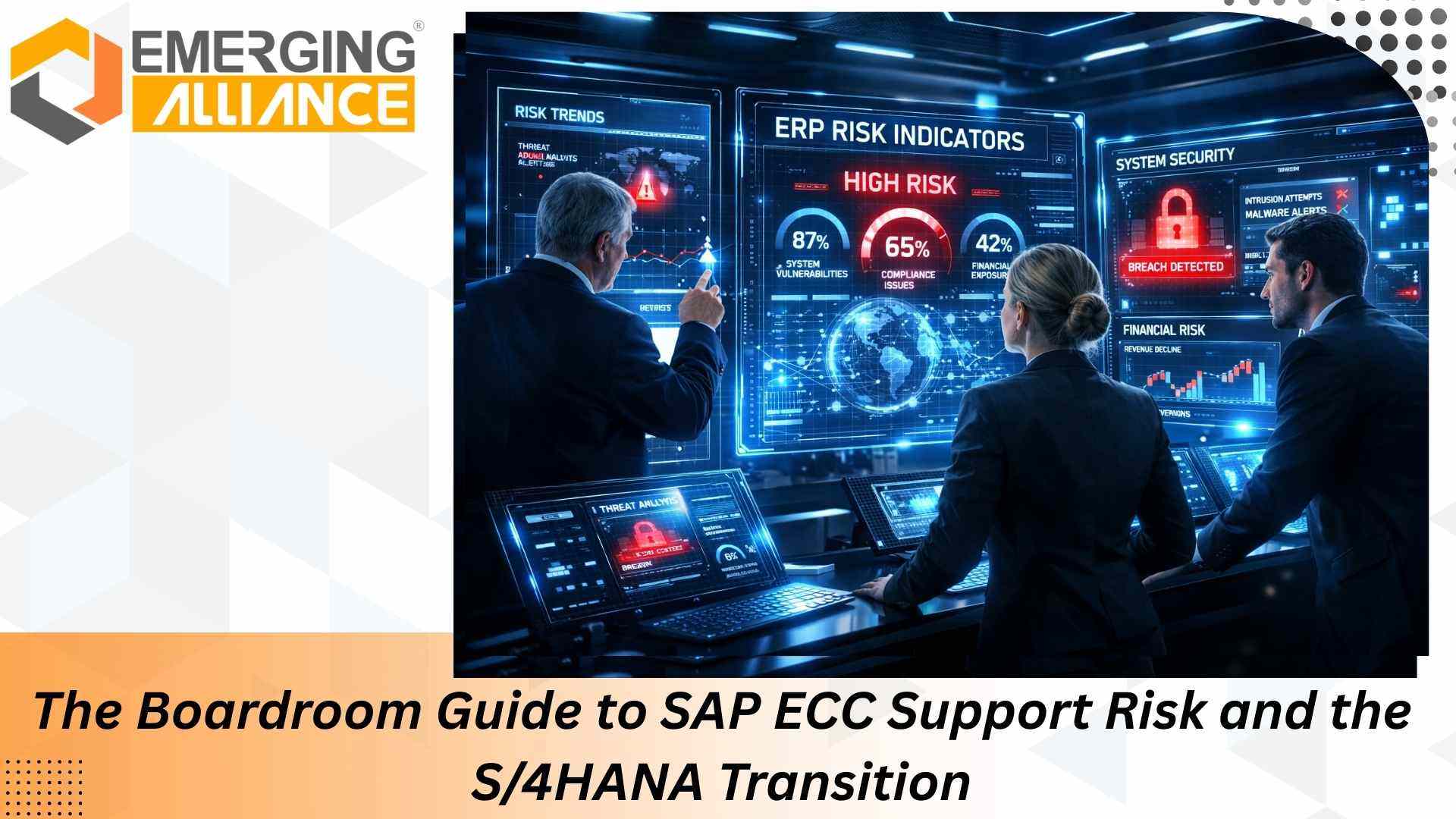
The Boardroom Guide to SAP ECC Support Risk and the S/4HANA Transition
Protect Business Continuity While Transitioning from ECC to S/4HANA
Across global enterprises, a major shift in enterprise technology strategy is underway. The approaching SAP ECC maintenance end date and the broader SAP ECC End-of-Life and Support Date are forcing executive teams to re-evaluate the stability, cost, and long-term viability of their ERP environments.The issue is not simply technical. It is a boardroom-level risk management discussion. ERP systems sit at the center of finance, supply chain, manufacturing, and customer operations. Any instability in SAP support can directly impact revenue, compliance, and operational continuity.
Why SAP ECC Support Risk Is Now a Board-Level Concern
SAP has announced a defined SAP ECC end-of-life deadline, with the SAP end of support 2027 milestone approaching rapidly. For many organizations, this announcement has triggered a strategic reassessment of their ERP roadmap.
The reality is that SAP’s customers with very large ECC systems often operate complex environments built over many years. These systems include deep integrations, customized workflows, and mission-critical business logic.
Replacing or upgrading these systems cannot happen overnight.
However, continuing to operate ECC without a structured SAP-ECC/S4-Support strategy introduces several risks:
• Operational disruption caused by system performance issues
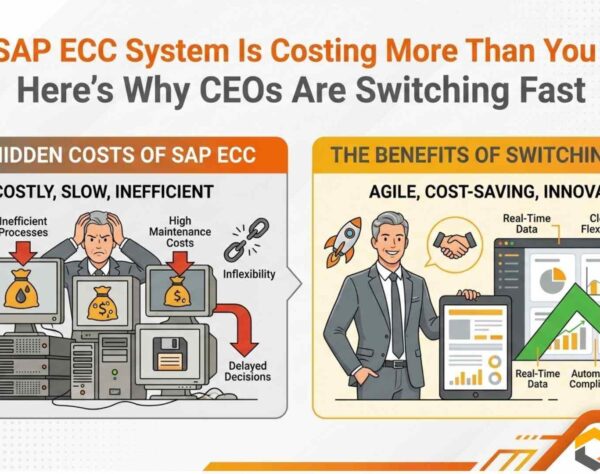
• Increasing maintenance complexity and cost
• Security vulnerabilities and compliance exposure
• Limited internal expertise to maintain legacy SAP environments
This is why organizations are increasingly adopting structured support frameworks while planning their SAP modernization strategy.
The Hidden Operational Risks of Weak SAP Support
Many enterprises still rely on reactive SAP support models where issues are resolved only after they affect users or business operations. While this approach may appear cost-effective in the short term, it often creates larger operational risks.
System Performance Instability
ERP performance directly affects operational productivity. Slow transaction processing or system bottlenecks can delay financial reporting, order processing, and inventory management.
Without proactive SAP system performance monitoring and optimization, organizations often struggle to maintain consistent system performance.
Limited Internal SAP Expertise
SAP environments require deep technical and functional expertise. As many experienced SAP ECC professionals move toward newer technologies like S/4HANA cloud, internal ECC support skills are becoming increasingly scarce.
This creates operational risk, particularly for enterprises that depend heavily on SAP for mission-critical workflows.
Complex Integrations and Customizations
Over the years, organizations have developed extensive integrations between SAP and other enterprise platforms such as CRM systems, analytics platforms, and supply chain tools.
These integrations must be carefully managed through structured SAP integration and customization support. Without this, small configuration issues can cascade into major operational disruptions.
Additionally, many organizations must perform SAP custom code analysis S/4HANA before planning their transition.
Security and Compliance Exposure
ERP platforms contain financial records, customer information, and operational data. Without consistent SAP security, patch, and compliance management, organizations risk exposure to cybersecurity threats and regulatory violations.
In highly regulated industries, this risk can translate into serious financial and reputational consequences.
Why SAP-ECC/S4-Support Is the Bridge to S/4HANA Transformation
Many organizations assume the solution is simply to upgrade SAP ECC to S/4HANA immediately. However, large-scale ERP transformations require careful planning.
Key considerations include:
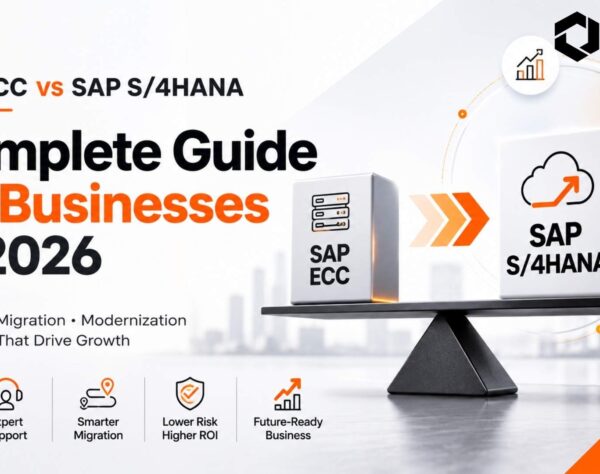
• Evaluating SAP ECC vs SAP S/4HANA architecture differences
• Assessing custom developments and integrations
• Planning infrastructure and cloud strategy
• Understanding SAP S/4HANA migration cost
• Selecting the right SAP S/4HANA implementation partner
Because of these complexities, many enterprises adopt a phased approach.
A strong SAP-ECC/S4-Support framework ensures that ECC systems remain stable while organizations prepare for SAP ECC to S/4HANA transformation.
This approach reduces risk and enables more strategic migration planning.
Key Capabilities of a Modern SAP-ECC/S4-Support Model
Forward-looking organizations expect SAP support providers to deliver far more than simple incident resolution. Today’s support models must operate as an extension of the enterprise technology team.
The most effective support frameworks include several critical capabilities.
24/7 SAP Application Support and Incident Management
Global enterprises operate across multiple time zones. Continuous ERP availability is essential for maintaining operational continuity.
Effective support frameworks provide:
• 24/7 system monitoring
• Rapid incident response
• Performance issue resolution
• User support and troubleshooting
This ensures that ERP systems remain operational regardless of geography or operational complexity.
SAP Integration and Customization Support
Modern ERP environments are highly interconnected. Integration failures can disrupt critical workflows across departments.
Comprehensive support includes:
• Monitoring system integrations
• Managing custom enhancements
• Supporting third-party integrations
• Maintaining enterprise application connectivity
These capabilities ensure seamless operations across complex digital ecosystems.
SAP Security, Patch, and Compliance Management
Maintaining SAP security requires ongoing monitoring and governance.
A structured approach includes:
• Security patch implementation
• Access governance controls
• Compliance monitoring
• Data governance enforcement
Strong security frameworks are essential for protecting sensitive enterprise data.
SAP System Performance Monitoring and Optimization
ERP performance directly impacts operational efficiency.
Proactive monitoring enables organizations to:
• Identify system bottlenecks
• Optimize database performance
• Improve transaction processing speed
• Enhance overall user productivity
Continuous optimization ensures ERP systems remain aligned with business growth.
SAP ECC to S/4HANA Advisory and Transition Support
Even while maintaining ECC systems, organizations must begin preparing for the future.
This preparation includes strategic planning such as:
• ECC landscape assessment
• SAP ECC to S/4HANA readiness evaluation
• Custom code remediation planning
• Migration roadmap development
Organizations also use tools such as the SAP maintenance savings calculator to evaluate the long-term financial benefits of modernization.
With SAP ECC end of support approaching, early preparation significantly reduces migration risks.
Choosing the Right SAP Transformation Partner
Many organizations initially seek support vendors to manage technical issues. However, long-term ERP stability requires a different kind of partnership.
The right SAP partner helps organizations:
• Maintain stable ECC operations
• Reduce operational and maintenance costs
• Strengthen system performance and security
• Prepare for SAP ECC to S/4HANA migration
Most importantly, they operate as strategic advisors in enterprise technology transformation, not just implementation vendors.
This strategic partnership ensures that SAP environments evolve alongside business objectives.
Conclusion
As the end of SAP ECC support approaches, organizations face a defining decision point in their ERP journey.
The transition to SAP S/4HANA will shape the next decade of enterprise technology architecture. However, rushing into migration without stable operational support can create unnecessary risk. A well-structured SAP-ECC/S4-Support strategy enables organizations to maintain operational continuity, optimize system performance, and prepare confidently for ERP modernization.
In an increasingly digital business environment, ERP stability and transformation readiness are no longer IT concerns they are strategic business priorities.
To learn more about our services and solutions, visit us at: Emerging Alliance
FAQs About SAP-ECC/S4-Support
1 Why are companies migrating from SAP ECC to SAP S/4HANA?
Companies migrate because SAP S/4HANA offers real-time analytics, simplified data models, automation, and cloud capabilities that support digital transformation.
2 What are the key differences between SAP ECC and SAP S/4HANA?
SAP ECC runs on traditional databases with batch processing, while S/4HANA uses an in-memory database that enables real-time processing and faster analytics.
3 How can organizations prepare for SAP ECC to S/4HANA migration?
Preparation includes system assessment, SAP custom code analysis, data readiness checks, and creating a phased migration roadmap.
4 What roles does SAP custom code analysis play in S/4HANA migration?
It identifies custom developments that may not work in S/4HANA and determines which ones should be updated, simplified, or removed.
5 What factors influence SAP S/4HANA migration cost?
Migration cost depends on system size, customizations, data volume, infrastructure choices, and integration complexity.
6 Should organizations move directly to S/4HANA Cloud or upgrade from ECC first?
Some companies move directly to S/4HANA Cloud, while others first convert SAP ECC to S/4HANA before modernizing further.
7 Why do enterprises need proactive SAP support before migrating to S/4HANA?
Proactive SAP support ensures system stability, security, and performance while preparing the ERP environment for migration.
8 How does proactive SAP monitoring improve ERP performance?
It tracks system health, detects issues early, prevents downtime, and improves overall ERP performance.
9 What are the biggest challenges during SAP ECC to S/4HANA migration?
Challenges include complex integrations, large data volumes, custom code remediation, and aligning processes with the S/4HANA architecture.
10 How can organizations reduce risk during the SAP ECC to S/4HANA transition?
Risk can be reduced through early assessments, custom code analysis, performance optimization, and a phased migration strategy.
Want to speak to an expert? Fill in the form below, and we will be in touch with you shortly!