
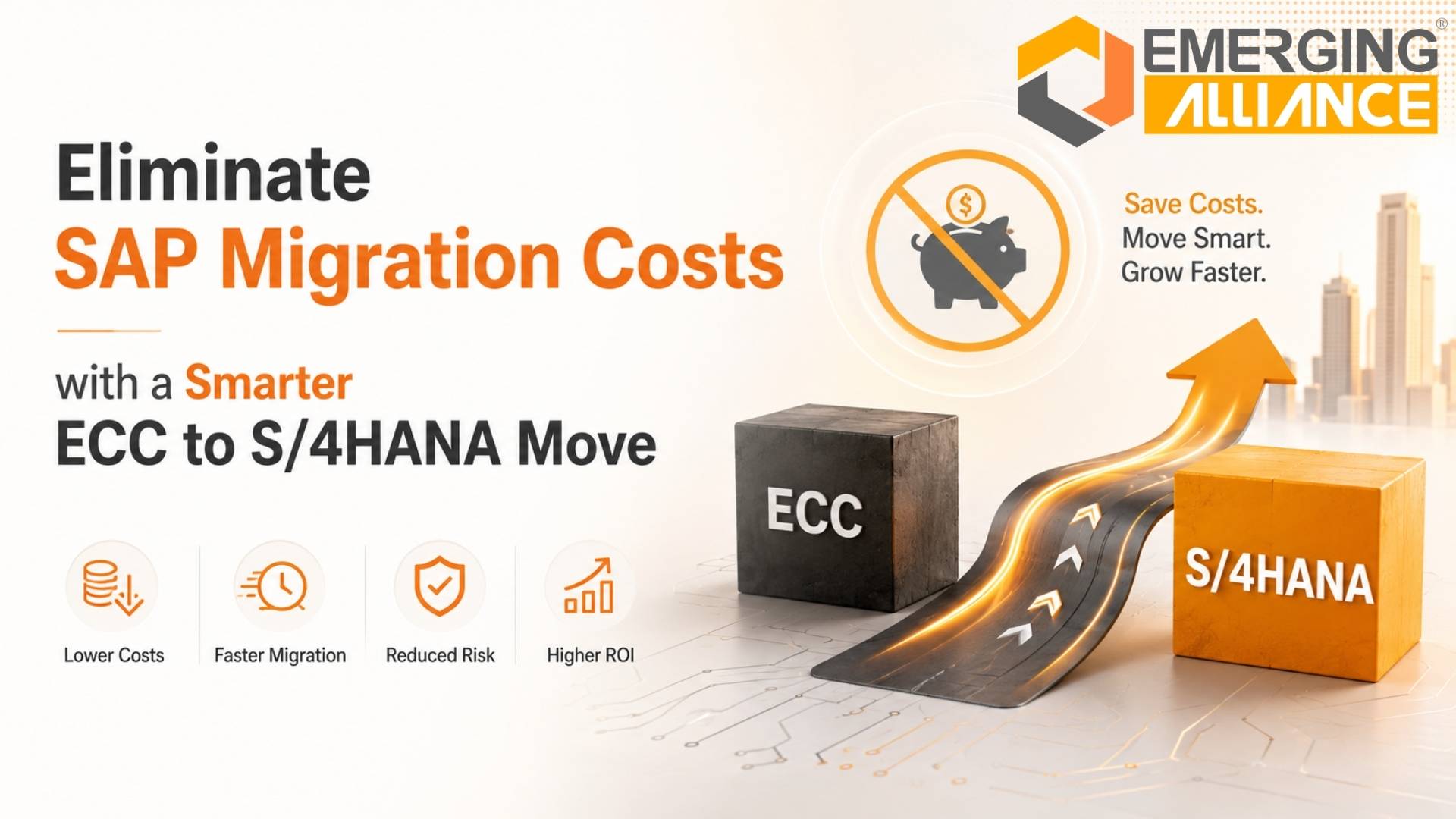
Eliminate SAP Migration Costs with a Smarter ECC to S/4HANA Move
hieve Faster Deployment, Better Cost Control, and Higher ROI
For enterprises, SAP ECC to SAP S/4HANA is no longer a future initiative—it is a strategic business priority. Yet many organizations delay the move because they fear migration costs, operational disruption, and uncertain returns.
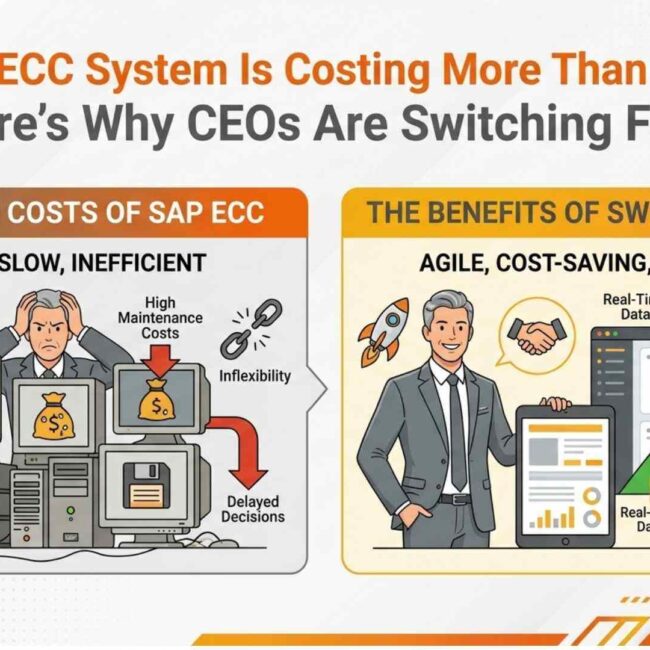
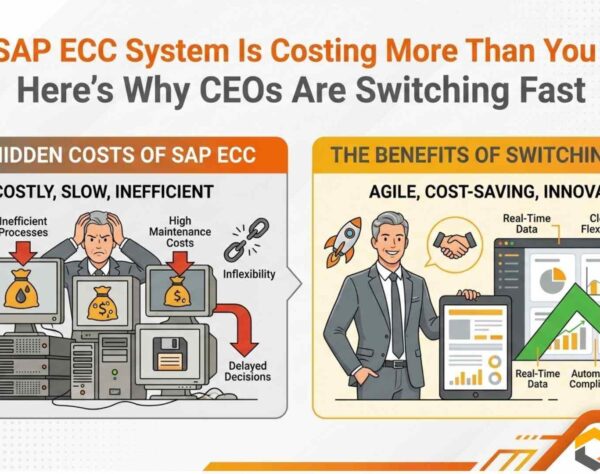
The real risk is often not migration itself. It is continuing to operate on aging systems that create workflow bottlenecks, limited visibility, rising support expenses, and growing compliance concerns.
As enterprises scale, manual processes become harder to manage. Reporting cycles slow down. Data becomes fragmented. Decision-making becomes reactive instead of proactive.
A well-planned ECC to S/4HANA migration enables organizations to modernize operations, automate critical processes, improve enterprise agility, and unlock real-time business intelligence.
The question for business leaders is no longer whether to migrate—but how to do it strategically while maximizing ROI and minimizing cost.
Why SAP ECC Customers Are Facing Growing Operational Challenges
Many organizations continue to rely on SAP ECC because it has supported business operations for years. However, today’s business environment demands greater speed, flexibility, and intelligence.
Common challenges faced by SAP ECC customers include:
- Increasing system maintenance and support costs
- Slow reporting and delayed decision-making
- Limited automation across departments
- Complex customizations that hinder scalability
- Fragmented data across business functions
- Compliance and audit risks from legacy processes
- Difficulty integrating modern digital platforms
As organizations expand across locations, business units, and markets, these limitations begin to affect revenue growth and operational efficiency.
A modern ERP platform must support enterprise growth rather than restrict it.
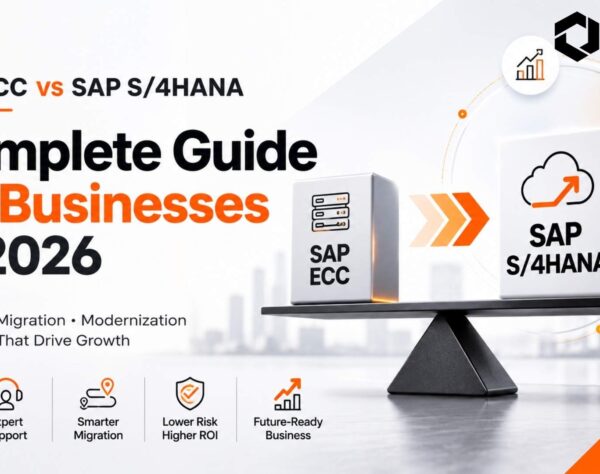
SAP ECC vs SAP S/4HANA: The Business Case for Modernization
The conversation around SAP ECC vs SAP S/4HANA extends far beyond technology upgrades.
This is fundamentally a business transformation initiative focused on agility, visibility, and operational excellence.
What Changes with SAP S/4HANA?
SAP S/4HANA introduces a simplified data model and leverages advanced SAP HANA database performance capabilities to deliver faster insights and streamlined processes.
Key business benefits include:
- Real-time business analytics
- Faster financial close processes
- Improved enterprise process automation
- Enhanced user experience
- Better forecasting and planning capabilities
- Integrated operational visibility
- Stronger support for digital transformation initiatives
For finance leaders, this means greater control over cash flow, profitability, and compliance.
For operations leaders, it means faster execution and reduced process delays.
For executives, it creates a foundation for scalable enterprise growth.
Building an ECC to S/4HANA Migration Strategy That Controls Cost
One of the biggest misconceptions is that migration costs are determined by technology alone.
In reality, migration success depends largely on planning, governance, and business alignment.
A smart S/4HANA migration strategy focuses on business outcomes before technical execution
Cost-Control Strategies Enterprises Should Prioritize
1. Assess Business Processes Before Migration
Many organizations migrate inefficient workflows into a new system.
Before migration:
- Eliminate redundant processes
- Standardize workflows
- Reduce unnecessary customizations
- Identify automation opportunities
This reduces implementation complexity and long-term support costs.
2. Cleanse and Rationalize Data
Poor data quality often drives migration delays and project overruns.
A structured data strategy helps:
- Remove obsolete master data
- Improve reporting accuracy
- Reduce migration effort
- Accelerate deployment timelines
3. Prioritize High-Value Business Areas
Not every process requires transformation on day one.
Focus first on:
- Finance transformation
- Procurement optimization
- Supply chain visibility
- Manufacturing efficiency
- Compliance automation
This approach delivers measurable ROI earlier.
4. Align Business and IT Leadership
Successful ERP modernization requires collaboration between:
- Finance
- Operations
- IT
- Supply Chain
- Executive Leadership
When stakeholders align around business objectives, migration becomes a strategic investment rather than an IT project.
Migrating to SAP S/4HANA Creates Enterprise-Wide Performance Gains
Organizations that approach migration strategically often realize value across multiple functions.
Finance Transformation
Modern finance teams require real-time visibility.
SAP S/4HANA helps organizations:
- Accelerate financial reporting
- Improve cash flow monitoring
- Strengthen audit readiness
- Enhance budgeting accuracy
- Increase financial transparency
Operations and Supply Chain
Operational teams gain access to:
- Real-time inventory visibility
- Automated workflows
- Faster order processing
- Better demand planning
- Improved resource utilization
Executive Decision-Making
Leadership teams benefit from:
- Live business dashboards
- Enterprise-wide visibility
- Faster strategic planning
- Data-driven decisions
- Reduced operational blind spots
The result is a more agile enterprise capable of responding quickly to market changes.
ERP Modernization Is a Competitive Advantage, Not an IT Upgrade
Organizations pursuing SAP digital transformation are increasingly treating ERP modernization as a growth strategy.
The objective is not simply replacing an older system.
The objective is creating an intelligent enterprise that can:
- Scale efficiently
- Improve operational resilience
- Increase productivity
- Automate repetitive work
- Strengthen compliance controls
- Enable innovation
This is where cloud ERP implementation, intelligent enterprise solutions, and enterprise process automation converge.
The companies that move early often gain stronger operational control and faster decision-making capabilities than competitors still dependent on legacy environments.
Why Enterprises Choose Emerging Alliance for SAP Transformation
Successful ERP modernization requires more than technical implementation expertise.
It requires a partner capable of aligning technology investments with business outcomes.
Emerging Alliance helps enterprises:
- Develop migration roadmaps
- Evaluate modernization options
- Optimize business processes
- Reduce migration risk
- Improve ROI realization
- Accelerate user adoption
- Enable long-term digital transformation
Our approach focuses on measurable business impact, operational efficiency, and sustainable growth rather than simply completing a software deployment.
Ready to Build Your SAP S/4HANA Migration Roadmap?
If your organization is evaluating SAP ECC to SAP S/4HANA, now is the right time to assess risks, opportunities, and business outcomes.
Whether your goal is cost optimization, finance transformation, process automation, or enterprise scalability, a strategic migration plan can significantly improve project success.
Frequently Asked Questions
1. What is the biggest business benefit of moving from SAP ECC to SAP S/4HANA?
The biggest benefit is gaining real-time visibility across finance, operations, and supply chain processes while improving automation and decision-making speed.
2. How long does an ECC to S/4HANA migration typically take?
The timeline depends on system complexity, data quality, integrations, and customization levels. A readiness assessment helps determine realistic timelines.
3. How does SAP S/4HANA improve enterprise reporting?
SAP S/4HANA provides real-time analytics and embedded reporting capabilities that reduce reporting delays and improve business visibility.
4. What factors influence SAP S/4HANA migration costs?
Costs depend on project scope, infrastructure strategy, customizations, data migration requirements, integrations, and organizational complexity.
5. Can existing SAP integrations be retained after migrating to SAP S/4HANA?
Yes. Most integrations can be retained, redesigned, or optimized depending on business requirements and modernization goals.
6. Is cloud ERP implementation required when moving to SAP S/4HANA?
No. Organizations can choose public cloud, private cloud, hybrid, or on-premise deployment models based on business needs.
7. How does SAP S/4HANA support finance transformation initiatives?
It improves financial planning, reporting, compliance management, profitability analysis, and cash flow visibility through real-time data processing.
8. What are the common migration challenges enterprises face?
Challenges often include data quality issues, change management, legacy customizations, integration complexity, and stakeholder alignment.
9. How does SAP S/4HANA help improve compliance and audit readiness?
The platform provides stronger controls, enhanced transparency, automated workflows, and improved reporting capabilities that support regulatory compliance.
10. What ROI can enterprises expect from migrating to SAP S/4HANA?
ROI varies by organization but typically comes from reduced operational costs, improved productivity, faster reporting, automation gains, and enhanced business agility.
Talk to Emerging Alliance today and discover how to reduce costs, accelerate deployment, and maximize ROI from your SAP modernization journey.