
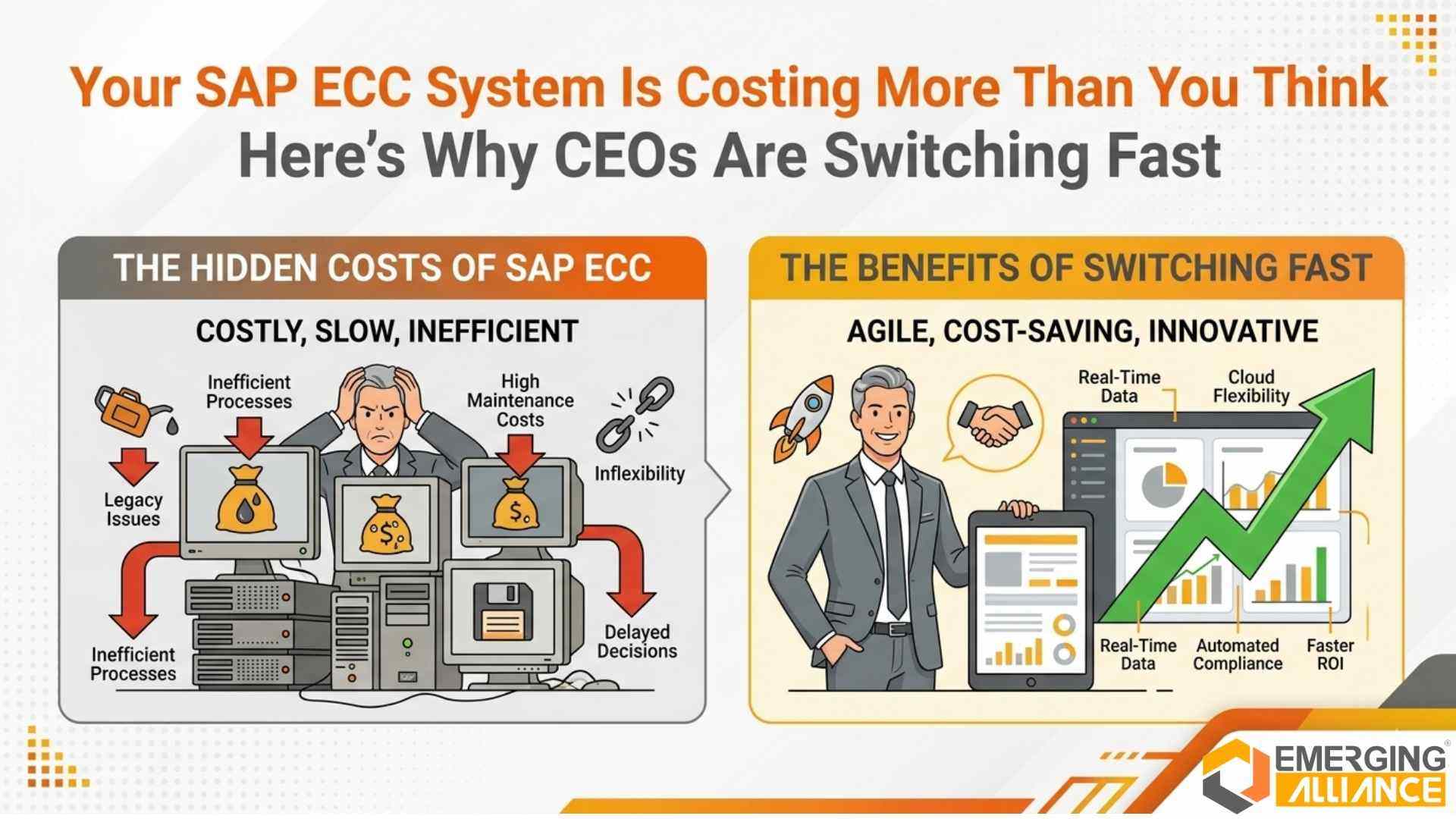
Your SAP ECC System Is Costing More Than You Think Here’s Why CEOs Are Switching Fast
Rising risks, higher support costs, and the 2027 deadline are reshaping ERP strategy
Enterprise leaders are no longer treating SAP modernization as a future IT initiative. For many organizations, SAP ECC to S/4HANA Migration has become an urgent business decision tied directly to operational continuity, profitability, compliance, and long-term scalability.
The challenge is no longer just aging infrastructure. Legacy ERP environments are creating hidden operational costs that impact finance, procurement, supply chain visibility, customer responsiveness, and enterprise agility. As the SAP ECC end of support 2027 deadline approaches, organizations delaying transformation are facing growing pressure from rising maintenance expenses, fragmented reporting, and increasing integration complexity.
CEOs and CIOs are now asking a different question:
“How much is our current ERP system slowing down enterprise growth?”
This shift is driving rapid adoption of S/4HANA cloud transformation strategies across manufacturing, healthcare, retail, logistics, automotive, and distribution sectors.
Emerging Alliance helps enterprises move beyond technical migration projects by aligning ERP transformation with business performance, automation goals, and digital growth strategy.
Why SAP ECC Systems Are Becoming a Business Liability
Many enterprises still rely on ECC because the platform has supported operations for years. But stability alone is no longer enough in modern enterprise environments.
Legacy ERP systems often create operational blind spots that become expensive over time.
Common business issues include:
- Delayed financial consolidation and reporting
- Limited real-time operational visibility
- High infrastructure and maintenance overhead
- Workflow bottlenecks across departments
- Manual approvals slowing execution
- Compliance risks from fragmented data
- Difficulty integrating cloud applications
- Rising dependency on custom legacy code
- Poor scalability for multi-entity expansion
The hidden cost is not only technical debt. It is lost business agility.
A global manufacturing enterprise using ECC may require multiple disconnected reporting tools just to monitor procurement, production, and finance performance. Leadership decisions become reactive instead of predictive.
This is why enterprise ERP transformation is now being treated as a board-level initiative rather than a back-office upgrade.
SAP ECC End of Support 2027 Is Accelerating Enterprise ERP Transformation
The SAP ECC maintenance end date is forcing organizations to reassess long-term ERP strategy.
As standard support phases out, enterprises may face:
- Increased support costs
- Reduced innovation access
- Higher cybersecurity exposure
- Compliance vulnerabilities
- Limited compatibility with modern cloud ecosystems
For large enterprises, delaying migration also increases project complexity later.
Organizations waiting until the final stages of the SAP ECC end-of-life deadline may encounter:
Resource Availability Challenges
Experienced SAP migration specialists are already in high demand. Delayed decisions may lead to longer implementation timelines and higher consulting costs.
Customization Complexity
Older ECC environments often contain years of undocumented custom developments. Without early SAP custom code analysis for S/4HANA, migration risk increases significantly.
Business Continuity Risks
Enterprises with heavily integrated finance, procurement, warehouse, and manufacturing systems require structured transition planning to avoid operational disruption.
Modern CIOs are approaching SAP modernization strategy as a phased transformation roadmap rather than a rushed migration exercise.
How SAP ECC to S/4HANA Migration Improves Enterprise Performance
The strongest business case for migration is not compliance. It is operational acceleration.
Organizations moving toward S/4HANA cloud transformation are prioritizing automation, visibility, analytics, and scalability.
Real-Time Financial Visibility
SAP finance system migration enables leadership teams to access consolidated operational and financial insights faster.
Instead of waiting for delayed reports, executives gain:
- Real-time profitability tracking
- Faster month-end closing
- Improved forecasting accuracy
- Better working capital visibility
- Stronger audit readiness
This becomes critical for enterprises operating across multiple business units or geographies.
Operational Automation
Manual workflows continue to create hidden inefficiencies inside legacy ERP systems.
An ECC to S/4HANA upgrade helps automate:
- Procurement approvals
- Inventory tracking
- Production planning
- Vendor collaboration
- Service workflows
- Financial reconciliation
The result is reduced operational friction and improved execution speed.
Scalable Cloud Infrastructure
Modern enterprises require systems that support growth without infrastructure complexity.
SAP Cloud ERP migration provides:
- Greater scalability
- Faster deployment flexibility
- Easier integration capabilities
- Lower infrastructure dependency
- Improved remote accessibility
This is especially important for organizations expanding into new markets, subsidiaries, or digital business models.
Why SAP S/4HANA Migration Services Require Strategic Expertise
Migration success depends far more on business alignment than technical execution alone.
Many ERP projects fail because organizations focus only on software deployment without evaluating operational redesign.
A successful transformation requires:
- Business process mapping
- Data governance planning
- Custom code optimization
- Integration assessment
- Change management alignment
- Industry-specific workflow modernization
This is where the role of an experienced SAP S/4HANA implementation partner becomes critical.
Emerging Alliance works with enterprises to build transformation roadmaps aligned with operational priorities, finance modernization, supply chain performance, and long-term scalability goals.
Instead of delivering isolated implementation services, the focus is placed on enterprise-wide digital transformation outcomes.
Strategic Areas Enterprises Must Evaluate Before Migration
Data Readiness
Poor-quality master data creates reporting inconsistencies and operational disruption after migration.
SAP data migration to S/4HANA requires structured cleansing, validation, and governance planning.
Process Standardization
Many organizations carry inefficient legacy workflows into modern systems. Migration should eliminate redundancy, not preserve it.
Cloud Readiness
Enterprises evaluating SAP cloud subscription model strategies must assess infrastructure, security, integration, and compliance requirements early.
Industry-Specific Requirements
Healthcare, manufacturing, logistics, retail, and distribution businesses each require different ERP modernization priorities.
Generic migration approaches often fail to address operational realities.
Understanding SAP S/4HANA Migration Cost Beyond Licensing
Enterprise leaders increasingly recognize that SAP S/4HANA migration cost is not simply a software budget discussion.
The real evaluation involves:
- Long-term operational savings
- Reduced maintenance dependency
- Automation impact
- Faster decision-making
- Lower reporting overhead
- Improved compliance management
- Reduced system fragmentation
Organizations that continue investing heavily in aging ECC environments may eventually spend more maintaining inefficiency than transforming operations.
A phased migration strategy often helps enterprises reduce disruption while controlling implementation risk.
Key cost factors typically include:
- System landscape complexity
- Custom development volume
- Data migration scope
- Integration architecture
- Deployment model selection
- User adoption requirements
- Industry compliance needs
This is why strategic planning becomes essential before initiating any SAP ECC upgrade to S/4HANA initiative.
The Competitive Advantage of Early SAP Modernization
Enterprises migrating early are not simply avoiding risk. They are gaining operational advantage.
Modern ERP environments enable organizations to:
- Respond faster to market changes
- Improve enterprise-wide visibility
- Accelerate digital initiatives
- Support AI-driven analytics
- Streamline finance operations
- Improve customer responsiveness
- Reduce process inefficiencies
- Enable scalable global operations
For leadership teams focused on long-term growth, legacy ERP modernization is increasingly tied to competitiveness.
The gap between digitally agile enterprises and legacy-dependent organizations continues to widen.
Why Enterprises Choose Emerging Alliance for SAP Transformation
ERP transformation requires more than technical implementation capability.
Enterprises need a partner that understands operational strategy, digital modernization, scalability planning, and long-term business outcomes.
Emerging Alliance helps organizations navigate:
- SAP ECC to S/4HANA Migration strategy
- Enterprise process modernization
- SAP Cloud ERP migration planning
- SAP data migration to S/4HANA
- Custom code assessment and optimization
- Finance transformation initiatives
- Scalable cloud transformation roadmaps
- Industry-specific ERP modernization
The objective is not simply system replacement.
It is building an intelligent, scalable enterprise foundation that supports future growth.
Ready to Move Beyond Legacy ERP Limitations?
The SAP ECC end-of-life deadline is approaching faster than many organizations anticipated. But the larger issue is not support expiration alone.
It is the growing operational cost of staying behind.
Emerging Alliance works with enterprise leaders to create structured, low-risk transformation roadmaps tailored to business priorities.
Frequently Asked Questions
1. What is the best approach for SAP ECC to S/4HANA Migration?
The best approach depends on system complexity, customizations, industry requirements, and business goals. Enterprises typically choose between greenfield, brownfield, or hybrid migration models.
2. How much does SAP S/4HANA migration cost for large enterprises?
SAP S/4HANA migration cost varies based on data volume, integrations, custom developments, infrastructure requirements, and deployment strategy. A detailed assessment is necessary for accurate planning.
3. Why is the SAP ECC end of support 2027 deadline important?
After the end of SAP ECC support, enterprises may face higher maintenance costs, limited innovation access, and increased compliance and cybersecurity risks.
4. How long does an ECC to S/4HANA upgrade usually take?
Implementation timelines vary depending on enterprise size, process complexity, and migration scope. Large enterprises often adopt phased rollout strategies to reduce operational disruption.
5. What are the biggest SAP data migration to S/4HANA challenges?
Common challenges include poor master data quality, legacy customizations, integration dependencies, and inconsistent reporting structures across business units.
6. Can SAP Cloud ERP migration improve operational scalability?
Yes. Cloud ERP environments help enterprises scale faster, integrate modern applications more easily, and reduce infrastructure management complexity.
7. Why is SAP custom code analysis for S/4HANA necessary?
Many ECC systems contain outdated or redundant customizations. Custom code analysis helps reduce migration risk and improves system performance after transformation.
8. How does SAP finance system migration improve reporting?
S/4HANA enables real-time financial visibility, faster reconciliation, improved forecasting, and better enterprise-wide reporting accuracy.
9. What industries benefit most from S/4HANA cloud transformation?
Manufacturing, healthcare, retail, automotive, logistics, pharmaceuticals, and distribution industries benefit significantly from automation and operational visibility improvements.
10. Why choose an SAP S/4HANA implementation partner instead of managing migration internally?
Experienced implementation partners reduce project risk, accelerate planning, improve governance, and align ERP transformation with long-term business strategy.
Schedule a strategic consultation to evaluate your SAP ECC to S/4HANA Migration readiness and identify the most efficient modernization path for your organization.