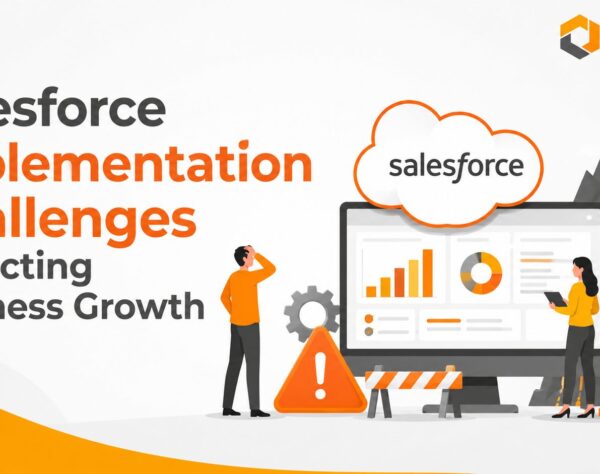

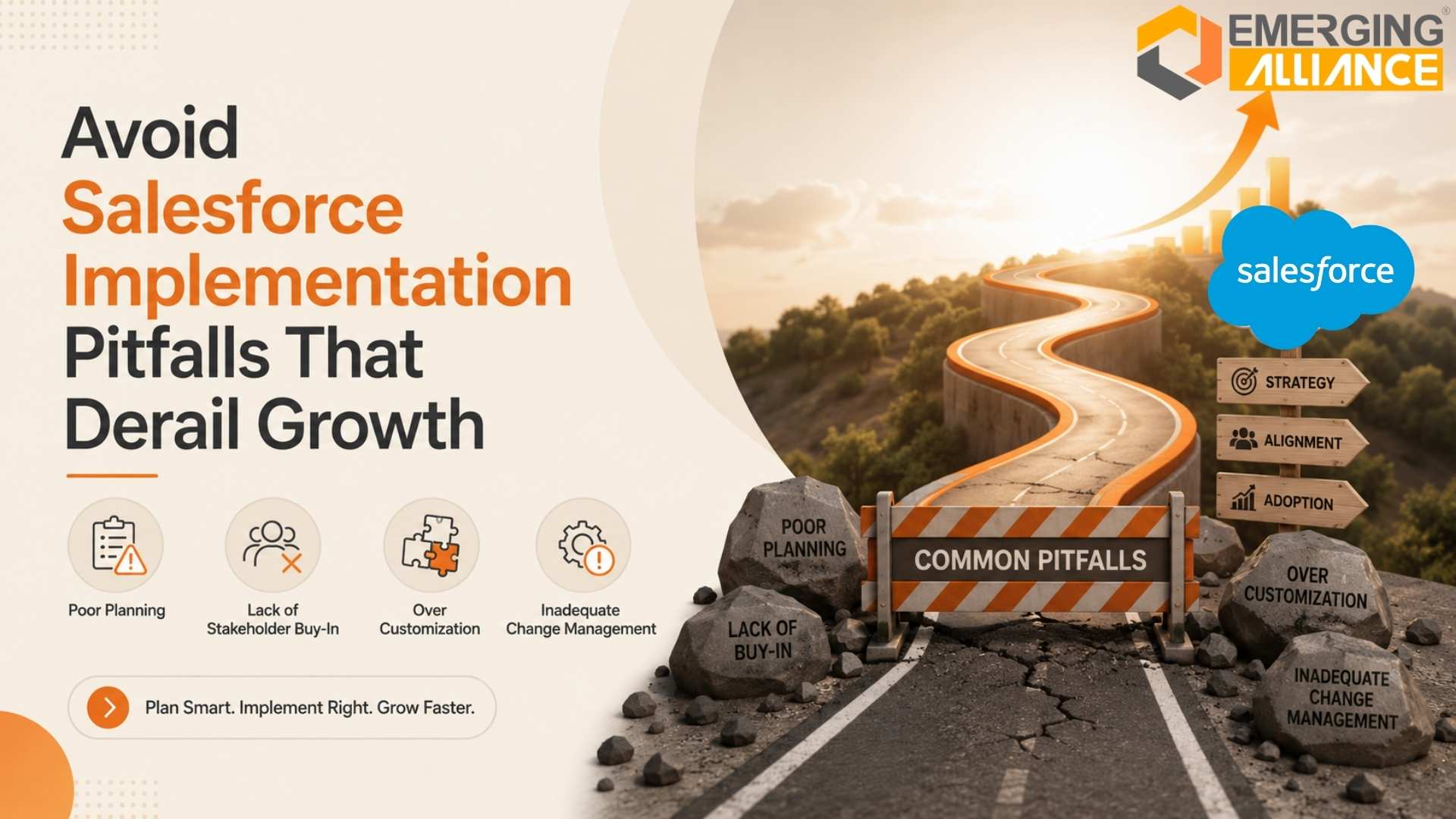
Avoid Salesforce Implementation Pitfalls That Derail Growth
Explore the Frameworks and Strategies Behind High-Performing Salesforce Deployments
Salesforce Implementation is often viewed as a technology project. In reality, it is a business transformation initiative that impacts sales, service, operations, finance, customer experience, and executive decision-making.
Many organizations invest heavily in Salesforce CRM yet struggle to achieve expected outcomes. User adoption remains low. Processes stay fragmented. Reporting lacks accuracy. Automation fails to scale. Leadership teams continue making decisions without complete visibility.
The challenge is rarely the platform itself.
The real challenge lies in implementation strategy, governance, process alignment, and long-term scalability.
For leaders, successful Salesforce implementation is not about going live. It is about creating a connected enterprise capable of sustained growth, operational efficiency, and measurable ROI.
Why Salesforce Implementation Projects Struggle Despite Strong Technology
Modern Salesforce systems are powerful enough to support complex enterprise requirements. However, implementation failures often originate from business and operational gaps rather than technical limitations.
Organizations frequently encounter challenges such as:
- Disconnected business processes across departments
- Poor data quality during migration
- Low employee adoption rates
- Unclear ownership of workflows
- Excessive customization without governance
- Lack of executive visibility into performance metrics
- Inefficient integrations with ERP and third-party systems
- Compliance and audit challenges
A Salesforce CRM implementation that simply replicates existing inefficiencies will not create transformation.
The objective should be redesigning processes, improving visibility, and enabling intelligent automation across the enterprise.
Enterprise Salesforce Implementation Requires More Than Configuration
Many businesses assume deployment success depends primarily on system setup.
In reality, enterprise success depends on aligning technology with strategic business objectives.
Key Questions Leadership Teams Must Address
Before implementation begins, organizations should clearly define:
- What operational bottlenecks need to be eliminated?
- Which manual processes should be automated?
- What visibility gaps affect decision-making?
- How should customer journeys be improved?
- Which KPIs will measure success?
- What future scalability requirements must be supported?
Without clear answers, even the most advanced Salesforce solution can become another disconnected business system.
A structured Salesforce implementation process should establish a roadmap that connects business objectives directly to platform capabilities.
The Most Common Salesforce CRM Implementation Risks Enterprises Face
As organizations expand, complexity increases.
Multiple business units, customer touchpoints, sales channels, and compliance requirements create challenges that demand a strategic implementation approach.
Data Migration Risks
Legacy CRM platforms, spreadsheets, and disconnected databases often contain inconsistent records.
Common issues include:
- Duplicate customer information
- Incomplete sales histories
- Inaccurate forecasting data
- Missing compliance documentation
Poor migration planning can compromise reporting accuracy from day one.
Workflow Complexity
Many enterprises operate with department-specific processes.
Sales, marketing, service, finance, and operations teams often work differently.
Without proper process mapping:
- Approval workflows become bottlenecks
- Service response times increase
- Customer experiences become inconsistent
- Revenue opportunities are delayed
Integration Challenges
Modern enterprises depend on connected systems.
Salesforce CRM Systems frequently require integration with:
- ERP platforms
- Marketing automation tools
- Finance applications
- Customer support platforms
- E-commerce solutions
- Analytics environments
Weak integration strategies create information silos that limit visibility and productivity.
Building a Scalable Salesforce Solution for Long-Term Growth
Successful organizations design Salesforce implementation services around future business needs rather than current requirements alone.
A scalable architecture should support:
Multi-Department Collaboration
Sales, marketing, service, operations, and leadership teams must operate from a unified source of truth.
Advanced Automation
Automation should eliminate repetitive activities such as:
- Lead assignment
- Approval routing
- Case escalation
- Customer onboarding
- Contract management
- Renewal management
Enterprise Reporting
Executives require real-time visibility into:
- Revenue performance
- Pipeline health
- Customer retention
- Service efficiency
- Operational productivity
Flexible Expansion
As organizations grow, Salesforce clouds such as:
- Salesforce Sales Cloud
- Salesforce Service Cloud
- Salesforce Marketing Cloud
must support additional business units, markets, products, and customer segments without requiring a complete redesign.
Why the Right Salesforce Implementation Partner Matters
Technology alone does not deliver transformation.
The quality of the Salesforce implementation partner often determines whether organizations achieve long-term success or ongoing operational frustration.
A strategic Salesforce consulting partner brings expertise beyond configuration.
They help organizations:
- Align CRM strategy with business objectives
- Design scalable architectures
- Improve cross-functional workflows
- Establish governance frameworks
- Manage risk throughout deployment
- Accelerate user adoption
- Optimize reporting and analytics
- Improve long-term ROI
The difference between a basic deployment vendor and a trusted Salesforce consulting partner becomes evident after go-live.
One delivers software.
The other delivers business outcomes.
Beyond Go-Live: Salesforce Managed Services Drive Continuous Value
Many organizations underestimate the importance of post-implementation optimization.
Business requirements evolve constantly.
Customer expectations change.
Processes mature.
Compliance requirements become more complex.
This is where Salesforce managed services become critical.
Ongoing support enables:
- Salesforce Admin Support
- Salesforce Development Services
- Salesforce Issue Detection and Resolution
- Process optimization
- Performance monitoring
- User adoption improvement
- Governance enforcement
- Continuous automation enhancements
Organizations that continuously optimize their Salesforce environment often realize greater long-term value than those treating implementation as a one-time project.
How Emerging Alliance Helps Enterprises Maximize Salesforce ROI
At Emerging Alliance, we view Salesforce implementation as a business transformation initiative rather than a software deployment exercise.
Our approach combines:
- Strategic consulting
- Process transformation
- Salesforce CRM implementation services
- Enterprise integrations
- Automation frameworks
- Data governance
- Adoption planning
- Managed support services
Whether your organization is deploying Salesforce for the first time, modernizing existing Salesforce systems, or expanding into new Salesforce clouds, our focus remains the same:
Helping leadership teams improve visibility, eliminate operational bottlenecks, increase productivity, and accelerate enterprise growth.
We work alongside decision-makers to ensure technology investments translate into measurable business outcomes.
Ready to Build a High-Performing Salesforce Implementation?
A successful Salesforce implementation is not measured by deployment completion.
It is measured by stronger customer relationships, improved operational efficiency, better executive visibility, scalable automation, and sustained business growth.
If your organization is evaluating Salesforce implementation services, planning a CRM transformation, or struggling with adoption and scalability challenges, Emerging Alliance can help you create a roadmap designed for long-term success.
FAQs About Salesforce for Implementation
1. What are the biggest challenges during Salesforce CRM implementation?
The most common challenges include poor data quality, low user adoption, unclear business processes, integration complexity, governance gaps, and inadequate change management planning.
2. How much does Salesforce implementation cost for an enterprise organization?
Salesforce implementation cost varies based on business complexity, number of users, integrations, customization requirements, cloud products, and deployment scope.
3. Why should businesses work with a Salesforce implementation partner?
A Salesforce implementation partner provides strategic planning, process optimization, technical expertise, risk management, and governance frameworks that improve project success rates.
4. How long does an enterprise Salesforce deployment typically take?
Deployment timelines depend on scope and complexity. Projects may range from a few months for focused implementations to longer durations for enterprise-wide transformations.
5. Can Salesforce integrate with ERP systems and other business applications?
Yes. Salesforce can integrate with ERP platforms, finance applications, marketing tools, customer service systems, e-commerce platforms, and analytics environments.
6. What role does Salesforce Marketing Cloud play in digital transformation?
Salesforce Marketing Cloud helps organizations automate customer engagement, personalize communications, improve campaign performance, and create data-driven marketing strategies.
7. How do certified Salesforce consultants improve project outcomes?
Certified Salesforce consultants bring technical expertise, implementation best practices, architecture guidance, and industry experience that reduce risks and improve scalability.
8. What are the benefits of Salesforce managed services after implementation?
Managed services provide ongoing optimization, support, governance, issue resolution, automation enhancements, and continuous performance improvements.
9. How can Salesforce improve compliance and reporting visibility?
Salesforce provides centralized data management, audit trails, workflow controls, automated approvals, and real-time dashboards that support compliance and executive reporting.
10. What should organizations evaluate before starting a Salesforce implementation project?
Organizations should assess business objectives, process maturity, integration requirements, data quality, user adoption readiness, governance models, and long-term scalability goals.
Schedule a Salesforce strategy consultation today and discover how a transformation-focused approach can unlock greater ROI from your Salesforce investment.