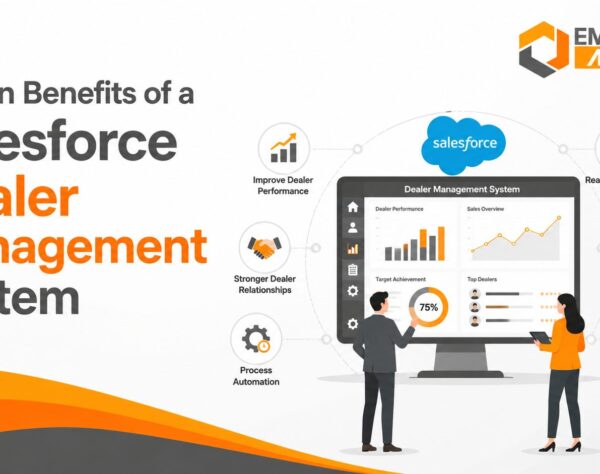


Salesforce DMS for CEOs Fix Dealer Chaos and Unlock Measurable ROI

Salesforce DMS gives CEOs real-time dealer visibility, operational control, and scalable distribution intelligence
Most dealership networks were never designed for today’s level of scale, speed, and customer expectation.
What once worked through regional coordination, spreadsheets, disconnected ERP systems, and manual dealer communication is now creating operational blind spots that directly impact profitability.
CEOs across automotive, manufacturing, electronics, FMCG, and industrial distribution sectors are facing a growing structural problem:
Dealer ecosystems are expanding faster than operational visibility.
As dealer networks scale across regions, businesses begin losing control over:
- Inventory accuracy
- Pricing governance
- Dealer performance consistency
- Lead conversion efficiency
- Credit exposure
- Customer experience quality
The result is silent revenue leakage across the distribution chain.
This is where a modern Salesforce DMS platform becomes strategically important—not as software, but as centralized operational intelligence for the entire dealer ecosystem.
A unified Dealer Management System Salesforce architecture enables organizations to connect dealer operations, customer engagement, inventory visibility, finance workflows, and channel analytics into a single scalable environment.
For leadership teams, this changes dealer management from reactive firefighting into measurable operational control.
Why Traditional Dealer Management Systems Are Failing Modern Enterprises
Many organizations still operate dealer networks through fragmented systems stitched together over time.
Typically, dealer operations are spread across:
- ERP platforms
- Standalone dealer software
- Email-based approvals
- Spreadsheet reporting
- Third-party inventory systems
- Manual order coordination
This fragmentation creates dangerous visibility gaps.
A regional dealer may appear profitable while hidden discounting erodes margins.
Inventory may appear available while actual fulfillment delays continue increasing.
Leads generated through marketing campaigns may never reach the right dealer at the right time.
Over time, these inefficiencies compound into operational instability.
Traditional DMS platforms fail because they were designed as transaction systems—not intelligence systems.
A modern Salesforce DMS cloud solution changes this fundamentally by creating a real-time operational layer across the entire distribution ecosystem.
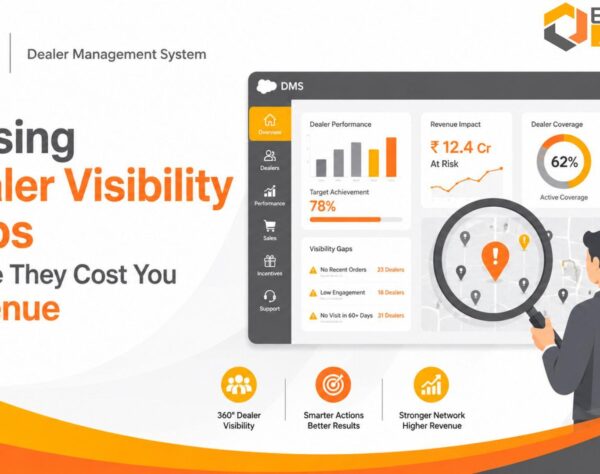
Instead of isolated dealer data, leadership gains centralized visibility into:
- Dealer sales performance
- Inventory movement
- Regional demand trends
- Service operations
- Lead conversion rates
- Channel profitability
- Dealer compliance metrics
This enables executives to make faster, data-driven decisions with significantly higher operational confidence.
How Salesforce DMS Directly Impacts Revenue and Profitability
Most enterprises underestimate how much revenue leakage exists inside disconnected dealer operations.
The problem is not usually one major failure.
It is thousands of small inefficiencies happening daily across inventory, approvals, lead routing, pricing, and dealer coordination.
A strategically implemented Salesforce Dealer Management System software improves profitability across multiple operational layers simultaneously.
With centralized visibility, organizations can identify:
- Slow-moving inventory before capital gets trapped
- Underperforming dealer regions before revenue declines escalate
- Delayed lead follow-ups before opportunities are lost
- Credit and billing inconsistencies before financial exposure increases
This creates measurable business impact through:
- Faster inventory turnover
- Improved dealer productivity
- Reduced operational overhead
- Better forecast accuracy
- Higher lead conversion rates
- Stronger pricing governance
- Lower reporting latency
Unlike legacy dealer systems, Salesforce enables real-time operational synchronization between dealers, field teams, finance teams, and leadership.
This is why modern enterprises increasingly view Salesforce DMS implementation as a revenue optimization initiative—not simply an IT project.
Salesforce DMS Creates a Unified Dealer Intelligence Ecosystem
The biggest strategic advantage of a Salesforce DMS platform is not just automation—it is operational unification. In many organizations, dealer intelligence is fragmented across CRM systems, ERP platforms, spreadsheets, emails, and disconnected inventory tools. Sales teams, finance departments, inventory managers, and dealers often operate in separate environments, resulting in delayed reporting, inconsistent data, and poor decision-making visibility.
A modern Dealer Management System on Salesforce platform eliminates these silos by creating a centralized operational ecosystem where dealer activities, customer interactions, inventory movement, service workflows, and financial data are connected in real time. This enables leadership teams to monitor dealer performance accurately, identify operational inefficiencies faster, and improve coordination across the entire distribution network.
For CIOs and CTOs, this creates a major strategic advantage. Instead of managing multiple disconnected systems, Salesforce provides a scalable cloud-based architecture with unified analytics, workflow automation, integration flexibility, and real-time visibility. The result is faster decision-making, stronger governance, and a dealer ecosystem built for scalable growth.
Salesforce DMS Integration with ERP Systems Improves Financial Governance
One of the largest operational blind spots in dealer ecosystems is the disconnect between dealer operations and financial systems.
Without integration, organizations struggle with:
- Inconsistent billing visibility
- Delayed financial reconciliation
- Uncontrolled dealer credit exposure
- Inventory valuation inaccuracies
- Margin reporting delays
A properly integrated Salesforce DMS with ERP systems bridges operational execution with financial intelligence.
This integration synchronizes:
- Orders
- Billing
- Dispatch workflows
- Inventory valuation
- Credit management
- Financial reporting
The result is stronger financial governance across the distribution network.
Executives gain accurate visibility into profitability drivers while reducing operational and reporting risks.
For enterprises managing large dealer ecosystems, this becomes critical for sustainable growth.
AI and Predictive Analytics Are Reshaping Dealer Management
The future of dealer management is no longer transactional.
It is predictive.
Modern Salesforce automotive solutions increasingly use AI-driven analytics to forecast:
- Dealer demand patterns
- Inventory requirements
- Lead conversion probability
- Customer retention risks
- Service revenue opportunities
This transforms dealer management from operational monitoring into strategic optimization.
Instead of reacting after problems occur, leadership teams can proactively identify operational risks before they impact revenue.
As dealership ecosystems become more competitive, predictive intelligence will become a major differentiator between scalable enterprises and operationally fragmented competitors.
Salesforce Dealer Automation Enables Scalable Expansion Without Operational Chaos
Many businesses expand dealer networks successfully—but fail operationally afterward.
Growth introduces:
- Pricing inconsistencies
- Process deviations
- Reporting gaps
- Customer experience fragmentation
- Approval bottlenecks
A modern Salesforce dealer automation system solves this by standardizing workflows while still allowing dealer-level flexibility.
Using advanced Salesforce DMS customization, enterprises can create scalable workflows aligned to real operational requirements.
This allows organizations to:
- Expand into new regions faster
- Maintain centralized governance
- Reduce manual coordination
- Improve operational consistency
- Scale dealer onboarding efficiently
The result is scalable growth without proportional operational complexity.
What CIOs and CEOs Must Get Right During Salesforce DMS Implementation
Technology alone does not guarantee transformation success.
Poor implementation strategy is one of the primary reasons dealer transformation initiatives fail.
Successful Dealer Management System Salesforce implementation requires:
Business-First Architecture
The platform must align with operational objectives, revenue strategy, and future scalability—not just technical deployment.
Real Workflow Customization
Effective Salesforce DMS customization reflects actual dealer behavior and operational realities.
ERP and Data Integration Strategy
Disconnected integrations create long-term operational instability.
Executive-Level Adoption Strategy
Dealer adoption is as critical as platform capability.
Long-Term Scalability Planning
The system must support future expansion, analytics, automation, and AI initiatives.
This is why implementation partner expertise becomes strategically important.
Why Emerging Alliance Is Positioned for Salesforce DMS Transformation
At Emerging Alliance, the focus is not simply software deployment.
The focus is operational transformation.
Emerging Alliance helps enterprises build scalable dealer ecosystems using:
- Advanced Salesforce DMS architecture
- ERP integration frameworks
- Dealer workflow automation
- Real-time analytics ecosystems
- AI-ready operational infrastructure
The objective is measurable business impact:
- Better visibility
- Stronger governance
- Faster decision-making
- Higher operational efficiency
- Scalable profitability
This approach enables organizations to move beyond fragmented dealer operations toward future-ready distribution ecosystems.
The Future of Dealer Management Systems Is AI-Driven and Fully Connected
The next generation of dealer ecosystems will not operate through disconnected software environments.
They will operate through intelligent, unified operational platforms powered by:
- AI-driven forecasting
- Workflow automation
- Real-time analytics
- Predictive dealer intelligence
- Unified CRM and ERP integration
A modern Salesforce DMS platform is uniquely positioned to lead this transformation because it combines operational execution, customer intelligence, automation, and scalability within one ecosystem.
Organizations investing now are not simply modernizing dealer operations.
They are building long-term competitive infrastructure.
Drive Measurable ROI with Salesforce DMS
If your dealer ecosystem lacks operational visibility, scalability, or financial control, the problem is not isolated inefficiency—it is structural fragmentation.
Emerging Alliance helps CIOs, CTOs, and business leaders:
- Identify hidden dealer operational inefficiencies
- Reduce revenue leakage across distribution channels
- Improve inventory and dealer visibility
- Integrate CRM, ERP, and dealer operations
- Build scalable Salesforce-powered dealer ecosystems
The longer disconnected dealer operations continue, the greater the operational and financial risk becomes.
Now is the time to transform dealer management into a measurable competitive advantage.
FAQs on Salesforce Dealer Management Systems
1. What makes Salesforce DMS different from traditional dealer management software?
Traditional DMS platforms primarily manage transactions. Salesforce DMS creates a connected operational intelligence ecosystem that integrates CRM, inventory, finance, automation, and analytics into a unified platform.
2. Can Salesforce DMS support multi-region dealership networks?
Yes. Salesforce DMS is designed to support large-scale, multi-location dealer ecosystems with centralized governance and localized operational flexibility.
3. How does Salesforce DMS improve dealer profitability?
It improves visibility into inventory, lead conversion, pricing governance, and dealer performance, helping organizations reduce operational inefficiencies and improve margins.
4. Can Salesforce DMS integrate with ERP systems like SAP?
Yes. Salesforce DMS can integrate with ERP platforms to synchronize finance, inventory, billing, dispatch, and reporting workflows in real time.
5. Is Salesforce DMS suitable for manufacturing and FMCG distribution networks?
Absolutely. Salesforce DMS is widely applicable across automotive, manufacturing, industrial distribution, electronics, and FMCG dealer ecosystems.
6. How long does Salesforce DMS implementation typically take?
Implementation timelines vary depending on workflow complexity, integration requirements, dealer network size, and customization scope.
7. What are the biggest risks in dealer transformation projects?
Poor integration strategy, weak dealer adoption, fragmented workflows, and lack of executive alignment are among the most common risks.
8. How does Salesforce automation improve dealer operations?
Automation reduces manual coordination, standardizes workflows, accelerates approvals, and improves operational consistency across dealer ecosystems.
9. What role does AI play in the future of dealer management?
AI enables predictive demand forecasting, dealer performance analysis, customer retention insights, and proactive operational optimization.
10. Why should enterprises choose Emerging Alliance for Salesforce DMS implementation?
Emerging Alliance combines Salesforce expertise, ERP integration capability, industry knowledge, and transformation-focused implementation frameworks designed for measurable ROI.t
Fill out the form to connect with our experts now